
Why Background Screening Needs More Than Technology
Today's employers face increasing pressure to hire efficiently while verifying qualifications, managing risk, and maintaining consistent screening procedures.
Technology has transformed how organizations approach these responsibilities. Digital workflows, automated data processing, and integrated screening tools can help reduce manual tasks and make information easier to access.
Yet background screening involves more than retrieving records.
A candidate's name may resemble someone else's. A former employer may take time to confirm work history. A licensing database may not reflect a recent renewal. A report may contain information that requires additional research before it can be interpreted correctly.
These situations demonstrate why the most effective background screening services need both advanced technology and knowledgeable human support.
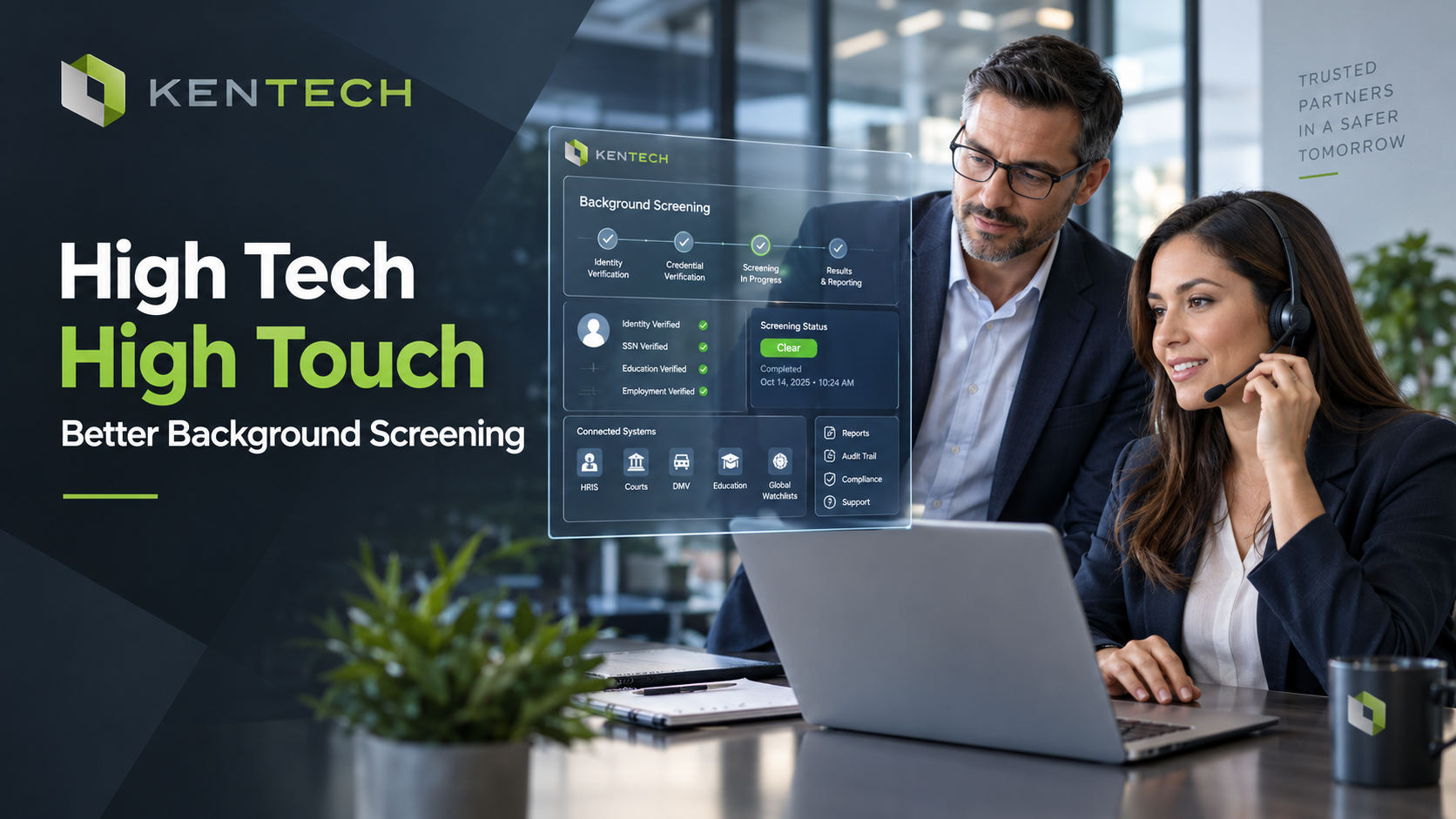
At KENTECH, the idea of "High Tech + High Touch" represents an approach that combines technology-driven processes with personal attention. Technology helps streamline the work, while human expertise helps address questions, clarify discrepancies, and support a more responsive experience.
What Technology Brings to Background Screening
Technology plays an important role in modern employment screening. When implemented appropriately, it can help organizations manage growing volumes of screening requests without relying entirely on manual coordination.
1. More Organized Screening Workflows
Digital screening systems can help employers submit requests, track progress, access reports, and coordinate screening activities.
Instead of relying on scattered emails or spreadsheets, authorized personnel may be able to use a more centralized workflow.
This can make it easier to see which checks are pending, identify delays, and determine whether additional information is needed.
2. Reduced Manual Administration
Automated processes can reduce repetitive tasks such as data entry, status updates, and routine notifications.
Less manual administration can give HR and recruiting teams more time to focus on candidate communication, hiring priorities, and the review of relevant findings.
However, automation should be applied carefully. A streamlined workflow is only useful when the underlying data, procedures, and quality controls are appropriate.
3. Greater Visibility Into Screening Progress
Recruiters and hiring managers need to know where candidates stand in the screening process.
Depending on the system, digital tools can provide status updates, flag incomplete information, and help teams identify tasks requiring attention.
Better visibility can support more realistic hiring timelines and help prevent candidates from being overlooked because of an unresolved administrative issue.
4. Support for Scalable Hiring
Organizations with multiple offices, hiring teams, or locations may need to coordinate screening across different roles and jurisdictions.
Technology can help standardize request submission, organize documentation, and apply consistent workflows across larger programs.
Scaling the process still requires appropriate oversight. Different positions may have different verification needs, and employers must account for the requirements that apply in each jurisdiction.
Why Human Expertise Still Matters
Automation can make screening more efficient, but it cannot independently resolve every question that arises during the process.
Human expertise is especially valuable when information is ambiguous, incomplete, disputed, or sensitive.
1. Resolving Identity and Record Discrepancies
Background screening depends on matching information to the correct individual.
Similar names, name changes, inconsistent dates, and incomplete identifying details can complicate that task.
A possible match should not automatically be treated as a confirmed record. Depending on the circumstances, additional identifiers, source review, or further research may be necessary.
Knowledgeable screening professionals can help investigate discrepancies and determine what additional steps may be appropriate.
2. Understanding Context
A screening result does not always tell the whole story.
An employment verification may return a different job title from the one listed on a resume. An education record may use a different institutional name following a merger. A professional license database may show a status that needs clarification.
These differences may have legitimate explanations.
Human review can help identify when additional verification is needed instead of treating every inconsistency as evidence of dishonesty.
3. Supporting Clear Communication
Screening delays can frustrate candidates, recruiters, and hiring managers.
When a request requires additional information or a search takes longer than expected, direct communication helps everyone understand what is happening and what needs to happen next.
Responsive support can clarify missing information, explain process steps, and direct questions to the appropriate team.
This is particularly important when hiring timelines are tight or a candidate is waiting for an important update.
4. Recognizing When Escalation Is Necessary
Some screening issues cannot be resolved through a routine automated workflow.
A disputed record, unclear credential, or complicated jurisdictional question may require additional research or review.
Human support helps identify when a matter should be escalated and when the available information is insufficient to support a conclusion.
Technology can flag an issue, but the next step often requires judgment.
The Problems With a Technology-Only Approach
A technology-only approach may appear efficient, especially when an organization is processing a high volume of candidates. However, relying on automation without adequate review can introduce avoidable problems.
Potential challenges include:
Incorrectly associating records with the wrong individual.
Treating incomplete information as a definitive result.
Failing to investigate conflicting data.
Providing limited assistance when a candidate disputes a finding.
Overlooking unusual circumstances that require additional verification.
Creating a frustrating experience when users cannot reach knowledgeable support.
These risks do not mean that automation is inherently unreliable. Rather, they demonstrate why technology should operate within a process that includes quality controls, appropriate escalation, and human accountability.
Employers should evaluate how a screening provider identifies potential errors, communicates unresolved issues, and supports corrections or disputes.
The Problems With a Manual-Only Approach
The opposite approach—relying exclusively on manual processes—also has limitations.
When screening requests are coordinated through spreadsheets, individual inboxes, and repeated phone calls, teams may struggle to maintain consistent records.
Manual workflows can create challenges such as:
Repeated data entry.
Delayed status updates.
Difficulty tracking large numbers of requests.
Inconsistent documentation.
Limited visibility across departments.
Increased administrative demands during hiring surges.
A knowledgeable team can provide valuable support, but it should not have to spend unnecessary time managing tasks that suitable technology could organize more effectively.
The goal is not to choose between technology and people. It is to use each where it provides the greatest value.
How High Tech + High Touch Works Together
A strong background screening process combines digital efficiency with human oversight at the points where each matters.
Consider an employer screening a candidate for a specialized position.
First, a digital workflow helps the employer submit the appropriate screening request and track its status. Available records and verification results are collected through the applicable processes.
If a discrepancy appears, the workflow identifies the item requiring attention. A screening professional can then investigate the issue, request clarification when appropriate, or determine whether additional verification is needed.
Once the information has been reviewed, the employer receives the relevant results and makes its decision according to its established policies and legal obligations.
In this example, technology helps coordinate the process, while human expertise supports issue resolution and communication.
The result is a more balanced approach than relying exclusively on either manual administration or automated outputs.
Why This Matters to the Candidate Experience
Background screening affects more than HR operations. It also shapes how candidates experience an organization.
Candidates may be concerned about privacy, uncertain about what information is being reviewed, or frustrated when a verification takes longer than expected.
A well-designed process should make it clear what information is needed, how candidates can provide it, and whom they can contact if questions arise.
When an issue appears, appropriate communication and a defined dispute-resolution process can help prevent misunderstandings.
Human support is particularly valuable when a candidate needs help understanding a process or addressing inaccurate information.
For employers, a respectful screening experience can complement broader recruiting and onboarding efforts. It does not guarantee that every candidate will have a positive experience, but it helps establish a more professional and responsive process.
Choosing a Background Screening Partner That Offers Both
When evaluating a screening provider, employers should look beyond the number of services offered or the speed of the ordering platform.
Consider asking these questions:
Technology and workflow
Can authorized users submit requests and track progress efficiently?
Are screening results organized in a clear, accessible format?
What workflow or integration options are available?
How are data security and access permissions managed?
Human support and quality
Who can assist when a result is unclear?
How are potential record mismatches handled?
What happens when a candidate disputes information?
Can users receive meaningful updates when a request is delayed?
How does the provider communicate the limitations of available records?
Accountability and compliance
Which responsibilities remain with the employer?
How are corrections and escalations managed?
What documentation is available?
How does the provider support the employer's established screening procedures?
A reliable partner should be able to explain its capabilities and limitations clearly rather than making unsupported promises about perfect accuracy or guaranteed turnaround times.
How KENTECH Brings Technology and Personal Support Together
KENTECH's "High Tech + High Touch" positioning reflects the importance of combining modern screening processes with responsive human support.
Technology can help organizations coordinate background checks and verification services, while knowledgeable assistance can help address questions, clarify discrepancies, and navigate situations that require additional attention.
KENTECH supports organizations with background screening and verification solutions, including services relevant to employment, education, credentials, driving records, and other screening needs.
The right combination depends on the organization's hiring volume, industry, roles, and compliance requirements.
Employers should choose screening workflows that improve efficiency without losing sight of record accuracy, candidate communication, privacy, and human accountability.
Better Background Screening Starts With the Right Balance
Technology has made background screening more scalable and easier to coordinate. Human expertise remains essential when information requires clarification, candidates have questions, or a situation falls outside a routine workflow.
The strongest screening strategy does not treat technology and personal support as competing priorities. It combines both to create a process that is efficient, responsive, and grounded in responsible decision-making.
KENTECH brings a High Tech + High Touch approach to background screening and verification. Contact KENTECH to explore solutions that can help your organization streamline screening workflows while keeping accuracy, service, and people at the center of the process.