
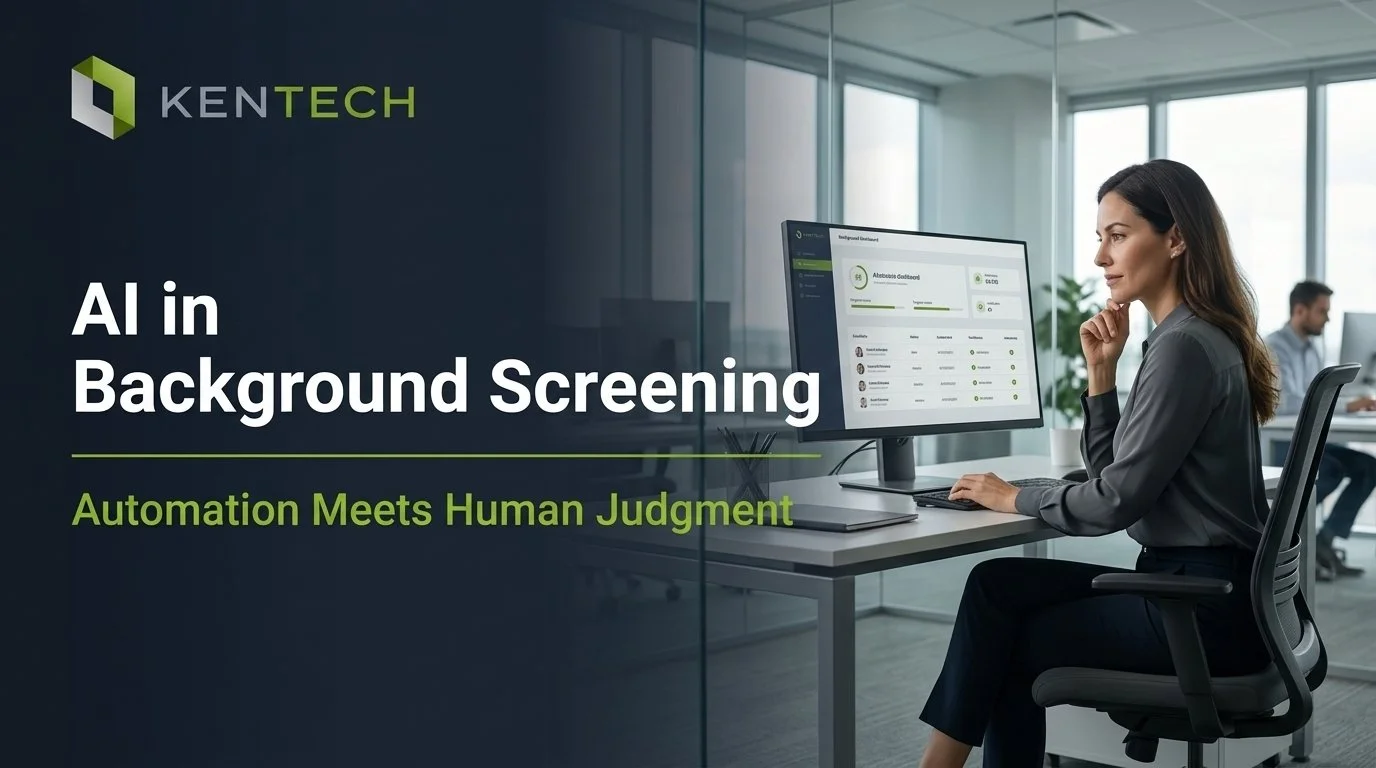
Artificial intelligence is changing how organizations recruit, evaluate, and screen job candidates. From automated application processing to digital identity checks, modern technology helps hiring teams manage information more efficiently.
However, faster screening does not automatically mean better hiring decisions.
Employers still need accurate information, consistent procedures, and responsible human oversight. While AI can help organize data and identify potential discrepancies, important employment decisions should not be left entirely to automated systems.
Understanding where to use technology and where human judgment matters can help organizations build a more effective AI background screening process.
How AI Is Changing Background Screening
Traditional background screening can involve several manual steps. Employers may need to collect candidate information, contact previous employers, verify education, review public records, and organize reports.
These tasks can take time, particularly when an organization hires across multiple locations or processes a large number of applications.
AI-powered tools can assist with certain administrative and analytical tasks, such as:
Organizing candidate information.
Identifying inconsistent dates or details.
Highlighting possible duplicate records.
Supporting identity verification workflows.
Routing screening requests.
Summarizing available information for review.
Providing status updates and reporting.
The goal is to reduce repetitive work while helping screening professionals focus on information that needs closer attention.
5 Background Screening Tasks That Can Benefit From Automation
1. Employment History Verification
Employment verification involves confirming information about a candidate's previous work experience.
Technology can help compare information across resumes, applications, and verification records.
For example, an automated system may identify overlapping employment dates, inconsistent job titles, or unexplained differences between submitted information and verified results.
KENTECH's Employ IQ employment verification solution combines structured verification workflows with discrepancy analysis and human verification.
2. Identity Verification
Identity validation is an important starting point for accurate screening.
Automated tools can help identify name variations, compare submitted information, and support address-history analysis.
However, an identity match should not be treated as proof of every aspect of an individual's identity or employment eligibility. Verification methods must be appropriate to the information being checked.
Explore Identity IQ to learn how KENTECH supports identity validation and fraud detection workflows.
3. Education Verification
Education checks can involve contacting schools, reviewing available records, and confirming credentials.
Automation can help organize requests, track responses, and identify inconsistencies in academic information.
Human review remains important when an institution has closed, records are incomplete, or international credentials require additional interpretation.
KENTECH's Degree IQ education verification service helps organizations verify academic credentials through structured domestic and international workflows.
4. I-9 Management and Onboarding
Form I-9 completion and employment eligibility verification involve specific requirements and deadlines.
Digital systems can help organize information, send reminders, track document completion, and maintain electronic records.
They do not remove the employer's responsibility to follow applicable Form I-9 rules.
KENTECH's I-9 IQ solution provides digital I-9 workflow support and integrates with its screening dashboard through its technology partner.
5. Screening Workflow Management
When an organization hires hundreds of employees, tracking screening requests manually can become difficult.
Workflow automation can help hiring teams monitor progress, manage requests, and access reports in one place.
KENTECH's screening technology solutions are designed to help organizations manage background screening and verification activities more efficiently.
What Still Needs a Human Touch?
Automation can improve efficiency, but certain situations require professional review.
Discrepancies Need Context
A mismatch does not automatically indicate dishonesty.
A former employer may have changed its company name. A candidate may have used a different name while attending school. Employment dates may differ because of payroll or administrative errors.
A human reviewer can examine the circumstances and determine whether additional verification is necessary.
Criminal Record Information Needs Careful Evaluation
A criminal record search may return information that requires additional review.
Employers should consider the accuracy and completeness of the information, applicable legal restrictions, and whether the information is relevant to the position.
A blanket rejection based on an automated flag can create compliance concerns.
AI Must Not Replace Fair Hiring Practices
Technology used in hiring can create discrimination risks if it produces or reinforces unfair outcomes.
The Equal Employment Opportunity Commission explains that federal employment discrimination laws apply to the use of AI and other technologies in recruitment, screening, and hiring.
Employers should evaluate tools carefully, monitor their effects, and ensure that employment standards are job-related and consistently applied.
How to Build a Responsible AI Background Screening Strategy
Organizations should begin by identifying which parts of their screening process are repetitive and suitable for automation.
Next, they should:
Select tools that address specific operational needs.
Confirm how candidate information is collected and processed.
Establish clear human review procedures.
Monitor data quality and potential errors.
Review applicable privacy and employment laws.
Maintain documentation of screening procedures.
Give candidates appropriate opportunities to correct inaccurate information.
AI should support a well-designed screening process rather than become a substitute for one.
Why the High Tech, High Touch Approach Matters
Technology can help organizations manage information more efficiently, but experienced screening professionals remain important.
KENTECH's High Tech, High Touch approach combines technology-driven workflows with investigative expertise.
This allows organizations to benefit from streamlined screening processes while retaining professional attention when verification becomes complicated.
The right combination can help employers improve operational efficiency without overlooking accuracy, fairness, and candidate experience.
Make Background Screening Smarter With KENTECH
AI is becoming an important part of modern employment screening, but technology works best when supported by clear policies and responsible human oversight.
Employers should automate repetitive tasks, review complex information carefully, and ensure that screening decisions comply with applicable requirements.
KENTECH helps organizations bring technology and investigative expertise together through background screening and verification solutions.
Want to improve your organization's screening workflow? Contact KENTECH to explore technology-driven background screening solutions with a human touch.