
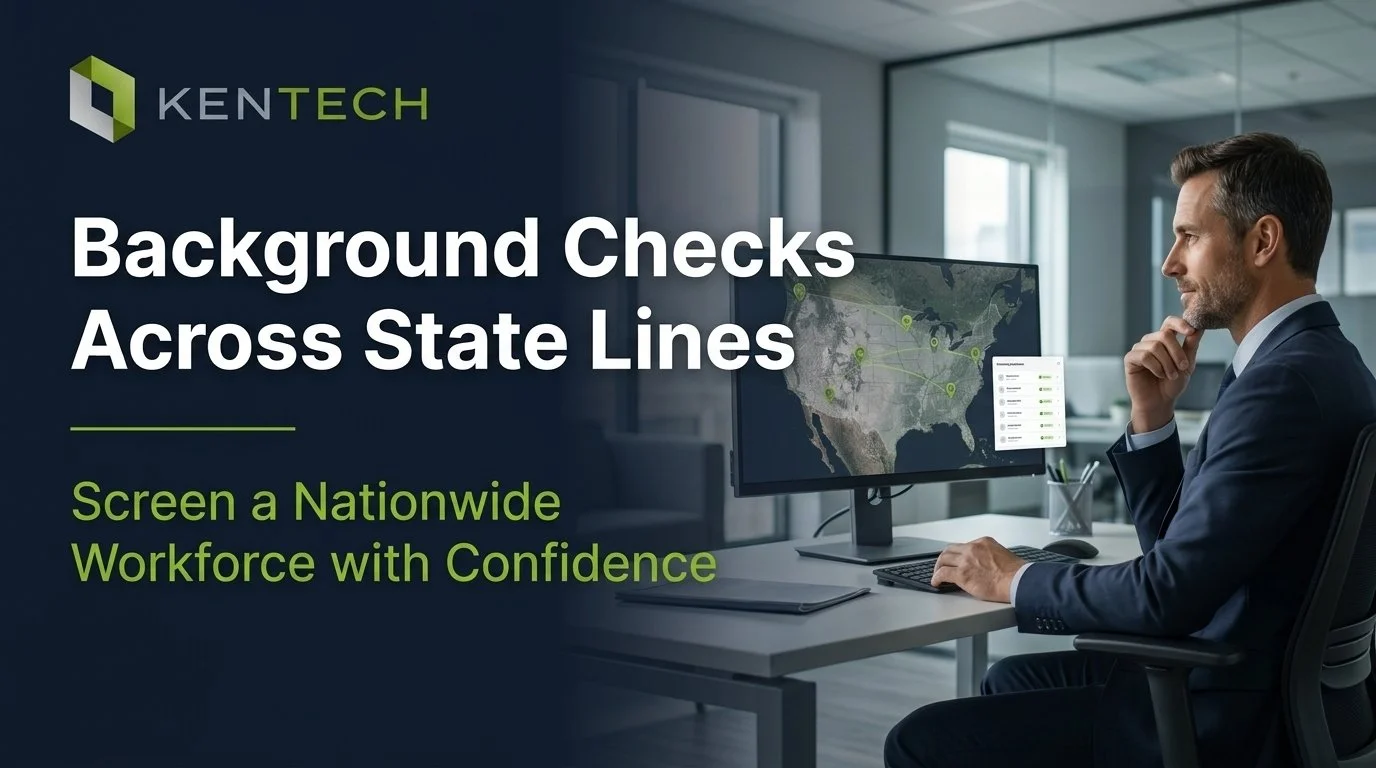
Hiring employees in different states gives organizations access to a larger talent pool. Companies can recruit remote workers, expand their operations, and fill positions with qualified candidates regardless of location.
However, hiring across state lines also creates additional background screening challenges.
Employment laws, record availability, reporting restrictions, and screening requirements may differ depending on the location. A process that works in one state may not meet the requirements of another.
That is why employers need a consistent approach to multi-state background checks. Understanding how these searches work can help organizations improve screening accuracy, manage compliance responsibilities, and make better-informed hiring decisions.
What Are Multi-State Background Checks?
Multi-state background checks involve screening candidates whose employment or residence history extends across multiple states.
For example, an applicant may have lived in California, worked in Texas, attended college in New York, and applied for a remote position with a company headquartered in Florida.
A screening process focused only on the employer's headquarters may not provide enough information.
Depending on the position and applicable law, employers may need to verify relevant employment history, education, identity information, and criminal records from appropriate jurisdictions.
The goal is to build a screening process that reflects the candidate's relevant history rather than relying on a single geographic location.
Why Multi-State Screening Can Be More Complicated
1. State Laws May Differ
Federal laws provide important protections for applicants and employees, but states and local governments may impose additional requirements.
These rules can affect:
When criminal history may be requested.
Which criminal records may be reported or considered.
Whether employers can conduct credit checks.
How applicants must be notified.
What information must be included in background screening procedures.
Employers should not assume that one nationwide policy automatically satisfies every state requirement.
A multi-state hiring program should be reviewed against the laws that apply to the employer, candidate, position, and screening activity.
2. Criminal Records Are Maintained Across Different Systems
Criminal records may be available through county, state, and federal sources.
These sources do not necessarily contain identical information.
A nationwide database search may provide useful leads, but it should not automatically be treated as a complete substitute for appropriate courthouse research.
Employers and screening providers should understand the source, scope, and limitations of every search.
3. Candidate Address History Matters
A candidate's previous residence information can help determine which jurisdictions may need to be considered.
However, address history should be validated carefully.
Misspelled names, incomplete addresses, and outdated information may affect search results.
KENTECH's Identity IQ service supports identity validation, address-history analysis, and jurisdiction mapping.
4. Verification Timelines Can Vary
Some records are available through digital systems, while others require direct contact with an institution, employer, or courthouse.
International and domestic verification requests can also have different processing requirements.
Employers should set realistic expectations and work with a screening provider that can communicate the status of pending searches.
6 Steps to Build a Better Multi-State Screening Process
Step 1: Establish a Standard Screening Policy
Create a written policy that explains which checks are required for each position or category of employment.
The policy should reflect legitimate business needs and applicable legal requirements.
For example, a financial role may require different checks from a warehouse position.
Avoid using identical screening packages for every job without considering responsibilities and legal restrictions.
Step 2: Verify Candidate Identity
Before conducting searches, confirm that the information belongs to the correct candidate.
Identity verification can help identify name variations and address-history inconsistencies.
This is especially important for candidates who have lived in multiple states or used different names.
Step 3: Identify Relevant Search Jurisdictions
Determine which locations are appropriate for the screening process.
Depending on the search and applicable requirements, this may involve county, state, or federal sources.
Employers should understand that national database searches have limitations and that additional primary-source research may be appropriate.
Step 4: Verify Employment and Education
A multi-state background screening program should not focus exclusively on criminal records.
Employment verification helps confirm previous work history, while education verification helps validate important academic credentials.
KENTECH provides Employ IQ for employment verification and Degree IQ for education verification.
These checks can help employers evaluate information that directly relates to a candidate's qualifications.
Step 5: Review Applicable Compliance Requirements
Employers should understand the FCRA and any applicable state and local consumer reporting laws.
When using a consumer reporting agency, employers generally need to provide a standalone disclosure and obtain written authorization before requesting a report.
If information in the report may lead to an adverse employment decision, the required pre-adverse and adverse action procedures must be followed.
Organizations should also review applicable fair chance and ban-the-box requirements, credit reporting restrictions, and record retention rules.
Step 6: Maintain Consistent Documentation
Keep records of screening requests, authorizations, completed searches, and relevant communications.
Documentation can help demonstrate that the organization follows a consistent process.
It also makes it easier to investigate discrepancies and respond to candidate questions.
Why Employers Should Look Beyond a Single Nationwide Database
A common misunderstanding is that one national database search covers every possible criminal record in the United States.
In reality, different sources contain different information, and data may vary in completeness and update frequency.
A responsible screening process should identify what a particular search actually covers.
Employers should work with providers that can explain the sources used, identify limitations, and determine when additional research is appropriate.
KENTECH combines technology and investigative expertise to support background screening and verification workflows.
Simplify Multi-State Background Screening With KENTECH
Hiring across state lines does not have to mean managing disconnected screening processes.
With an organized approach, employers can coordinate identity verification, employment checks, education verification, and appropriate record searches.
KENTECH's screening solutions help organizations manage these activities while supporting more informed hiring decisions.
Expanding your workforce across multiple states? Contact KENTECH to explore comprehensive background screening and verification solutions for your organization.