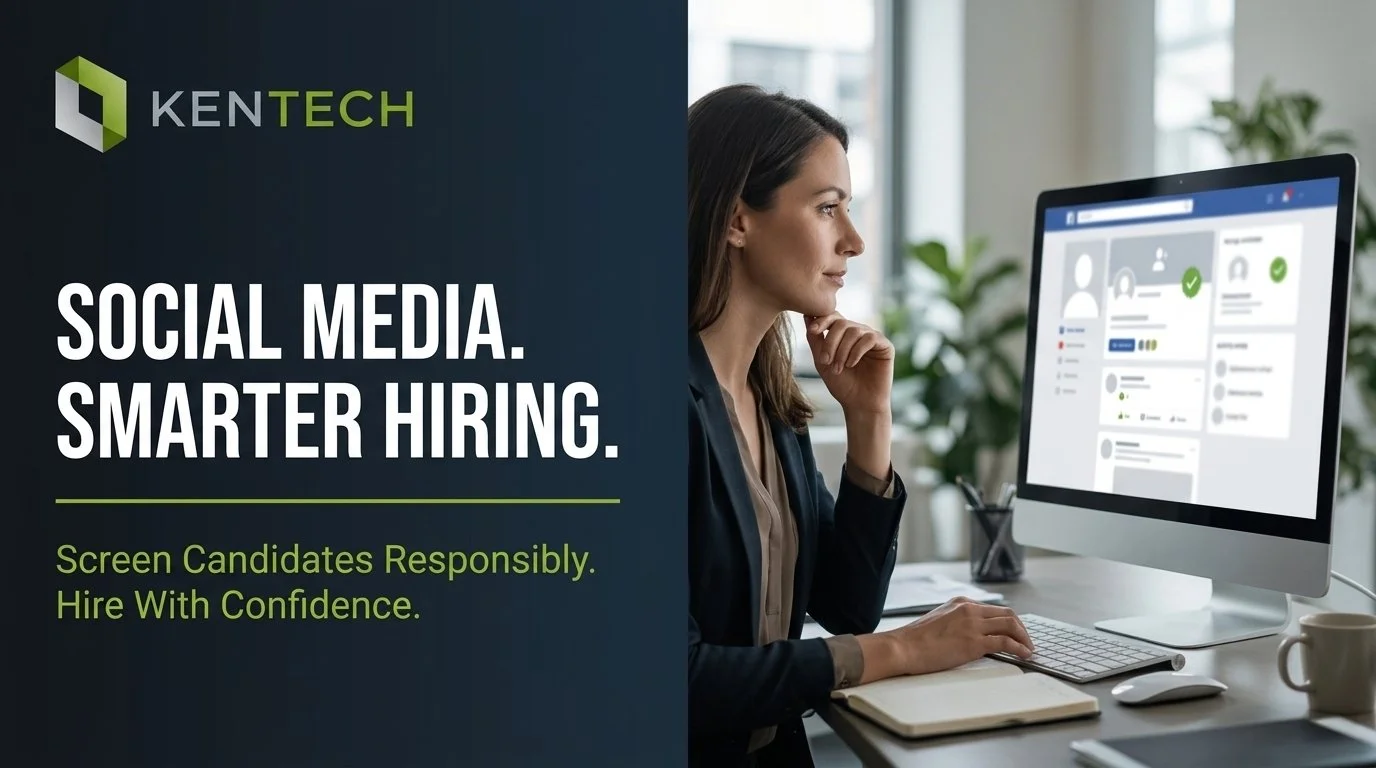
Social media has become part of everyday life, and it can reveal information that does not always appear on a resume. From professional achievements to public conversations, online activity may give employers additional context when evaluating job candidates.
However, reviewing someone's social media before hiring requires more than searching their name and scrolling through their profiles. Employers must understand what information they can review, what they should avoid, and how to protect candidate privacy.
Social media screening can help organizations identify relevant concerns and gain a better understanding of a candidate's public online presence. But when handled carelessly, it can also create privacy issues, discrimination risks, and legal problems.
So, what can employers legally and ethically review during social media screening? Understanding the boundaries can help organizations build a fairer and more consistent hiring process.
What Is Social Media Screening?
Social media screening is the process of reviewing publicly available online information about a job applicant as part of the hiring process.
Employers may review platforms such as LinkedIn, Facebook, Instagram, X, and other public websites to understand information relevant to a candidate's professional background and workplace conduct.
For example, a hiring manager may review a candidate's public LinkedIn profile to confirm professional experience or look at publicly available posts that raise legitimate concerns about workplace behavior.
However, social media screening should not become an investigation into someone's private life.
The purpose should be to identify information that is relevant to the position, not to judge candidates based on personal opinions, lifestyle choices, or protected characteristics.
KENTECH's Social.IQ social media screening solution helps organizations analyze publicly available online content through AI-powered screening, role-specific insights, and structured reporting.
1. What Employers Can Legally Review on Social Media
In the United States, employers can generally review publicly available information when evaluating job applicants. However, how that information is collected and used matters.
Some examples of information employers may consider include:
Public professional information: Employers can review publicly available LinkedIn profiles, professional achievements, work-related posts, and career information.
Public statements involving workplace conduct: Posts that contain credible threats, harassment, or other conduct directly relevant to the responsibilities of a position may deserve further review.
Potential misrepresentation: Public professional claims that appear inconsistent with information provided in an application may warrant clarification.
Public business-related activity: For certain positions, publicly available information about professional activities, industry participation, or business relationships may provide relevant context.
The important distinction is that publicly accessible information is not automatically appropriate to use in a hiring decision.
Employers should have a legitimate, job-related reason for considering any information they find.
2. What Employers Should Avoid Reviewing or Using
Social media profiles can reveal personal information that has nothing to do with someone's ability to perform a job.
For example, a public profile may reveal a person's religion, race, national origin, age, disability-related information, or other protected characteristics.
Under federal employment discrimination laws, employers cannot use this information to make unlawful hiring decisions.
Employers should avoid:
Rejecting candidates because of their religion or political beliefs.
Making decisions based on race, ethnicity, gender, or age.
Using disability-related information to discriminate.
Judging candidates based on lawful personal activities unrelated to the job.
Making assumptions about someone's character based on isolated posts.
Using private or restricted information obtained without proper authorization.
Employers should also avoid requesting personal social media passwords or requiring candidates to access private accounts during an interview. Many states have laws restricting these practices.
A candidate's personal opinions or online interests do not automatically indicate whether they will be a good employee.
3. Understand the Fair Credit Reporting Act (FCRA)
One of the most important legal considerations in employment background screening is the Fair Credit Reporting Act (FCRA).
The FCRA establishes requirements for using consumer reports in employment decisions.
When an employer obtains a social media background report from a third-party company that qualifies as a consumer reporting agency, the FCRA may apply.
Depending on the arrangement, employers generally must:
Provide a clear written disclosure before obtaining the report.
Obtain the applicant's written authorization.
Follow applicable requirements for using the report.
Provide a copy of the report and a summary of rights before taking adverse action based on the report.
Provide the required adverse action notice if the decision is finalized.
Not every social media search automatically falls under the FCRA. The requirements depend on who collects the information, how the service operates, and how the resulting report is used.
Employers should understand these distinctions before incorporating social media screening into their hiring procedures.
KENTECH's Compliance.IQ solution helps organizations standardize hiring compliance workflows, maintain documentation, and improve audit readiness.
4. Why Consistency Matters in Social Media Screening
One of the biggest problems with manual social media screening is inconsistency.
For example, one hiring manager may review every candidate's public Facebook and LinkedIn profiles, while another may only look at applicants who raise questions during an interview.
This creates opportunities for unequal treatment and subjective decisions.
A consistent screening policy helps reduce these risks.
Employers should establish clear guidelines covering:
Which platforms are reviewed: Identify the public platforms and sources that are relevant to the screening process.
When screening takes place: Apply a consistent process and define when social media reviews occur during recruitment.
What information matters: Establish job-related screening criteria before reviewing candidate profiles.
Who conducts the review: Consider using trained screening professionals rather than allowing individual hiring managers to make informal judgments.
How findings are documented: Record relevant information objectively and maintain appropriate documentation.
How candidates can respond: Give applicants a reasonable opportunity to explain information that may be inaccurate, incomplete, or taken out of context.
A standardized process makes it easier to explain how decisions are made and helps organizations avoid relying on personal opinions.
5. Why Context Matters When Reviewing Online Content
Social media posts do not always tell the complete story.
A comment may be sarcastic. A photograph may have been shared years ago. A discussion may involve a topic that has nothing to do with the candidate's professional responsibilities.
Without context, employers may misunderstand what they see.
For example, a candidate may share a controversial article without supporting its message. Another applicant may participate in a public discussion about workplace conditions that is legally protected activity.
Employers should avoid treating every controversial post as evidence of misconduct.
Instead, they should consider:
Whether the content is authentic.
Whether it is publicly accessible.
Whether the information is relevant to the position.
Whether the content is recent or outdated.
Whether the post has been interpreted correctly.
Whether the candidate has an opportunity to provide context.
A careful review helps employers distinguish meaningful concerns from ordinary online activity.
6. How Technology Can Improve Social Media Screening
Manually reviewing multiple social media profiles can be time-consuming, especially when organizations hire large numbers of employees.
It can also lead to inconsistent interpretations and unnecessary exposure to personal information.
Technology can help organizations create a more structured screening process.
KENTECH's Social.IQ uses AI-powered public profile analysis to identify potentially relevant online behavior, highlight positive indicators, and organize findings into structured reports.
Its approach includes:
Publicly available content aggregation.
AI-assisted behavioral analysis.
Role-specific screening insights.
Identification of potential concerns such as harassment and threatening behavior.
Recognition of positive indicators such as leadership and community engagement.
Structured reporting with compliance safeguards.
Human review remains important. Automated systems should support the screening process, not replace careful judgment or make final hiring decisions without appropriate oversight.
7. Combine Social Media Screening With Other Background Checks
Social media screening should not be the only method employers use to evaluate candidates.
Online information provides limited context and cannot independently verify every detail of a person's professional background.
Employers should consider combining social media reviews with other appropriate verification services.
For example:
Employ.IQ: Helps verify previous employment, job titles, responsibilities, and employment history.
Reference.IQ: Supports structured professional reference checks and role-specific feedback.
Social.IQ: Analyzes publicly available social media information for relevant behavioral insights.
Using complementary screening methods gives employers a broader understanding of a candidate without relying too heavily on one source of information.
Each screening component should be relevant to the position and conducted according to applicable laws and organizational policies.
Build a Fair and Responsible Hiring Process With KENTECH
Social media screening can provide useful information during recruitment, but it must be handled carefully.
Employers need to understand the difference between public and private information, avoid discriminatory practices, follow applicable FCRA requirements, and evaluate online content in the proper context.
A consistent screening policy helps organizations make more informed decisions while respecting candidate privacy and individual rights.
KENTECH combines investigative expertise with technology-driven screening solutions to help employers evaluate candidates through a more structured process.
With Social.IQ and its complementary employment verification and reference checking services, organizations can gain additional insights while maintaining a focus on responsible hiring practices.
Ready to improve your social media screening process? Explore KENTECH's Social.IQ solution at https://www.ekentech.com/socialiq or contact KENTECH today to learn how its screening technology can support more informed, consistent, and compliant hiring decisions.