
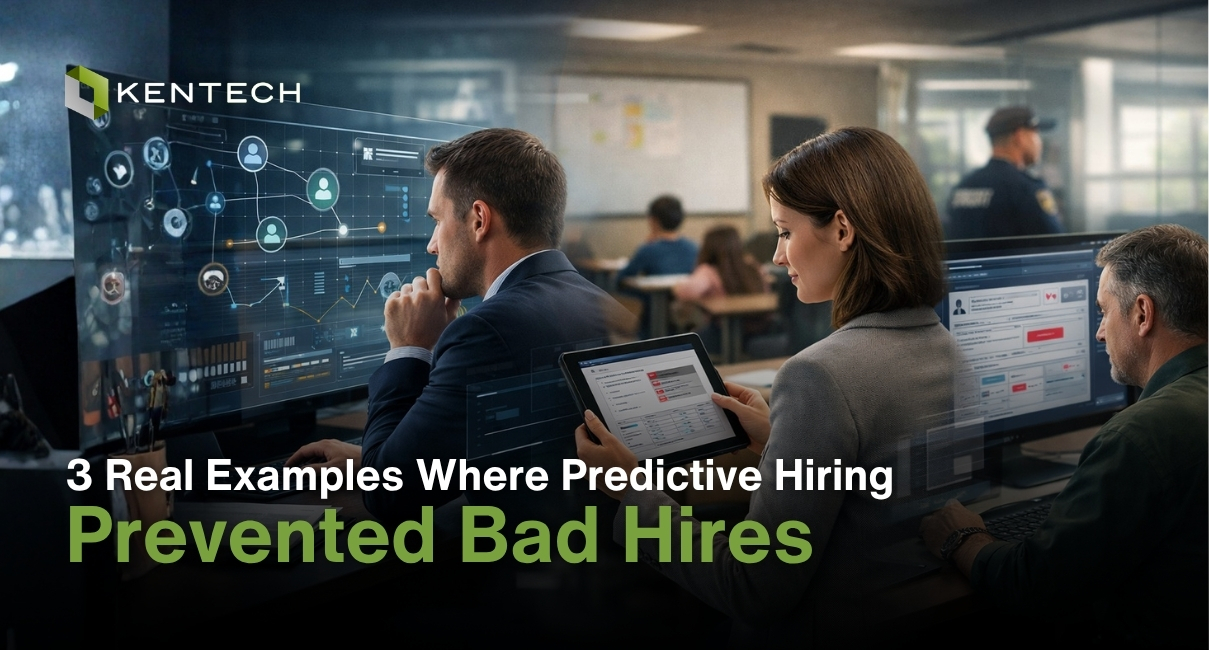
Across enterprise, education, and government sectors, hiring has become a high-stakes exercise in risk management. Labor shortages persist, regulatory scrutiny is increasing, and a single bad hire can trigger safety incidents, compliance failures, or reputational damage that lasts years. At the same time, organizations are expected to move faster than ever, often filling critical roles under intense operational pressure. In this environment, traditional background screening alone is no longer sufficient. The organizations that consistently avoid costly hiring mistakes are those that combine rigorous screening with predictive insight. The thesis is simple but consequential: predictive hiring, grounded in modern background intelligence, allows organizations to identify risk earlier, make defensible decisions, and protect both people and mission outcomes.
When Traditional Screening Leaves Blind Spots
Conventional background checks remain essential, but they are often misunderstood and misapplied. Many organizations treat screening as a final checkbox rather than a strategic input, relying on static reports that reflect the past without illuminating future risk. This approach can leave blind spots, especially in roles involving access to vulnerable populations, sensitive data, or critical infrastructure.
Several myths persist around background checks. One common belief is that a clean criminal record equates to low risk. Another is that screening is primarily about disqualification rather than informed decision-making. In reality, background checks are multidimensional tools that require context, interpretation, and alignment with role-specific risk profiles.
Key risk factors emerge when screening is treated narrowly or inconsistently:
Incomplete scope of checks. A comprehensive background check can include criminal history, employment and education verification, identity validation, license and credential verification, sanctions and watchlist screening, and continuous monitoring. Omitting elements creates gaps.
Lack of contextual analysis. A record without context can mislead decision-makers. Time elapsed, relevance to job duties, and evidence of rehabilitation all matter.
Manual and fragmented processes. Disconnected vendors and manual reviews increase error rates and slow hiring timelines, encouraging shortcuts.
Reactive compliance posture. Organizations that screen only to satisfy minimum regulatory requirements often miss emerging risk indicators.
Assumption that screening predicts performance. Background checks assess risk and integrity, not job success or cultural alignment.
When these issues converge, the result is predictable: hires who technically pass screening but later demonstrate unsafe behavior, credential fraud, or chronic performance failures. The cost is not just financial. It erodes trust among employees, stakeholders, and the communities organizations serve.
How Predictive Intelligence Changes Hiring Outcomes
Predictive hiring reframes background screening from a retrospective filter into a forward-looking decision system. This is where KENTECH has focused its innovation, particularly through its IQ product, Talent.IQ. Rather than treating data points in isolation, modern screening platforms integrate multiple signals to surface patterns that indicate potential risk before a hiring decision is finalized.
Talent.IQ is designed to help organizations understand not just what happened in a candidate’s past, but what that history suggests when aligned with the specific demands of a role. This approach is especially relevant in regulated and mission-driven environments where the margin for error is small.
A modern predictive screening approach incorporates several principles:
Holistic factor analysis. Criminal history, employment gaps, credential validity, and identity consistency are evaluated together, not in silos.
Role-based risk modeling. Risk indicators are weighted differently depending on whether a role involves financial authority, student contact, public safety, or data access.
Early signal detection. Patterns such as repeated short-term employment, unverifiable credentials, or discrepancies across records can flag concerns before onboarding.
Decision support, not automation bias. Predictive tools inform human judgment rather than replace it, supporting fair and defensible hiring decisions.
Scalable compliance alignment. Enterprise and government employers benefit from standardized processes that adapt to jurisdictional requirements without slowing hiring.
Consider three real-world scenarios. In an education setting, predictive analysis surfaced inconsistencies between claimed credentials and verified records, preventing the placement of an unqualified instructor before classroom access. In a government contractor environment, role-specific screening identified patterns of prior compliance violations that traditional checks had not weighted appropriately, averting a costly contract risk. In an enterprise healthcare context, continuous monitoring revealed post-hire license changes that allowed leadership to intervene before patient safety was compromised.
These outcomes were not driven by exclusionary tactics, but by better intelligence. Predictive hiring enables organizations to distinguish between manageable risk and unacceptable exposure, while maintaining fairness and transparency.
A More Responsible Way Forward
The future of hiring belongs to organizations that treat background screening as a living system rather than a static hurdle. Predictive intelligence does not eliminate risk, but it dramatically improves an organization’s ability to anticipate it, respond proportionately, and document sound decision-making. For enterprise, education, and government leaders, this capability is becoming a core component of operational resilience.
KENTECH’s work in this space reflects a broader shift toward responsible hiring practices that protect people, institutions, and public trust. By integrating comprehensive background factors, dispelling persistent myths about screening, and applying predictive insight through platforms like Talent.IQ, organizations can move faster without sacrificing safety or integrity. The takeaway is clear: smarter hiring is not about hiring less - it is about hiring with foresight, accountability, and respect for the mission at stake.