
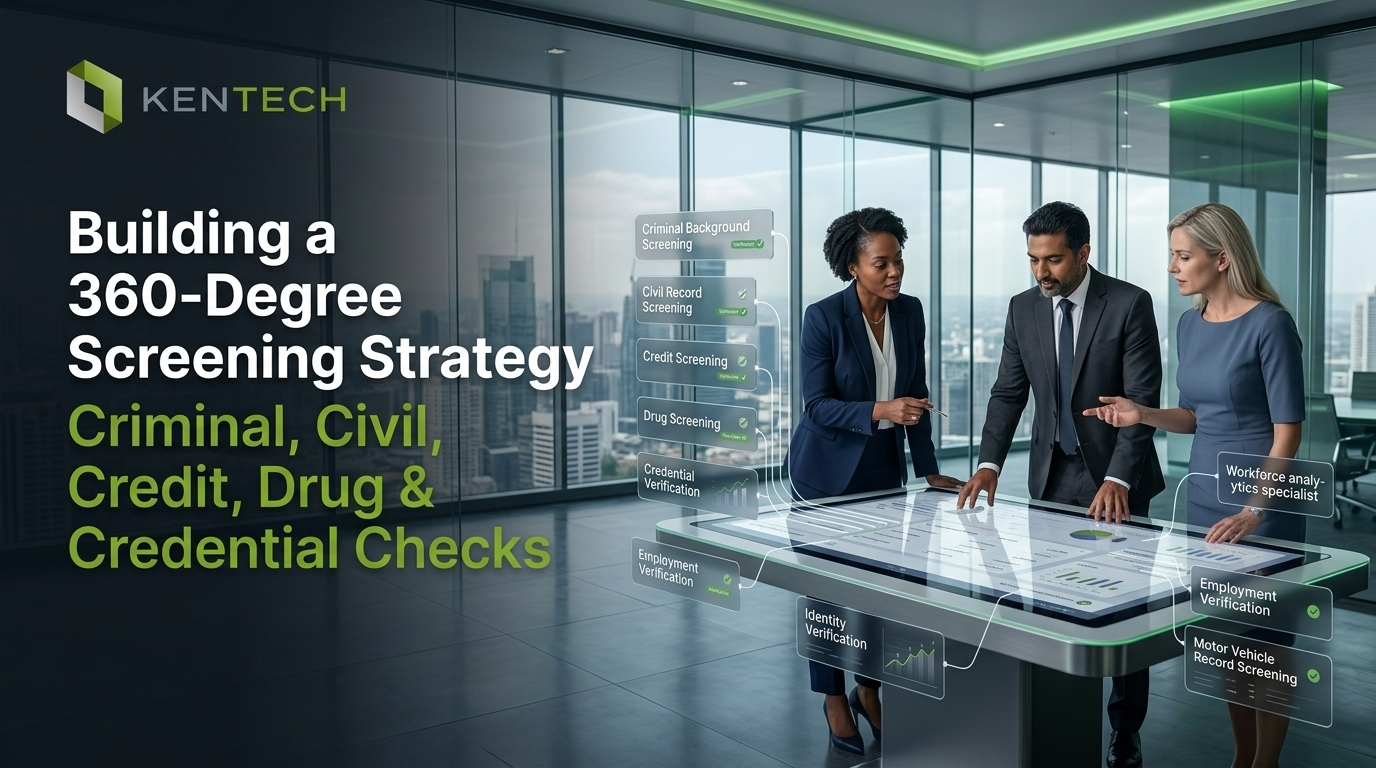
Modern hiring decisions require more than reviewing a résumé and conducting an interview.
Organizations face increasingly complex workforce risks involving identity, credentials, financial responsibility, workplace safety, regulatory compliance, and access to sensitive information.
A single background check rarely provides enough information to address all of these areas.
This is why organizations are increasingly taking a 360-degree approach to background screening.
Instead of relying on one screening service, a comprehensive strategy combines multiple relevant checks based on the responsibilities of each position.
These may include:
Criminal background checks
Civil record searches
Credit screening
Drug screening
Education verification
Employment verification
Professional credential verification
Identity verification
Motor vehicle record checks
International screening
Continuous monitoring
The objective is not to collect as much information as possible.
The objective is to collect the right information for the right position.
What Is 360-Degree Background Screening?
A 360-degree screening strategy provides a broader view of a candidate by evaluating multiple relevant dimensions of their professional and personal background.
Think of traditional screening as looking through one window.
A 360-degree strategy provides multiple windows.
Each screening service answers a different question.
Criminal screening: Are there relevant criminal records?
Civil screening: Are there relevant civil proceedings?
Credit screening: Is financial information relevant to this position?
Drug screening: Does the position require substance testing?
Credential verification: Are claimed qualifications accurate?
Employment verification: Does professional history match the candidate's claims?
Identity verification: Are screening results connected to the correct individual?
Together, these services can provide a more complete picture.
Criminal Background Checks
Criminal screening is one of the most commonly used employment screening services.
Where legally permitted and relevant, it can help employers identify certain criminal records associated with a candidate.
However, criminal screening should be conducted carefully.
Organizations should understand the limitations of databases and ensure that information is verified appropriately.
Employers should also follow applicable laws governing the use of criminal records in employment decisions.
A criminal record should not automatically be treated as proof that someone is unsuitable for a position.
Context and job relevance matter.
Civil Record Searches
Criminal records are not the only type of legal information that may be relevant.
Civil record searches can provide information about certain civil proceedings, depending on the jurisdiction and applicable laws.
For some organizations and positions, civil records may provide additional context.
As with other screening services, employers should determine whether civil screening has a legitimate connection to the responsibilities of the position.
Credit Screening
Credit checks may be relevant for certain positions involving significant financial responsibility, subject to applicable laws.
Potential examples include certain:
Financial executives
Accounting roles
Banking positions
Payroll responsibilities
Financial control positions
Credit screening should not be used universally.
Financial circumstances can arise for many reasons, and a credit report does not automatically predict workplace behavior.
Organizations should establish clear criteria and use credit screening only when appropriate and legally permissible.
Drug Screening
Drug screening may be relevant for safety-sensitive positions and certain regulated industries.
It can be particularly important for roles involving:
Commercial driving
Heavy machinery
Transportation
Certain healthcare responsibilities
Hazardous environments
Testing policies should be clearly communicated and consistently applied.
Organizations should also understand applicable laws, particularly where rules concerning marijuana and other substances differ between jurisdictions.
Credential Verification
Credentials are increasingly important in specialized industries.
Candidates may claim degrees, certifications, licenses, or specialized training that employers need to verify.
Credential verification can help organizations confirm:
Educational qualifications
Professional certifications
Licenses
Training
Specialized credentials
For regulated professions, verifying active credentials can be especially important.
Employment Verification
Employment verification adds another important layer.
Employers can confirm relevant information about a candidate's professional history, including previous employers, dates of employment, and job titles where available.
This can help organizations identify discrepancies between an application and verified employment history.
Employment verification can be particularly useful when positions require substantial previous experience.
Identity Verification Connects Everything Together
A comprehensive screening strategy begins with verifying identity.
The organization needs confidence that the person being screened is the person applying for the job.
Identity verification helps connect information from different screening services to the correct candidate.
This is especially important for remote and international hiring.
Digital identity verification can also help organizations streamline hiring while maintaining appropriate controls.
Build Screening Around the Position
A 360-degree strategy does not mean every employee receives every possible background check.
That approach can be unnecessary, inefficient, and potentially inappropriate.
Instead, organizations should create position-specific screening packages.
For example:
Commercial Driver
Identity verification
Criminal screening
MVR check
Drug screening
Employment verification
Financial Executive
Identity verification
Criminal screening
Employment verification
Education verification
Credential verification
Credit screening where legally permissible
Technology Administrator
Identity verification
Criminal screening
Employment verification
Education and credential verification
Other relevant workforce risk screening
Healthcare Professional
Identity verification
Criminal screening
Employment verification
Education verification
Professional license verification
Drug screening where appropriate
This approach allows employers to match screening requirements to actual risk.
Why Layered Screening Is More Effective
Different screening services reveal different types of information.
A candidate could have a verified employment history but lack a required professional license.
Another candidate could have legitimate educational credentials but a driving history that creates concerns for a transportation position.
A single screening service would not necessarily reveal every relevant issue.
Layered screening helps organizations avoid these blind spots.
Technology Makes 360-Degree Screening More Practical
Managing multiple screening services manually can become complicated.
Modern screening platforms can help organizations centralize screening workflows and manage multiple checks through a single process.
Technology can help with:
Candidate authorization
Screening requests
Status tracking
Document management
Alerts
Reporting
Compliance workflows
For organizations hiring at scale, centralized screening can improve efficiency and consistency.
Continuous Monitoring Adds Another Layer
A comprehensive screening strategy does not necessarily end when an employee starts work.
For appropriate positions, organizations may implement continuous background monitoring.
This can help identify certain relevant changes after hiring.
Continuous monitoring may involve areas such as:
Criminal record changes
Professional license status
Sanctions information
Driving records
The scope should depend on the role and applicable legal requirements.
Protect Candidate Privacy
A 360-degree screening strategy must also be a responsible screening strategy.
Organizations should only collect information that is relevant and legally permissible.
They should provide appropriate disclosures, obtain required authorization, protect sensitive data, and establish clear retention procedures.
More information is not automatically better.
The objective is relevant intelligence, not unnecessary surveillance.
Measure the Effectiveness of Your Screening Strategy
Organizations should periodically evaluate whether their screening program is actually helping the business.
Useful questions include:
Are screening requirements aligned with job responsibilities?
Are policies applied consistently?
Are screening processes creating unnecessary delays?
Are verification results helping hiring teams make better decisions?
Are compliance requirements being followed?
Are high-risk positions receiving appropriate screening?
Should screening requirements change as roles evolve?
Regular reviews help organizations keep their screening programs relevant.
Conclusion
A 360-degree background screening strategy gives employers a broader approach to workforce risk management by combining multiple relevant screening services.
Criminal, civil, credit, drug, credential, employment, identity, driving, and other checks each provide a different perspective.
The key is not to screen every candidate for everything.
The key is to create intelligent, position-specific screening programs that provide the information employers actually need to make responsible hiring decisions.
By combining multiple screening services with modern technology, consistent policies, and appropriate compliance controls, organizations can build stronger workforce risk management programs and make more informed hiring decisions.
KENTECH provides comprehensive background screening and workforce intelligence solutions designed to help organizations build customized screening strategies based on their industries, positions, and workforce risk requirements.