
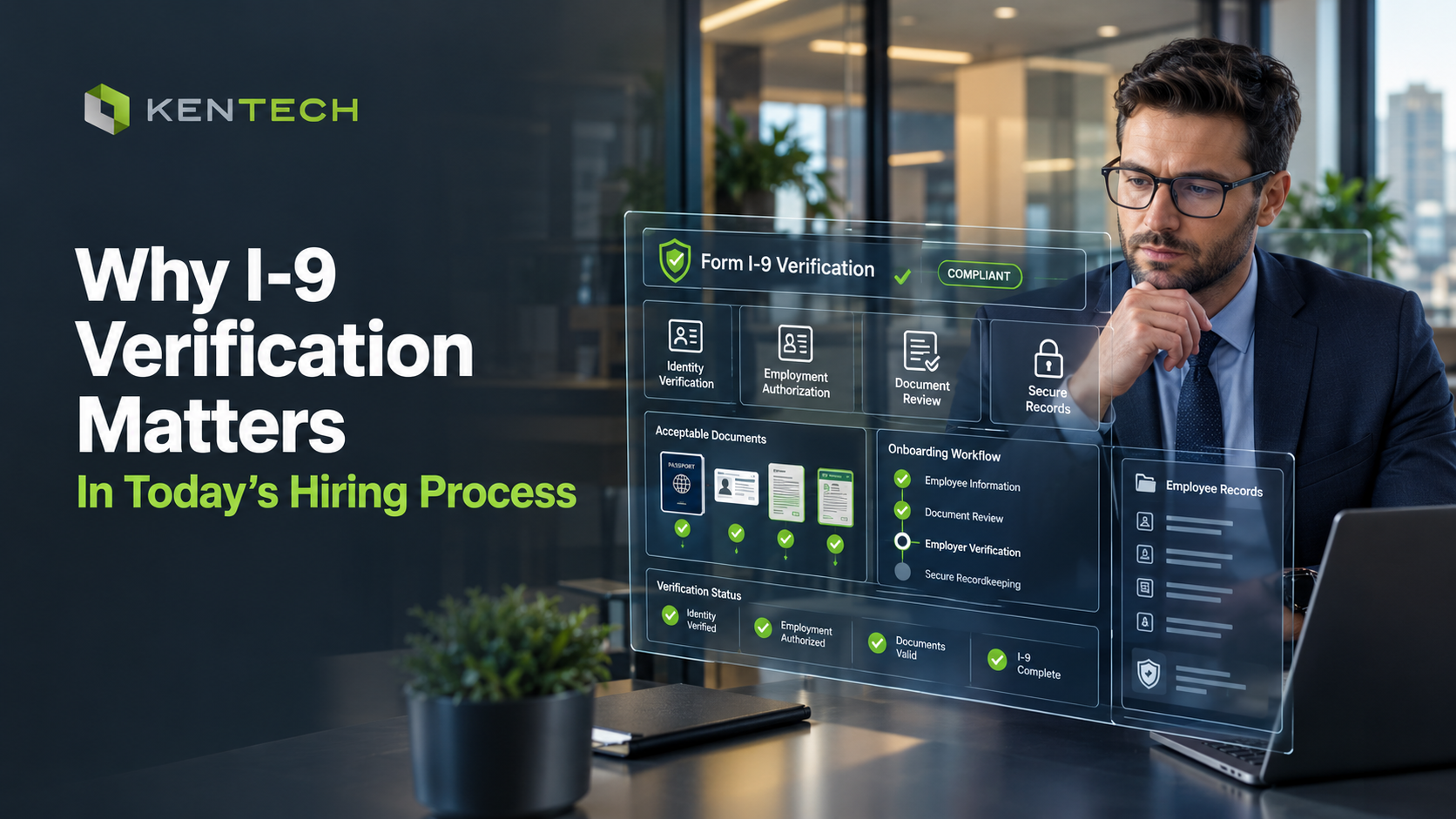
Hiring the right employee involves more than reviewing a resume, conducting interviews, and checking references. Before a new employee begins working, employers in the United States also have important employment eligibility verification responsibilities.
This is where I-9 verification becomes an essential part of the hiring process.
Form I-9, Employment Eligibility Verification, is used to document the identity and employment authorization of individuals hired in the United States. Federal requirements generally apply to employees regardless of whether they are U.S. citizens or noncitizens.
For today's employers, properly managing I-9 verification is about more than completing another onboarding form. It is about establishing a consistent process for collecting, reviewing, documenting, and retaining the information required under federal employment eligibility rules.
What Is I-9 Verification?
I-9 verification is the process employers use to document an employee's identity and authorization to work in the United States.
The Form I-9 process involves both the employee and employer.
Employees generally complete Section 1 no later than their first day of employment, while the employer or authorized representative completes the employer verification portion within the required timeframe. The current Form I-9 requires the employer or authorized representative to examine acceptable documentation from the appropriate lists and complete the applicable certification.
The process is designed to establish two things:
The employee's identity
The employee's authorization to work in the United States
Importantly, employees generally choose which acceptable documents to present from the Form I-9's Lists of Acceptable Documents. Employers should not specify which particular acceptable document an employee must provide.
Why Does I-9 Verification Matter?
I-9 verification matters because employment eligibility verification is a federal requirement, not simply an optional HR practice.
Employers are responsible for properly completing and retaining Form I-9 records and making them available for inspection by authorized government agencies when required.
For organizations managing hundreds or thousands of employees, maintaining accurate I-9 records can become a significant operational responsibility.
A consistent process can help employers:
Standardize employee onboarding
Verify required information
Reduce avoidable documentation errors
Maintain organized I-9 records
Support compliance efforts
Prepare for potential inspections
Create clearer internal procedures
Improve the employee onboarding experience
The goal is not simply to complete a form.
The goal is to establish a repeatable process that helps the organization meet its employment eligibility verification responsibilities.
I-9 Verification Starts During Onboarding
One reason I-9 verification deserves attention is that it is closely connected to the employee onboarding process.
New employees are already completing multiple forms, providing payroll information, reviewing company policies, and setting up accounts.
Adding I-9 requirements to this process means HR teams need a clear workflow.
A well-organized onboarding process should make it clear:
Who is responsible for each part of Form I-9
When the employee must complete their portion
When the employer must complete its portion
Which documentation is acceptable
How documentation is examined
How completed forms are stored
When reverification may be required
Without clear procedures, organizations can encounter inconsistent practices between departments, locations, or hiring managers.
Employers Must Follow the Documentation Rules
One of the most important aspects of I-9 verification is understanding the acceptable documentation requirements.
Form I-9 provides Lists of Acceptable Documents.
An employee may generally present either:
One document from List A, which establishes both identity and employment authorization; or
One document from List B establishing identity and one document from List C establishing employment authorization.
Employees generally choose which acceptable documentation to present. Employers should not demand a particular document from an employee when other acceptable documentation is available.
This is an important part of maintaining a consistent and nondiscriminatory verification process.
HR teams should therefore train those responsible for I-9 verification to follow the established requirements rather than creating their own documentation rules.
Accuracy Matters
A completed Form I-9 is only useful when the information is accurate and the required process has been followed.
Errors can occur when:
Employees enter incomplete information
Employer sections are completed late
Required signatures are missing
Documentation information is entered incorrectly
Forms are not stored properly
Reverification requirements are overlooked
Different locations follow different procedures
Even when an error is unintentional, it can create additional administrative work for HR teams.
For larger organizations, small process inconsistencies can become difficult to manage when multiplied across hundreds or thousands of employee records.
That is why standardization matters.
I-9 Verification and Remote Hiring
Modern hiring has also changed how employers think about employee onboarding.
Organizations may hire employees who work remotely, across multiple locations, or through distributed teams.
Federal rules allow certain employers to use an alternative procedure for examining Form I-9 documentation when authorized requirements are met. The current Form I-9 includes a field for employers to indicate when an authorized alternative procedure was used.
However, remote I-9 processes should not simply be treated as a digital version of the traditional process.
Employers need to understand which remote examination procedures are available to them and what requirements apply.
This is particularly important for organizations with:
Remote employees
Multiple office locations
Distributed HR teams
High-volume hiring
Hybrid workforces
Employees located in different regions
A consistent technology-enabled process can help HR teams manage these requirements more efficiently while maintaining appropriate controls.
Proper Recordkeeping Is Part of the Process
I-9 responsibilities do not end after the form is completed.
Employers are required to retain Forms I-9 for current employees and former employees according to federal retention rules. ICE guidance states that employers must retain Forms I-9 for at least three years after the date of hire or one year after employment ends, whichever is later.
This means organizations need a reliable system for maintaining records.
Important considerations include:
Secure storage
Controlled access
Organized employee records
Retention schedules
Retrieval procedures
Protection of sensitive employee information
For organizations with large workforces, maintaining paper records across multiple locations can create unnecessary administrative complexity.
Digital workflows can help centralize the process, but employers still need appropriate procedures for security, retention, and access.
I-9 Compliance Is More Than a Checkbox
It can be tempting to think of I-9 verification as simply another onboarding task.
But effective I-9 management involves several interconnected responsibilities.
Organizations need to consider:
Timing: Are the employee and employer portions completed within the required timeframes?
Documentation: Are acceptable documents handled according to the applicable requirements?
Consistency: Are employees treated consistently throughout the verification process?
Recordkeeping: Are Forms I-9 properly retained and accessible when required?
Training: Do HR professionals and authorized representatives understand their responsibilities?
Technology: Does the organization's workflow support accurate and secure processing?
Looking at I-9 verification as a complete workflow rather than a single form can help organizations identify weaknesses before they become larger administrative problems.
Avoid Unnecessary Documentation Requirements
Another important consideration is avoiding practices that could create discrimination concerns.
Employees have choices regarding which acceptable documentation they present. Employers generally cannot demand a specific document when the employee has provided another acceptable document from the required lists. The Form I-9 itself includes an anti-discrimination notice addressing citizenship, immigration status, and national origin.
For HR teams, this means I-9 training should cover not only how to complete the form, but also how to conduct the process consistently and appropriately.
A strong process protects the integrity of the verification system while respecting employee rights.
Why Businesses Need a Consistent I-9 Process
The larger an organization becomes, the more difficult it can be to maintain consistent onboarding procedures.
Imagine an organization hiring employees across 20 locations.
If every HR team handles I-9 verification differently, the organization may end up with different processes for:
Document examination
Form completion
Record storage
Remote verification
Reverification
Error correction
Employee communication
A standardized I-9 workflow can help reduce unnecessary variation.
This is particularly valuable for organizations with frequent hiring, seasonal employees, multiple locations, or large HR departments.
How KENTECH Can Help
I-9 verification is an important part of a modern employment screening and onboarding strategy.
Organizations need a process that supports accurate verification while helping HR teams manage documentation, workflows, records, and compliance responsibilities efficiently.
KENTECH provides employment screening and verification solutions designed to help organizations manage today's increasingly complex hiring environment.
Through technology-driven screening solutions and a high-touch approach, KENTECH can help organizations build more structured employment verification processes while supporting broader background screening needs.
For employers, the objective is simple: create a hiring process where employment eligibility verification is handled consistently, efficiently, and responsibly.
Make I-9 Verification Part of a Stronger Hiring Process
A successful hiring process does not end when a candidate accepts an offer.
It continues through onboarding, employment eligibility verification, documentation, recordkeeping, and ongoing workforce management.
I-9 verification provides an important foundation for that process by helping employers document employee identity and employment authorization as required under federal law.
As hiring becomes more distributed, digital, and fast-paced, organizations need dependable systems for managing these responsibilities.
KENTECH can help organizations strengthen their employment screening and verification strategy with solutions designed for modern employers.
Ready to improve your I-9 verification process? Contact KENTECH today to learn how its employment verification and screening solutions can support a more organized, consistent hiring process.