
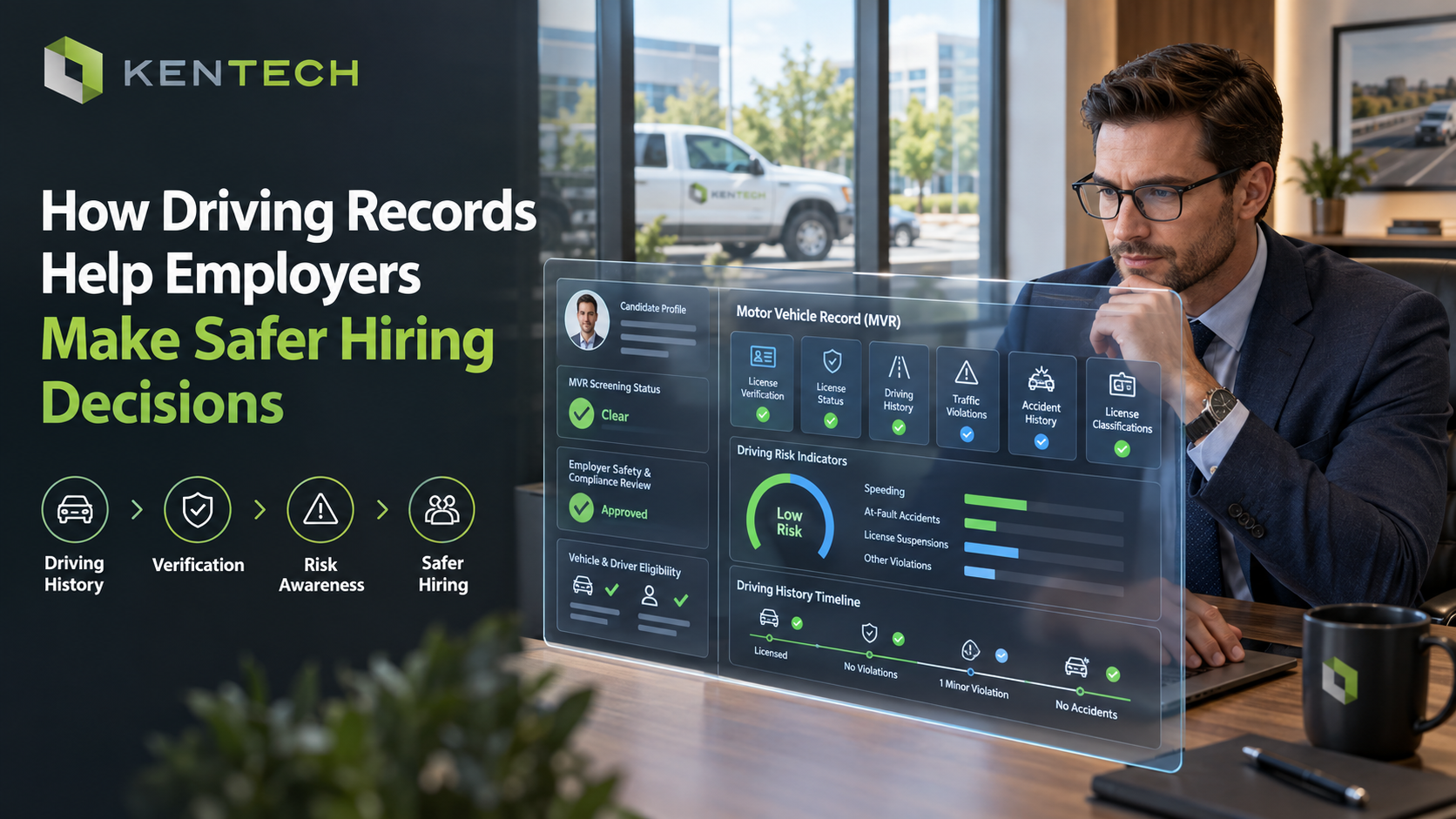
Hiring the right employee involves more than reviewing a resume and conducting an interview. For positions that require employees to drive, an applicant's driving history can provide important information that may not appear anywhere else in the hiring process.
A Motor Vehicle Record (MVR) check allows employers to review driving-related information associated with a candidate's record, such as license status, violations, accidents, and other information available through applicable motor vehicle records.
For employers with drivers, delivery personnel, field technicians, transportation workers, sales representatives, or other employees who operate vehicles as part of their job, understanding driving history can be an important component of a broader screening process.
What Is a Motor Vehicle Record Check?
A Motor Vehicle Record check, commonly called an MVR check, is a screening process used to review an individual's driving history through applicable motor vehicle records.
Depending on the jurisdiction and the type of record available, an MVR report may contain information such as:
Driver's license status
License classifications or restrictions
Traffic violations
Moving violations
Accident-related information
Suspensions or revocations
Commercial driving information, where applicable
Other driving-related records maintained by the relevant authority
The exact information available can vary based on state requirements, record type, and applicable laws.
For employers, the purpose is not simply to collect information. The goal is to determine whether a candidate's documented driving history is relevant to the responsibilities and risks associated with the position.
Why Driving History Matters During Hiring
A candidate may have an impressive resume and strong interview performance while still having a driving history that requires additional consideration for a position involving regular vehicle operation.
This is particularly important when employees drive company vehicles, transport customers or products, visit job sites, or spend substantial time on the road.
A driving record can help employers identify information that may warrant further review before making a hiring decision.
For example, an employer may discover:
A driver's license is currently suspended or restricted.
A candidate has a pattern of serious traffic violations.
The applicant has accumulated multiple recent violations.
The candidate's driving history differs from information provided during the application process.
A commercial driver has records that may be relevant to the requirements of the position.
These findings do not automatically determine whether someone should be hired. Instead, they give employers additional job-related information to consider as part of a consistent screening process.
MVR Checks Help Employers Evaluate Driving-Related Risk
One of the primary benefits of driving record checks is that they give employers a more complete view of an applicant's driving history.
Consider a company hiring delivery drivers. The employee may spend several hours each day operating a company vehicle. In that environment, driving behavior can have implications beyond the individual employee.
A serious driving incident could potentially affect:
Employee safety
Other motorists
Customers
Company vehicles
Insurance requirements
Operational continuity
Company reputation
An MVR check can help employers incorporate documented driving information into their overall risk assessment.
Rather than relying exclusively on an applicant's statement that they are a safe driver, employers can use appropriate screening information to support a more informed evaluation.
Driving Records Can Help Verify License Status
For many driving-related positions, having a valid license is a fundamental job requirement.
An MVR check can help employers verify whether a candidate's license status aligns with the requirements of the position.
This can be especially important when a job requires:
A valid driver's license
A specific license classification
Commercial driving credentials
Certain endorsements
Authorization to operate particular types of vehicles
License status can change over time. Therefore, verifying driving credentials during the hiring process can help employers avoid relying solely on information supplied by an applicant.
Patterns Can Matter More Than a Single Record
A driving record should be considered in context.
One isolated violation may tell an employer something different from a repeated pattern of serious violations. Similarly, an older incident may need to be evaluated differently from multiple recent events.
Employers can establish consistent screening criteria based on the requirements of each position.
For example, a company might create different screening standards for:
Employees who occasionally drive
Employees who regularly operate company vehicles
Delivery drivers
Commercial drivers
Employees transporting passengers
Employees working in safety-sensitive transportation roles
A role-specific approach helps employers focus on information that is actually relevant to the job.
MVR Screening Can Support Consistent Hiring Practices
Consistency is an important part of a structured employment screening program.
If an organization checks driving records for one candidate but not another candidate applying for the same type of driving position, its screening process may lack consistency.
A defined MVR screening policy can help organizations establish a repeatable process.
That process might include:
Identifying which positions require driving.
Establishing job-related screening criteria.
Obtaining appropriate authorization where required.
Reviewing applicable motor vehicle records.
Evaluating results against established standards.
Applying the same process consistently to similarly situated candidates.
Following applicable federal, state, and local requirements.
This approach allows organizations to integrate driving records into a broader workforce screening strategy instead of treating every candidate differently.
Driving Records Are One Piece of the Screening Process
An MVR check should not necessarily stand alone.
For many employers, driving history is one component of a broader background screening program.
Depending on the position, an employer may also consider:
Identity verification
Criminal background checks
Employment verification
Education verification
Professional license verification
Drug screening
Credit screening where legally appropriate
Reference checks
Continuous background monitoring
Combining appropriate screening services can give employers a more complete picture of an applicant's qualifications and potential job-related risks.
For a transportation-focused role, for example, the employer may need to verify both the candidate's driving history and other qualifications required for the position.
Why Employers Should Avoid Relying on Self-Reported Driving History
Applicants may be asked to provide information about their driving history during the hiring process. However, self-reported information does not necessarily provide the same level of verification as an appropriate records search.
Candidates may unintentionally forget older violations or provide incomplete information.
An MVR check provides an additional verification step that can help employers compare relevant driving information against established hiring requirements.
This is particularly valuable when driving is an essential function of the job.
Building a Safer Hiring Process With Better Information
Safer hiring does not mean attempting to eliminate every possible workplace risk. No screening process can guarantee that an employee will never be involved in an accident or violation.
Instead, effective screening helps employers make decisions using relevant, documented information.
For organizations whose employees drive as part of their jobs, driving records can provide an important source of information that may otherwise be overlooked.
By incorporating MVR checks into an appropriately designed screening program, employers can better understand a candidate's driving history, verify important credentials, and apply consistent job-related standards.
Make Driving Records Part of a Smarter Screening Strategy
A candidate's driving history can be an important consideration when the responsibilities of a position involve operating a vehicle.
KENTECH helps organizations strengthen their employment screening processes with technology-driven background and verification solutions. By incorporating Motor Vehicle Record checks into a broader screening strategy, employers can access relevant information to support more informed and consistent hiring decisions.
Whether you're hiring delivery drivers, field employees, commercial drivers, or employees who regularly operate company vehicles, the right screening process can help your organization identify relevant risks before an employee gets behind the wheel.
Looking to strengthen your driver screening process? Contact KENTECH to learn how Motor Vehicle Record checks can fit into your employment screening program.