
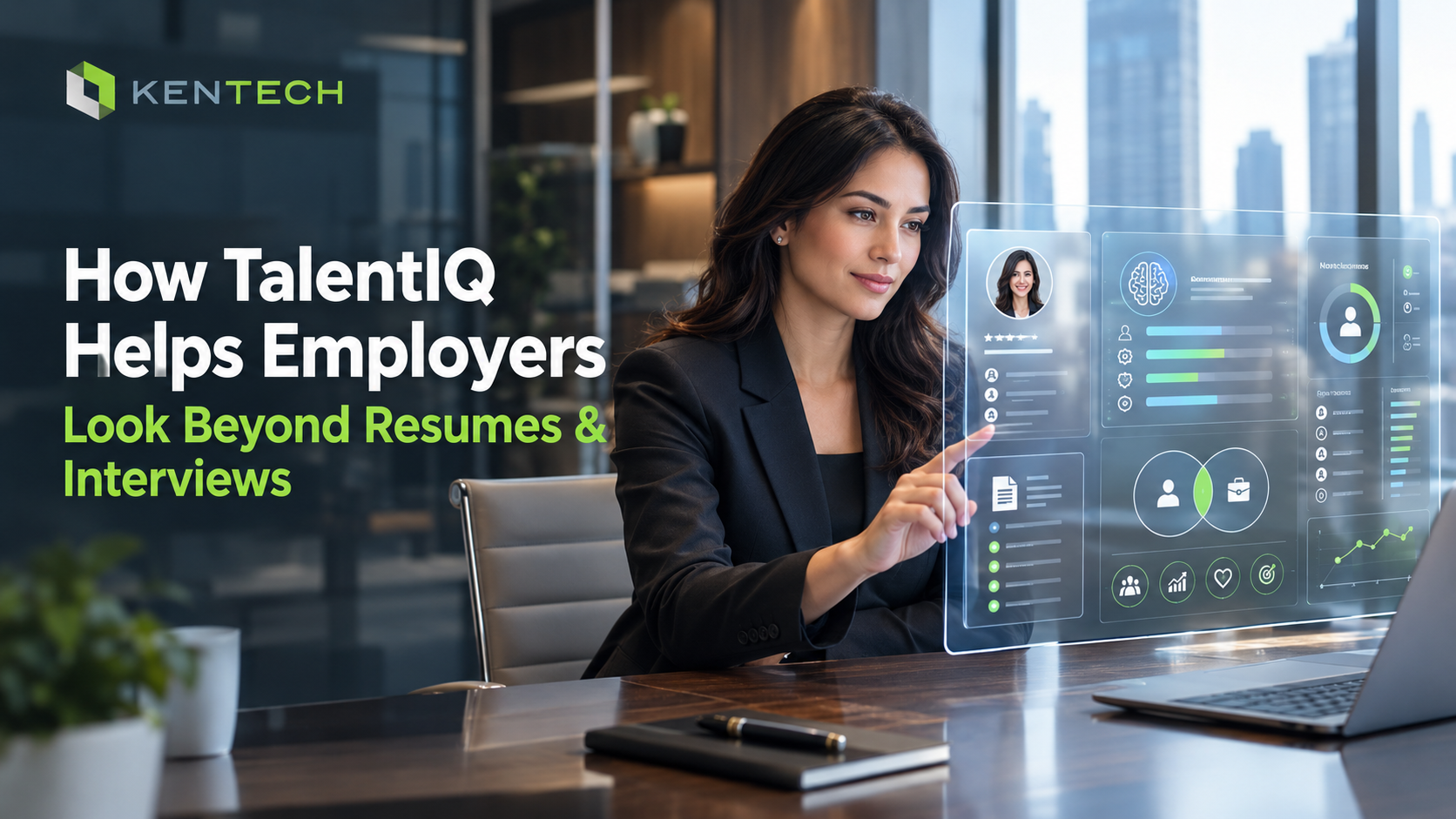
A resume can tell an employer where a candidate has worked, what they studied, and which accomplishments they want to highlight.
An interview can reveal how someone communicates, responds to questions, and presents themselves to a potential employer.
Both are valuable.
But neither necessarily tells the complete story.
Modern employers increasingly need to understand more than a candidate's experience on paper or performance during a conversation. They also want deeper insight into how candidates approach workplace situations, what motivates them, where their natural strengths may exist, and how their behavioral patterns may align with the requirements of a particular role.
This is where TalentIQ enters the hiring process.
KENTECH's TalentIQ is designed to provide AI-powered talent intelligence that goes beyond traditional resume and interview evaluation. Its approach combines adaptive assessments, behavioral analysis, role-specific evaluation, predictive matching, and actionable insights to give employers another layer of information to consider during hiring.
A Resume Is a Starting Point, Not the Complete Picture
Resumes remain an important part of recruiting.
They help employers quickly understand a candidate's:
Employment history
Education
Skills
Professional accomplishments
Certifications
Career progression
Areas of experience
But resumes are also self-presented documents.
Candidates decide what to emphasize, how to describe their experience, and which accomplishments to place at the center of their professional story.
That does not make a resume unreliable. It simply means employers are seeing one perspective of the candidate.
A candidate may have an impressive background but struggle in an environment that requires rapid decision-making.
Another candidate may have a less traditional career path but demonstrate strengths that could make them highly relevant to a particular role.
The challenge for employers is identifying those differences.
Interviews Have Their Own Limitations
Interviews provide another important source of information.
They allow hiring managers to ask questions, explore experience, and observe how candidates communicate.
However, interviews can also be influenced by the format itself.
Candidates know they are being evaluated. They prepare answers, practice common questions, research companies, and learn how to present themselves professionally.
Interview performance can therefore tell employers something important—but it may not reveal every behavioral pattern that matters once the candidate is actually working in the organization.
This creates an important question:
What else can employers learn before making a hiring decision?
TalentIQ is designed to help address that gap.
What Is TalentIQ?
TalentIQ is KENTECH's AI-powered talent intelligence solution designed to provide deeper insight into candidate potential.
According to KENTECH, TalentIQ uses a 15-minute adaptive assessment and analyzes candidate responses for behavioral patterns and emotional tendencies rather than relying exclusively on rehearsed interview responses.
The platform is built around four primary dimensions of potential:
Authentic Experience Mapping
Vibrational Pattern Analysis
Resonance Matching
Energy Activation Blueprint
KENTECH presents these components as a way to explore areas such as decision-making, resilience, behavioral patterns, strengths, motivations, leadership tendencies, and potential work environments.
The result is intended to give employers another perspective to consider alongside traditional hiring information.
1. TalentIQ Can Add Behavioral Insight
A resume primarily describes what someone has done.
An interview explores what someone says about their experience.
TalentIQ is designed to examine another dimension: behavioral and response patterns within an assessment environment.
KENTECH says its real-time analysis evaluates candidate responses for behavioral and emotional patterns during the adaptive assessment.
This can help hiring teams explore questions that are difficult to answer from a resume alone.
For example:
How does a candidate approach workplace scenarios?
What strengths appear consistently in their responses?
What types of environments may align with their working style?
How might their behavioral tendencies relate to a particular position?
Which areas may deserve deeper discussion during an interview?
These insights are not intended to eliminate human judgment.
Instead, they can give hiring teams additional information to consider.
2. Assess Candidates Against the Role
One of the more important elements of TalentIQ is its emphasis on role-specific assessment.
KENTECH's platform allows organizations to upload a job description or use an AI template builder to create assessments around specific job requirements and organizational characteristics.
This matters because hiring should not be based on a generic definition of a "good candidate."
The right candidate for one position may not be the right candidate for another.
A sales position may require different strengths from a technical security role.
A leadership position may demand different behavioral characteristics from an administrative position.
A customer-facing role may emphasize communication and adaptability, while another position may place greater importance on analytical thinking or structured decision-making.
Role-specific assessment can help employers evaluate candidates within the context of the position they are actually being considered for.
3. Look for Potential, Not Just Experience
One of the biggest limitations of traditional hiring is that experience can become a shortcut for potential.
Employers may naturally gravitate toward candidates who have already held similar positions.
But experience and potential are not always identical.
Someone with a nontraditional career background may possess strengths that transfer effectively into a new role.
Another candidate may have years of experience but demonstrate a weaker alignment with the responsibilities or environment of a particular position.
TalentIQ is designed to help employers explore these dimensions through its assessment and talent-intelligence framework.
The goal is to provide information that may help employers look beyond a candidate's career history and consider what they may be capable of contributing in the future.
4. Give Interviews More Context
TalentIQ does not have to be viewed as a replacement for interviews.
In fact, it can be used to make interviews more focused.
KENTECH's own TalentIQ materials describe actionable recommendations designed to help employers with interviewing and onboarding.
Imagine an employer receives an assessment indicating that a candidate demonstrates particular strengths in areas relevant to the position.
Instead of spending the entire interview trying to discover basic information, the hiring manager can use the available insights to develop more targeted questions.
This can turn the interview into a deeper conversation.
Rather than asking only:
"Tell me about yourself."
The interviewer can explore specific situations, behaviors, strengths, challenges, and experiences that are relevant to the role.
The technology provides additional information.
The human interviewer provides context.
Together, they can create a more informed evaluation process.
5. Reduce Reliance on Gut Feeling
Hiring decisions can sometimes be influenced by instinct.
A candidate may appear confident.
Another may be particularly personable.
Someone else may share interests with the interviewer.
These impressions can influence how candidates are perceived even when they have little connection to actual job requirements.
Structured assessment can introduce another source of information into the process.
TalentIQ is designed to provide standardized assessment data that can be considered alongside resumes, interviews, background screening, references, and other hiring information.
This does not eliminate subjectivity from hiring.
Instead, it can give organizations more structured information to incorporate into their decision-making process.
6. Combine Talent Intelligence With Background Screening
Talent intelligence and background screening answer different questions.
A background check can help verify information such as identity, employment history, education, credentials, criminal records, and other relevant information depending on the screening package.
TalentIQ approaches another part of the hiring question: understanding candidate potential, behavioral patterns, and role alignment.
Together, these capabilities can contribute to a broader hiring strategy.
For example:
Resume: What does the candidate say about their experience?
Employment verification: Can relevant employment information be confirmed?
Education verification: Can claimed educational credentials be verified?
Background screening: What relevant records and information should the employer consider?
TalentIQ: What additional behavioral and potential insights can be explored?
Interview: How does the candidate explain and contextualize these findings?
This layered approach moves hiring away from relying on a single source of information.
7. Make the Hiring Process More Data-Informed
Modern HR teams have access to more recruiting data than ever before.
The challenge is not simply collecting more information.
It is collecting information that can actually help hiring teams understand candidates in a meaningful way.
KENTECH describes TalentIQ as providing real-time analysis, predictive matching, and actionable insights as part of its talent-intelligence approach.
For employers, the potential value is in bringing these insights into a structured hiring workflow.
Instead of relying exclusively on a resume, interview, or first impression, hiring teams can consider multiple information sources before reaching a conclusion.
TalentIQ Should Complement Human Judgment
Technology should not be treated as a substitute for responsible hiring judgment.
Candidate assessments are one source of information.
Employers should still consider job requirements, qualifications, verified experience, applicable screening information, structured interviews, references, organizational policies, and relevant legal or compliance requirements.
TalentIQ can provide additional insight, but hiring decisions should remain grounded in the employer's established criteria and appropriate human review.
This distinction is important.
The objective is not to let an algorithm make the hiring decision.
The objective is to give hiring professionals more information with which to evaluate candidates.
Build a More Complete View of Your Candidates With KENTECH
Today's employers face a hiring environment where resumes are increasingly polished, interviews can be rehearsed, and traditional recruiting methods may leave important questions unanswered.
Looking beyond the resume does not mean abandoning traditional hiring tools.
It means adding more meaningful layers of information.
KENTECH's TalentIQ is designed to help employers explore candidate potential through AI-powered talent intelligence, adaptive assessments, behavioral analysis, role-specific evaluation, and actionable insights.
When combined with appropriate background screening and candidate verification, TalentIQ can become part of a broader strategy for understanding candidates before they join the organization.
The hiring process should ultimately answer more than:
"Does this candidate look good on paper?"
It should help employers explore:
"What information can we verify, what strengths can we understand, and how does this candidate align with the requirements of the role?"
That is the value of looking beyond resumes and interviews.
Ready to see what your hiring process may be missing? Contact KENTECH to explore TalentIQ and discover how AI-powered talent intelligence can add another layer of insight to your candidate evaluation process.