
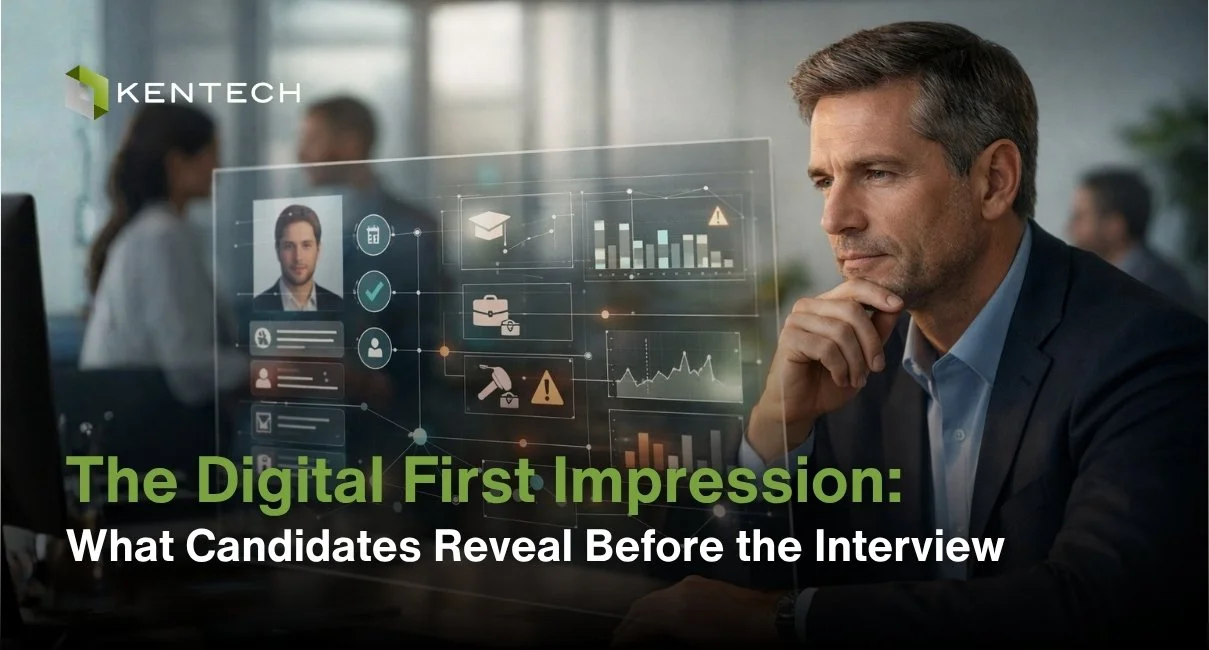
Hiring decisions are increasingly shaped long before a résumé is reviewed or an interview is scheduled. Digital footprints, credential records, and behavioral signals now form an early narrative about a candidate’s readiness, reliability, and risk profile. For organizations operating in enterprise, education, and government environments, this shift carries significant consequences. Trust, safety, and compliance depend on understanding who a candidate is beyond polished application materials. The central challenge is no longer whether background screening matters, but how organizations interpret and act on early signals responsibly. A digital-first hiring environment demands smarter, context-driven background intelligence that protects institutions while respecting individuals.
Where Hidden Risks Quietly Emerge
Modern hiring risk rarely announces itself in obvious ways. It often lives in omissions, inconsistencies, or misunderstood data points that surface only when information is reviewed in isolation. Traditional background checks were designed for a slower labor market, where time allowed for sequential verification and manual review. Today, compressed hiring timelines and remote workflows increase the likelihood that material risks are missed or misinterpreted.
Many organizations still rely on outdated assumptions about what a background check covers and what it actually reveals. This gap creates exposure across safety, reputation, and regulatory compliance, particularly in sectors serving vulnerable populations or handling sensitive data.
Common risk areas that frequently go unexamined include:
Identity discrepancies caused by name variations, address history gaps, or incomplete documentation.
Criminal record misinterpretation, where context, recency, or jurisdictional differences are ignored.
Employment and education verification delays that lead to provisional hiring without confirmation.
Digital behavior signals, such as public online activity, that may indicate policy misalignment or reputational risk when viewed without proper safeguards.
Overreliance on binary pass-fail outcomes that fail to reflect nuanced risk profiles.
Compounding these risks are persistent myths surrounding background checks. One common myth is that a clean criminal record equals low risk, when factors like falsified credentials or undisclosed employment gaps may be more predictive in certain roles. Another misconception is that background screening is inherently punitive, rather than a tool for informed, fair decision-making when applied consistently. These misunderstandings limit the strategic value of screening and reduce it to a compliance checkbox rather than a governance function.
Reframing Trust Through Contextual Intelligence
KENTECH approaches background screening as an intelligence process, not a transaction. Its IQ product, SocialIQ, reflects a modern philosophy that evaluates information holistically while aligning with ethical, legal, and mission-driven standards. Rather than flooding decision-makers with raw data, the focus is on relevance, context, and proportionality.
A comprehensive background check is not a single action but a constellation of factors that together form a credible picture. These factors include identity verification, criminal history, employment and education confirmation, professional license validation, and appropriate review of publicly available online presence. When integrated intelligently, these elements reduce false positives and support fair chance hiring principles.
KENTECH’s modern approach emphasizes:
Context-aware analysis that distinguishes between historical data and present-day risk.
Role-specific screening criteria aligned with organizational values and regulatory requirements.
Technology-enabled workflows that accelerate verification without sacrificing accuracy.
Transparent reporting that supports defensible, auditable hiring decisions.
Ethical use of digital data, ensuring privacy, consent, and relevance remain central.
By addressing long-standing myths directly, KENTECH reframes background checks as protective rather than exclusionary. A prior record does not automatically define a candidate, just as a credential alone does not guarantee integrity. The value lies in synthesis, understanding how multiple signals interact within the context of a specific role and environment.
Building Safer Growth With Purpose
As organizations scale, the cost of a single mis-hire increases. Safety incidents, compliance violations, and reputational damage can undermine years of progress and erode public trust. At the same time, overly rigid screening practices can restrict access to opportunity and conflict with diversity and inclusion commitments. The balance between vigilance and fairness is where modern background intelligence proves essential.
KENTECH supports organizations in achieving this balance by embedding purpose into process. SocialIQ enables hiring teams to move beyond surface-level checks and toward informed judgment, grounded in data but guided by values. This approach is particularly critical in education and government sectors, where decisions impact communities, students, and public confidence.
A digital first impression is unavoidable in today’s hiring landscape. What matters is how organizations interpret that impression and whether they are equipped to separate meaningful insight from noise. By treating background screening as a strategic capability rather than an administrative hurdle, organizations can expand their workforce with confidence, consistency, and integrity. The future of hiring belongs to those who understand that trust is built through context, not assumptions, and that safer growth begins with smarter insight.