
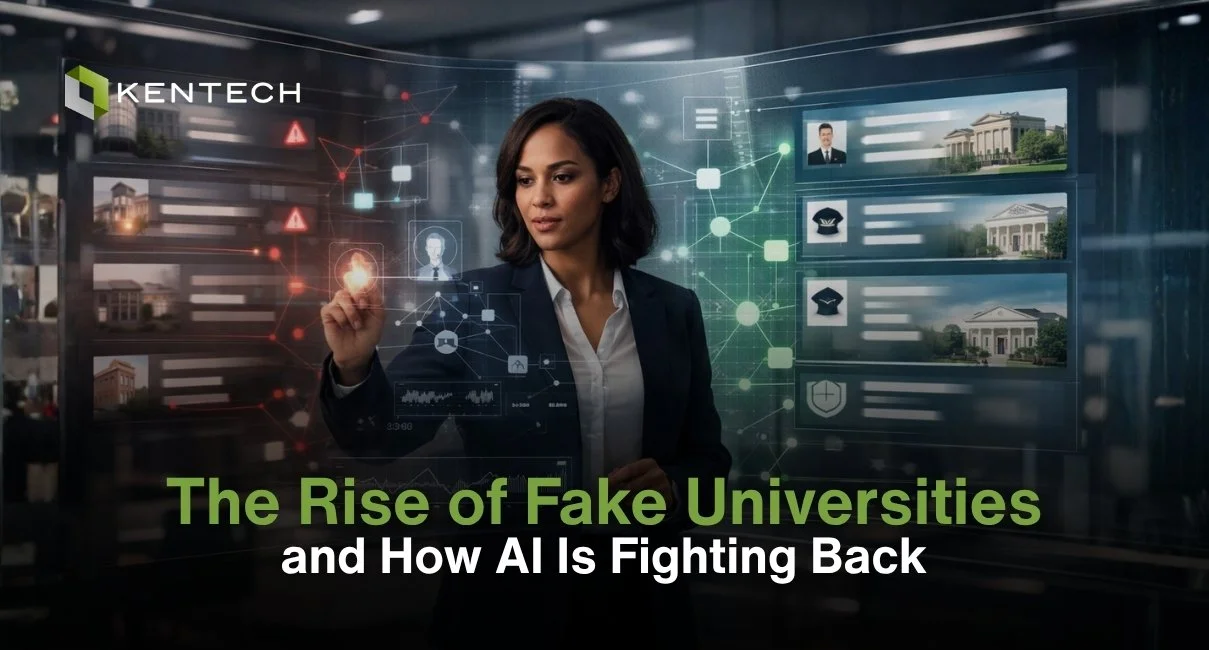
Credential fraud is no longer a fringe concern reserved for isolated bad actors. It has become a systemic risk affecting employers, academic institutions, and government agencies worldwide. The rapid expansion of online education, combined with global hiring and credential portability, has made it easier than ever for diploma mills and fake universities to present themselves as legitimate. At the same time, traditional verification methods have struggled to keep pace with the scale and sophistication of this problem. The result is a growing trust gap where resumes look credible, credentials appear polished, and yet the underlying qualifications may be entirely fabricated. Addressing this challenge requires a modern, intelligence-driven approach to background screening, especially when education verification is central to workforce integrity.
When Credentials Become a Liability
Fake universities and unaccredited programs pose serious risks across sectors. In enterprise environments, unverified degrees can lead to unqualified hires in critical roles, exposing organizations to compliance failures, operational errors, and reputational damage. In education, fraudulent credentials undermine academic standards and devalue legitimate achievements. In government, the consequences can be even more severe, affecting public trust, security, and service delivery.
The risk is amplified by persistent myths surrounding background checks. One common misconception is that education verification is a simple checkbox exercise. Another is that all institutions listed on a resume are inherently legitimate if they appear professional online. In reality, the background screening process is multifaceted, and education verification is one of its most complex components.
Several factors make this challenge difficult to manage at scale:
The global proliferation of diploma mills that mimic real institutions with convincing websites and documentation.
Inconsistent accreditation standards across countries and regions.
Manual verification processes that are slow, fragmented, and prone to human error.
Outdated databases that fail to capture newly emerged or dissolved institutions.
Assumptions that criminal checks alone are sufficient to assess candidate risk.
A comprehensive background check extends far beyond criminal history. It includes identity validation, employment history, education verification, professional license confirmation, and ongoing compliance considerations. Treating any single factor in isolation creates blind spots. Education fraud thrives in those gaps, where speed is prioritized over accuracy and where verification relies on static lists instead of dynamic intelligence.
Intelligence-Driven Verification At Scale
To counter these risks, background screening must evolve from reactive validation to proactive intelligence. KENTECH has approached this challenge by integrating advanced analytics, artificial intelligence, and human expertise into its IQ product suite, including DegreeIQ. Rather than relying solely on manual outreach or limited accreditation lists, this approach evaluates educational credentials within a broader risk and context framework.
DegreeIQ is designed to assess the legitimacy of academic institutions and credentials with greater depth and precision. By leveraging AI-driven data analysis, it identifies patterns associated with diploma mills, unaccredited programs, and misrepresented degrees. This does not eliminate human judgment. Instead, it augments investigative teams with tools that surface risk indicators faster and more consistently.
A modern education verification strategy incorporates several critical elements:
Continuous monitoring of global accreditation bodies and regulatory changes.
Pattern recognition to detect anomalies in institution names, locations, and credential formats.
Cross-referencing education data with identity and employment histories.
Escalation pathways where AI flags potential fraud for expert review.
Transparent reporting that supports compliance and audit readiness.
This approach also helps dispel another common myth: that technology replaces due diligence. In practice, the most effective background screening combines automation with accountability. AI accelerates discovery and reduces noise, while trained professionals interpret findings and apply context. For enterprise, education, and government clients, this balance is essential to making defensible decisions.
By embedding education verification within a broader screening ecosystem, KENTECH supports organizations in understanding not just whether a degree exists, but whether it is meaningful, credible, and aligned with role requirements. This is particularly important as remote hiring and international talent pools continue to expand.
Trust, Verification, And The Future Of Credentials
As credential fraud becomes more sophisticated, trust must be earned through rigor rather than assumed through appearance. Fake universities exploit the perception of legitimacy, counting on outdated processes and time constraints to slip through. The future of background screening lies in adaptive systems that learn, update, and respond to emerging threats without sacrificing fairness or transparency.
Education verification is not about exclusion. It is about integrity. When organizations verify credentials accurately, they protect qualified candidates, uphold standards, and reinforce public confidence. DegreeIQ reflects a broader shift toward intelligence-led screening, where each factor of a background check contributes to a holistic understanding of risk and qualification.
The rise of fake universities is a reminder that credentials alone are not proof. Verification is the proof. By combining advanced technology with principled investigation, organizations can move forward with confidence, knowing that trust is built on evidence, not assumption.