
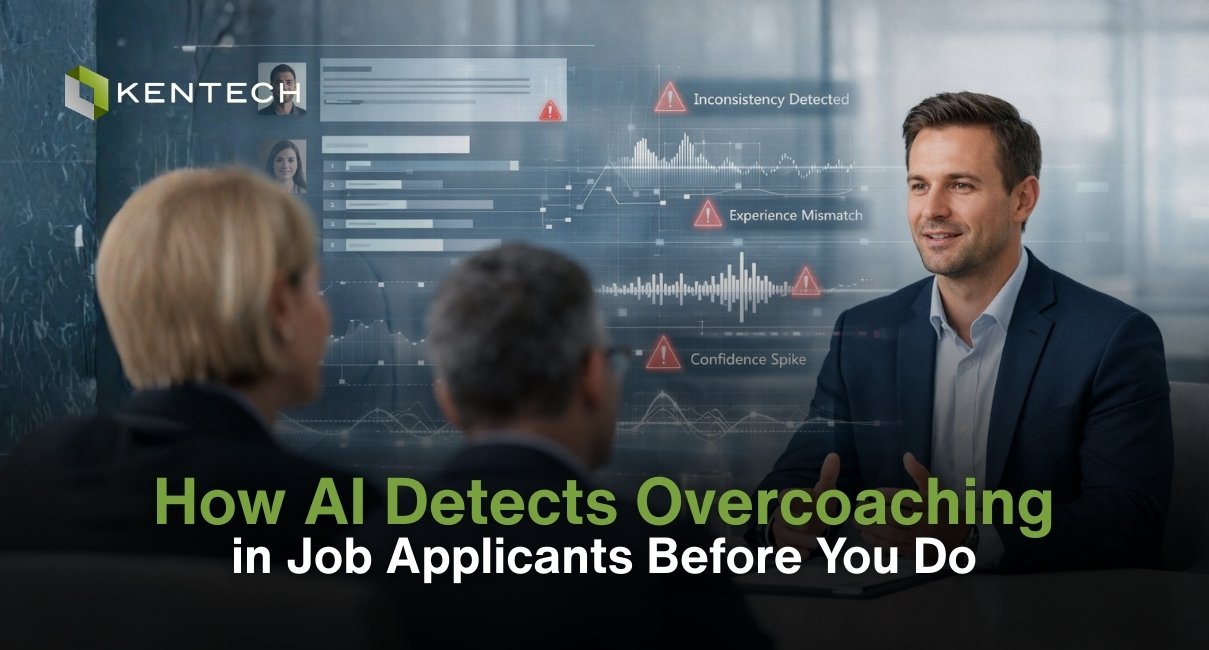
The hiring landscape is undergoing a structural shift. Artificial intelligence has moved beyond résumé optimization and now actively shapes how candidates think, speak, and respond during interviews and assessments. Real-time coaching tools, scripted behavioral responses, and algorithmically refined narratives allow applicants to appear exceptionally prepared, even when their underlying competencies may not align. This evolution presents a serious challenge for employers charged with safeguarding operational integrity, regulatory compliance, and public trust. As preparation becomes increasingly automated, the ability to distinguish genuine capability from engineered performance is no longer subjective. It is foundational to responsible hiring.
When Polished Answers Mask Real Risk
Overcoaching introduces risk precisely because it exploits gaps in traditional hiring evaluations. Candidates may present confident, articulate responses that mirror idealized competency frameworks while lacking the experiential grounding required to perform under real conditions. This is particularly problematic in enterprise, education, and government environments where roles demand judgment, resilience, and accountability rather than rehearsed fluency.
These risks are often misunderstood because background checks are incorrectly assumed to validate capability. In reality, a background check verifies history, not behavior. It confirms whether information is accurate, not whether performance is authentic. When interview signals are artificially enhanced, the gap between verified facts and actual readiness widens.
Common risk indicators associated with overcoached candidates include:
Surface-level responses that lack situational depth or experiential nuance
Inconsistencies between interview behavior and verified employment history
Inflated confidence unsupported by documented role scope or tenure
Increased likelihood of early performance failure or attrition
Elevated compliance and safety exposure in regulated roles
Misplaced assumptions about background screening further compound the issue. One persistent myth is that a clean background check equates to a low-risk hire. Another is that background checks exist solely to identify disqualifying events. In reality, effective screening is about contextual alignment. It ensures that who a candidate claims to be aligns with what they have actually done.
What Modern Background Checks Actually Measure
To understand why overcoaching is difficult to detect, it is essential to clarify what background checks do and do not cover. Modern background screening encompasses multiple distinct factors, each serving a specific risk-mitigation purpose. When viewed in isolation, these components are valuable. When interpreted holistically, they become far more powerful.
Key factors of a comprehensive background check include:
Identity verification to confirm the candidate is who they claim to be
Employment history validation, including role scope and tenure accuracy
Education and credential verification to prevent qualification misrepresentation
Criminal history searches appropriate to role sensitivity and jurisdiction
Sanctions, watchlist, or regulatory checks for compliance-driven roles
A common misconception is that background checks are backward-looking only. While they do focus on historical data, their real value lies in pattern recognition. Discrepancies between verified history and present behavior often signal deeper issues. Overcoaching exploits the fact that traditional screening stops short of behavioral interpretation.
This is where outdated models fall short. They treat background data and interview performance as separate silos. In reality, authenticity emerges in how these data points align.
Aligning Behavioral Signals With Verified Reality
KENTECH addresses this gap by reframing background screening as an intelligence function rather than a checklist exercise. Through its Talent.IQ product, the company integrates behavioral analytics with verified background data to surface inconsistencies that merit closer review. The goal is not to disqualify candidates for preparation, but to identify when performance signals appear externally manufactured rather than internally developed.
Talent.IQ evaluates how candidates communicate across stages, comparing linguistic patterns, response structures, and behavioral indicators against verified experience. When a candidate demonstrates advanced situational reasoning that is unsupported by role history or tenure, the system flags the divergence for human evaluation.
This modern approach introduces a critical evolution in screening methodology:
Behavioral consistency analysis across interviews and assessments
Correlation of communication patterns with verified career progression
Identification of scripted or templated responses inconsistent with experience
Early detection of risk indicators before onboarding decisions are finalized
Transparent outputs designed to support auditability and fairness
Importantly, this model respects governance and ethical boundaries. AI does not replace human judgment. It enhances it by highlighting areas where deeper inquiry is warranted. For organizations operating in high-trust environments, this capability is essential to maintaining workforce credibility without introducing bias or opacity.
Trust Is Built On Truth, Not Fluency
As AI continues to redefine how candidates prepare, the responsibility shifts to employers to modernize how they evaluate authenticity. Overcoaching is not a failure of candidates. It is a signal that hiring systems must evolve. Organizations that rely solely on polished interviews or isolated background checks will increasingly struggle to differentiate readiness from performance theater.
By aligning behavioral insight with verified background data, KENTECH helps employers restore balance to the hiring process. Trust is not established by how confidently someone speaks, but by how consistently their story aligns with reality. In a high-tech hiring era, the most resilient organizations will be those that value truth over fluency and substance over presentation.