
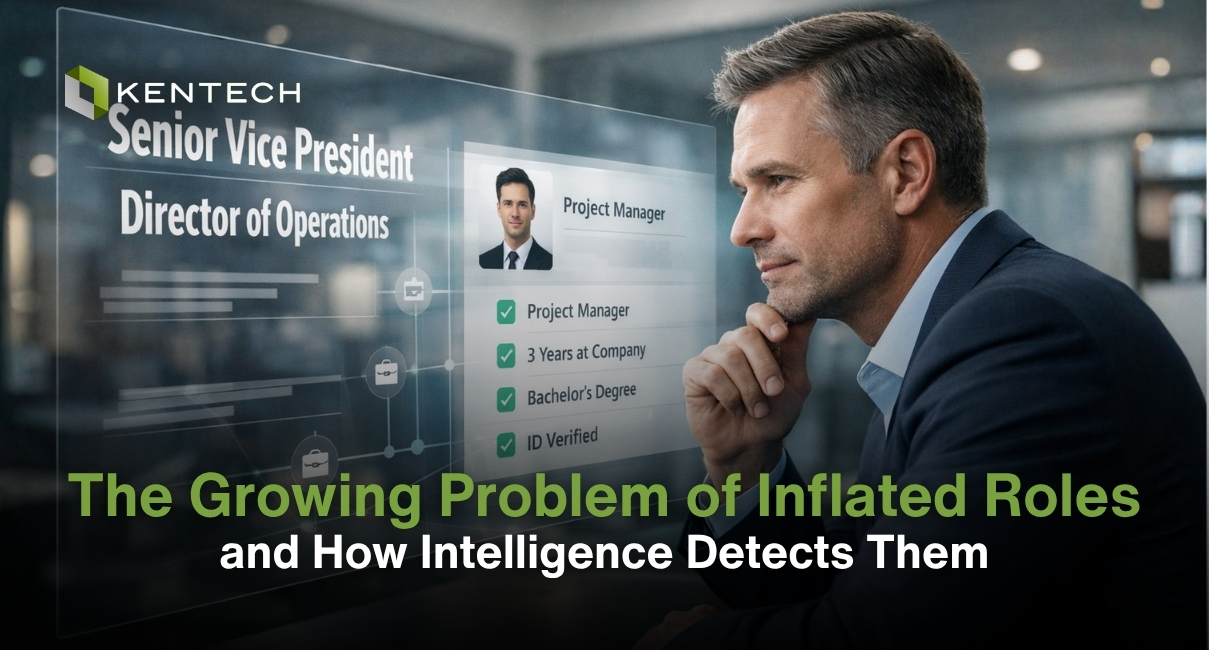
In an era defined by competitive hiring, rapid career mobility, and digital resumes, role inflation has become a quiet but consequential trend. Candidates increasingly embellish job titles, responsibilities, or tenure to keep pace with perceived market expectations. While not always malicious, these exaggerations can distort hiring decisions, expose organizations to risk, and undermine institutional trust. For enterprise, education, and government employers, where credibility and compliance are non-negotiable, the challenge is no longer whether resume inflation exists, but how reliably it can be identified. The central truth is clear. Modern workforce risk demands modern intelligence that can separate narrative from fact without sacrificing fairness or speed.
When Titles Outpace Truth
Inflated roles introduce risk at multiple levels of an organization. A mismatched hire can disrupt team performance, weaken leadership pipelines, and create compliance exposure, especially in regulated or mission-critical environments. In education and government settings, inaccurate role representation can also affect public trust and operational integrity. What makes the issue more complex is that inflation is rarely obvious. It often appears as subtle inconsistencies rather than outright falsehoods.
Many organizations still rely on outdated or fragmented verification processes that struggle to detect these nuances. Manual checks, incomplete data sources, or overreliance on self-reported information leave gaps that sophisticated misrepresentation can slip through. Compounding the problem are persistent myths about background screening that create false confidence or unnecessary hesitation.
Common risks and misconceptions include:
Assuming job titles are standardized across industries or employers.
Believing longer resumes equate to deeper experience.
Treating employment verification as a binary yes or no check rather than a contextual analysis.
Overlooking discrepancies in dates, scope of responsibility, or reporting structure.
Believing background checks only focus on criminal history.
In reality, employment verification is only one factor within a broader background check ecosystem. A comprehensive screen can include identity validation, education verification, professional license checks, criminal history searches at multiple jurisdictional levels, and ongoing compliance monitoring. When any one of these elements is isolated or minimized, the overall picture becomes less reliable. Role inflation thrives in those blind spots.
Intelligence That Sees The Full Picture
Addressing inflated roles requires more than faster checks. It requires contextual intelligence that understands how data points relate to one another. KENTECH approaches this challenge through EmployIQ, an advanced screening solution designed to bring clarity, consistency, and insight to employment verification and beyond. Rather than treating background checks as a transactional step, EmployIQ supports a risk-aware hiring philosophy grounded in accuracy and accountability.
At its core, EmployIQ integrates multiple verification factors into a single, intelligent workflow. Employment history is analyzed alongside education, credentials, and identity data to surface inconsistencies that may otherwise appear plausible in isolation. This approach recognizes that role inflation often emerges through patterns, not single data points.
Key elements of a modern background check through EmployIQ include:
Employment verification that assesses title, dates, and scope of responsibility.
Education verification aligned to role requirements and institutional standards.
Criminal history searches tailored to jurisdictional relevance.
Identity validation to ensure records accurately match the individual.
Compliance safeguards that align with FCRA and sector-specific regulations.
Equally important is dispelling myths that hinder effective screening. One common misconception is that advanced screening technologies are inherently invasive or biased. In practice, intelligence-driven platforms are designed to enhance fairness by applying consistent criteria and reducing subjective judgment. Another myth is that deeper screening slows hiring. When intelligently automated, comprehensive checks can actually reduce delays by minimizing rework and follow-up inquiries.
KENTECH positions EmployIQ not as a gatekeeper, but as a decision-support tool. By providing verified context, it empowers hiring teams to make informed choices while maintaining transparency and respect for candidates. This balance is especially critical in education and government sectors, where ethical standards and public accountability intersect.
Trust Built On Verified Context
The challenge of inflated roles is ultimately a challenge of trust. Organizations must trust that the people they bring into critical roles are prepared, qualified, and aligned with their mission. Candidates must trust that screening processes are fair, accurate, and purpose-driven. Intelligence-led background screening bridges that gap by replacing assumptions with verified context.
As workforce narratives continue to evolve, the ability to distinguish potential from exaggeration will define resilient institutions. By embracing comprehensive screening factors, rejecting outdated myths, and applying intelligence where it matters most, organizations can protect their mission without compromising opportunity. The takeaway is straightforward. Trust is not built on titles alone. It is built on verified truth, applied consistently, and guided by values that place integrity at the center of every decision.