
Creating a safe and productive workplace requires more than hiring qualified employees. Organizations also need policies that help manage workplace risks while treating candidates and employees consistently.
For many businesses, drug screening for employers is one component of a broader background screening and workforce risk management strategy.
Drug screening can be particularly relevant for positions involving safety-sensitive responsibilities, commercial driving, heavy equipment, healthcare, transportation, manufacturing, or other roles where impairment could create significant risks.
However, an effective testing program is not simply about ordering a test.
Employers need to consider when testing should occur, which positions should be included, how policies are communicated, how results are handled, and what legal requirements apply.
A thoughtful program can help organizations support workplace safety while creating a consistent and professional candidate experience.
Why Employers Use Drug Screening
Drug screening may help organizations identify potential substance-related risks relevant to certain positions.
For safety-sensitive jobs, impairment can potentially affect an employee's ability to operate equipment, drive vehicles, interact with customers, or perform critical responsibilities.
A well-designed program can therefore complement other employment screening services such as identity verification, criminal background checks, employment verification, and professional credential verification.
The purpose should be connected to legitimate business and safety considerations.
Drug screening should not be viewed as a substitute for good management, employee support, workplace safety policies, or effective supervision.
Instead, it can be one layer within a comprehensive workforce risk strategy.
Pre-Employment Drug Screening
Many employers incorporate drug testing into the pre-employment process for positions where testing is legally permitted and appropriate.
Pre-employment screening can help organizations establish consistent hiring standards before a candidate begins working.
The process should be clearly explained to applicants.
Candidates should understand that testing may be required as part of the hiring process and should receive appropriate disclosures and authorizations where required.
Consistency is critical.
If an employer requires drug screening for one candidate applying for a particular position, comparable candidates should generally be subject to the same policy.
This helps create a fairer and more defensible screening process.
Define Which Positions Require Testing
Not every position necessarily carries the same level of workplace risk.
Organizations should identify roles where drug screening is relevant based on legitimate business, safety, regulatory, or contractual requirements.
Potential examples may include:
Commercial drivers
Heavy equipment operators
Certain manufacturing positions
Safety-sensitive workers
Healthcare roles
Certain government or regulated positions
Jobs involving hazardous environments
The appropriate testing requirements can vary significantly by industry and jurisdiction.
Employers should therefore develop role-specific policies rather than automatically applying identical requirements to every employee.
Create a Clear Written Policy
A successful drug screening program begins with a clear policy.
The policy should explain important elements of the program, including when testing may occur, which positions are covered, how employees will be notified, and how results are handled.
Depending on the organization, a policy may address:
Pre-employment testing
Post-incident testing
Random testing
Reasonable-suspicion testing
Return-to-duty testing
Follow-up testing
Applicable regulatory requirements
Employees should be given appropriate information about the policy and understand the organization's expectations before testing occurs.
Clear communication can reduce confusion and create greater consistency.
Understand Applicable Laws
Drug testing is subject to legal requirements that can vary depending on location, industry, employee classification, and the type of testing involved.
Employers should understand applicable federal, state, and local requirements before implementing or changing a testing program.
Certain industries may also operate under specific regulatory requirements.
Organizations should be particularly careful when dealing with marijuana or other substances because laws and employment rules can differ significantly between jurisdictions.
A screening program that is appropriate in one location may not be appropriate in another.
For complex situations, employers should work with qualified legal and compliance professionals.
Protect Candidate and Employee Information
Drug screening involves sensitive personal information.
Employers and screening providers should use appropriate procedures for collecting, transmitting, storing, and accessing testing information.
Access should generally be limited to authorized individuals with a legitimate business need.
Organizations should also establish appropriate retention and disposal procedures.
Data security is not simply an IT concern. It is an important part of responsible workforce screening.
Handle Results Consistently
A drug screening result should be handled according to established procedures.
Organizations should avoid making assumptions based on incomplete or unverified information.
Screening providers, medical review processes, and applicable legal requirements may play important roles in interpreting results.
Employers should also have a clear process for communicating relevant outcomes to candidates or employees and handling any required review or dispute process.
Consistency is particularly important.
Policies should not change based on the identity of the candidate, department, seniority, or personal relationship.
Combine Drug Screening With Broader Background Screening
Drug testing provides only one piece of information.
A stronger employment screening strategy can combine drug screening with other relevant services, including:
Criminal background checks
Employment verification
Education verification
Identity verification
Professional license verification
Motor vehicle record checks
Credit checks for appropriate positions
Civil record searches
Cyber-related screening where relevant
This layered approach gives employers a broader understanding of workforce risk.
The exact combination should depend on the position and legitimate business requirements.
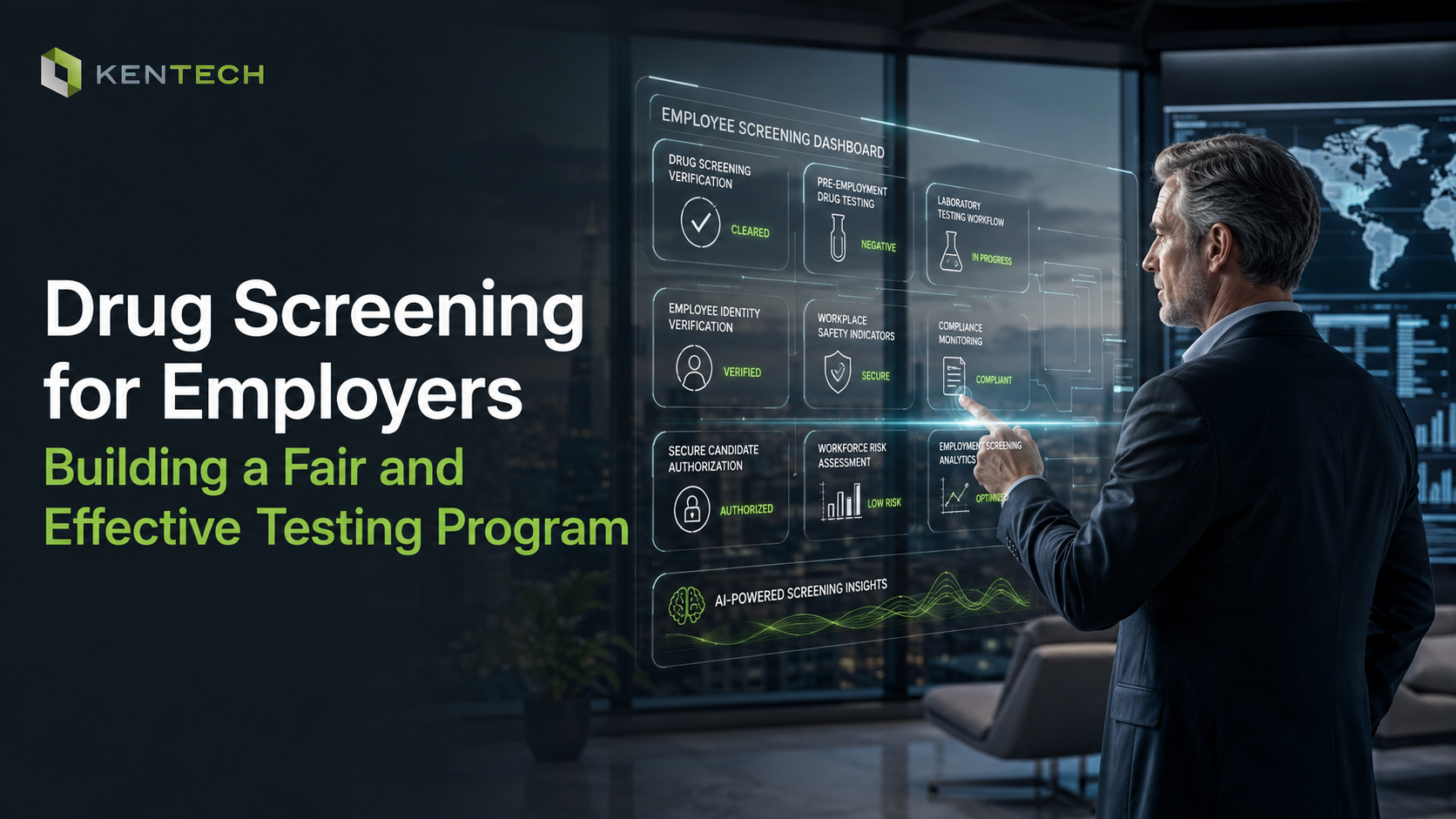
Use Technology to Improve Screening Management
Modern screening platforms can help organizations manage testing workflows more efficiently.
Digital processes can simplify candidate authorization, status tracking, documentation, and communication.
For organizations hiring large numbers of employees across multiple locations, centralized screening management can help maintain consistency.
Technology can also help HR and compliance teams monitor screening status and maintain organized records.
However, automation should support—not replace—human oversight.
Sensitive employment decisions require appropriate review and judgment.
Building a Fair Program
Fairness should be central to any employment drug screening program.
Employers should establish objective criteria, apply policies consistently, communicate requirements clearly, and follow applicable laws.
A strong program should protect the organization without unnecessarily creating barriers for qualified candidates.
Drug screening works best when it is treated as one component of a broader workforce strategy rather than as a standalone hiring filter.
Conclusion
Drug screening for employers can play an important role in workplace safety and workforce risk management, particularly for safety-sensitive and regulated positions.
The most effective programs are built around clear policies, consistent application, appropriate testing procedures, responsible data handling, and compliance with applicable laws.
When combined with comprehensive background screening, drug testing can help employers make more informed decisions while building safer and more reliable workforces.
KENTECH provides employment screening and workforce intelligence solutions designed to help organizations manage hiring risk, verify candidate information, and build stronger workforce screening programs.