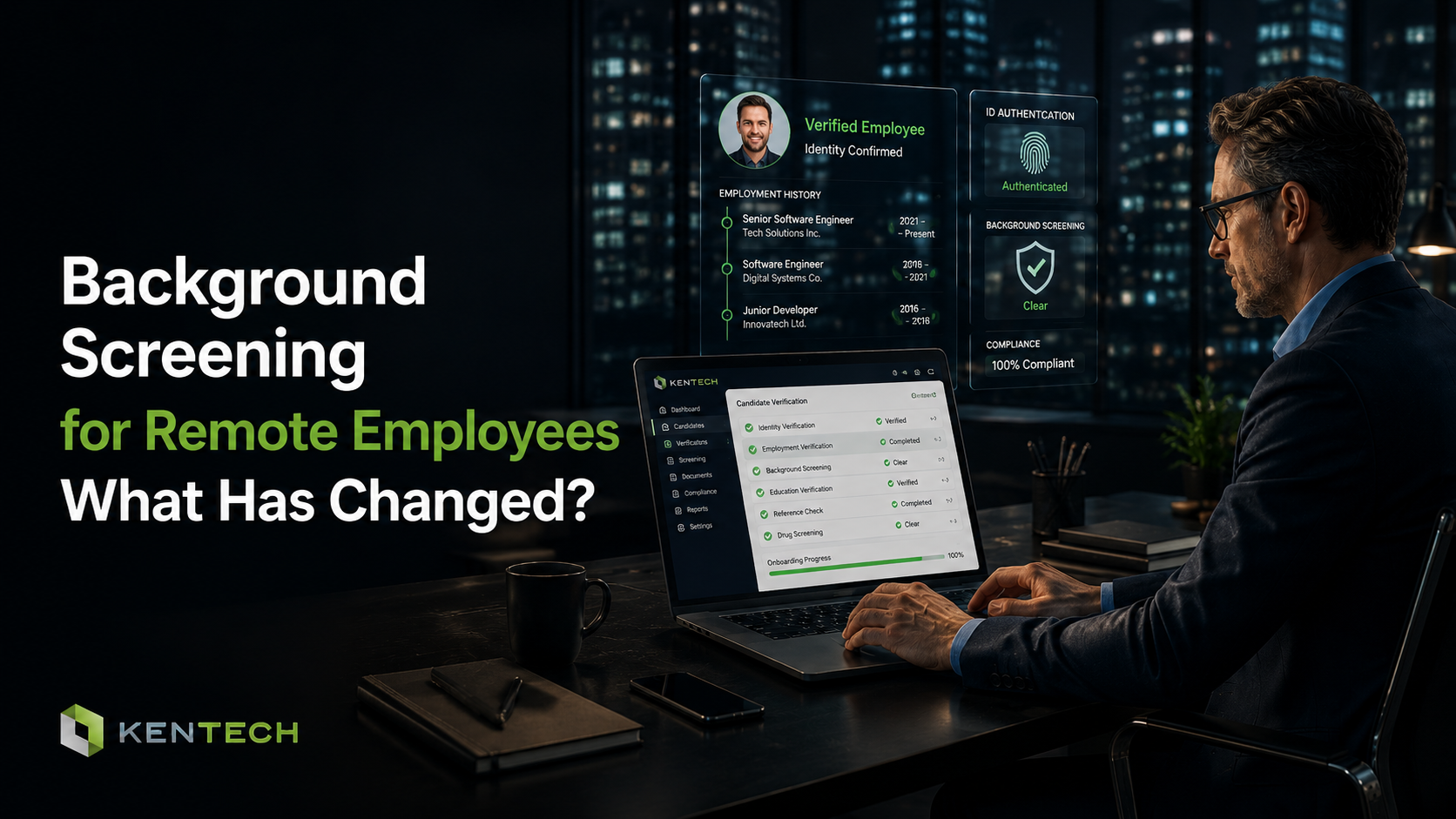
Remote work has transformed the modern workplace.
Employees can now work from home, coworking spaces, different cities, and even different countries while collaborating with organizations they may never physically visit.
For employers, this flexibility creates access to a much larger talent pool. Companies can recruit specialized professionals without requiring relocation, expand into new markets, and build distributed teams across multiple locations.
But remote hiring also introduces a new question:
How do you confidently verify someone you may never meet in person?
Traditional hiring processes often relied on face-to-face interviews, physical documents, office visits, and location-based employment practices. Remote recruitment has changed many of those assumptions.
As a result, background screening for remote employees has become increasingly important.
Organizations now need reliable ways to verify candidate identities, employment histories, education, professional credentials, and other relevant information while managing privacy, security, and compliance requirements across different jurisdictions.
Remote screening isn't necessarily about doing more screening.
It's about doing the right screening in a more digital, distributed, and increasingly global hiring environment.
Why Remote Hiring Has Changed Background Screening
Before remote work became widespread, many organizations had a relatively straightforward hiring environment.
A candidate would apply for a position, attend an interview at a company location, provide identification, complete onboarding paperwork, and eventually begin working at the employer's facility.
Remote hiring changes that process.
A candidate may complete the entire recruitment process without ever entering a company office.
This creates several challenges:
How is the candidate's identity verified?
How are documents authenticated?
How are employment records confirmed?
How are international credentials verified?
How does an employer protect sensitive screening information?
How does the organization maintain consistent screening policies across different locations?
These questions have made digital identity verification and remote employment screening increasingly important components of modern workforce management.
Identity Verification Has Become More Important
Identity verification is one of the most important components of remote hiring.
When employers and candidates do not meet face-to-face, organizations need reliable methods for confirming that the individual applying for the position is actually the person being screened.
Identity verification may involve appropriate checks of:
Government-issued identification
Name and date of birth
Address information
Identity documents
Other authorized identifying information
Digital verification technologies can make this process faster and more convenient for remote candidates.
However, employers should ensure that identity verification methods comply with applicable privacy and employment regulations.
The objective is simple:
Verify the right person before making the hiring decision.
Remote Hiring Has Expanded the Need for Digital Verification
Remote recruitment has accelerated the adoption of digital employment screening.
Candidates can now authorize screening, submit information, verify credentials, and complete portions of onboarding electronically.
This creates a more streamlined hiring experience while allowing employers to manage screening processes across geographically distributed workforces.
Digital workflows can help organizations:
Reduce paperwork
Accelerate candidate onboarding
Centralize screening records
Improve communication
Track verification status
Manage candidates across multiple locations
For organizations hiring hundreds or thousands of remote employees, centralized screening technology can significantly improve operational efficiency.
Employment Verification Is More Complicated—and More Important
Remote work has also changed the nature of employment verification.
A candidate may have worked remotely for companies located in several different cities or countries. They may have held multiple contract positions, worked through staffing agencies, or operated as an independent contractor.
These arrangements can make employment histories more complex to verify.
Employers may need to confirm:
Previous employers
Dates of employment
Job titles
Employment status
Relevant professional experience
Verification helps organizations determine whether the candidate's professional history aligns with the requirements of the position.
This can be particularly important for remote positions where employers may have fewer opportunities to independently observe a candidate's professional capabilities before hiring.
Education Verification Matters in a Remote Hiring Environment
Remote hiring has expanded access to global talent, which means organizations increasingly encounter candidates with educational credentials from different countries and institutions.
Education verification can help confirm:
Degree earned
Educational institution
Field of study
Graduation date
Professional certifications
Other relevant qualifications
This is especially important for positions where specific educational credentials are required.
Digital verification processes can make it easier for organizations to manage education checks remotely while maintaining organized records.
Remote Work Has Made International Hiring Easier
One of the biggest changes brought by remote work is the ability to hire talent from almost anywhere.
A company based in the United States may hire an employee who previously lived and worked in several countries.
That creates opportunities—but also additional screening challenges.
International background checks may involve:
International identity verification
Overseas employment verification
International education verification
Country-specific criminal record searches
Professional license verification
Sanctions screening
Every country has different laws, databases, privacy requirements, and recordkeeping practices.
Employers should therefore avoid assuming that domestic screening procedures will work internationally.
Global hiring requires a screening strategy that accounts for the laws and information availability of each jurisdiction.
Remote Employees Can Create New Security Considerations
Remote employees may have access to highly sensitive organizational resources from locations outside the traditional office environment.
Depending on their position, they may access:
Customer information
Financial records
Intellectual property
Proprietary software
Internal communications
Personal employee data
Confidential business documents
This makes workforce risk management increasingly important.
Background screening can form one layer of an organization's overall security strategy.
For higher-risk positions, employers may combine screening with:
Identity verification
Criminal background checks
Sanctions screening
Professional license verification
Continuous background monitoring
Access controls
Security training
Workforce intelligence
The goal is to create a layered approach to workforce security rather than relying on one screening service.
Continuous Background Monitoring for Remote Employees
Remote hiring has also increased interest in ongoing background monitoring.
A pre-employment background check provides information about a candidate at a particular point in time.
But remote employees may remain with an organization for years.
Circumstances can change after hiring.
Depending on the position and applicable laws, continuous monitoring can help organizations identify certain relevant developments after employment begins.
Potential monitoring categories may include:
Criminal record changes
Professional license changes
Sanctions information
Motor vehicle records
Regulatory developments
Continuous monitoring should be implemented carefully and consistently, with appropriate authorization and compliance procedures.
It should also be relevant to the position rather than treated as a one-size-fits-all requirement.
Compliance Is More Complicated for Remote Workforces
One of the biggest changes associated with remote employment is geographic complexity.
A company may have:
Employer → Employee → Screening Provider
operating across several different jurisdictions.
That means organizations may need to consider multiple sets of employment, privacy, and background screening requirements.
Employers should establish clear policies covering:
Candidate authorization
Required disclosures
Permitted screening information
Data storage
Data access
Data retention
Cross-border data transfers
Adverse employment decisions
Organizations should also periodically review their screening procedures as laws and business practices evolve.
For complex situations, employers should consult qualified legal and compliance professionals.
Remote Background Screening Should Be Consistent
Another important consideration is consistency.
Remote employees should not necessarily be subject to completely different screening standards simply because they work outside a traditional office.
Employers should develop objective screening criteria based on:
Position responsibilities
Industry requirements
Access to sensitive information
Regulatory obligations
Geographic considerations
Legitimate business needs
For comparable positions, consistent screening policies can help organizations maintain fairness and reduce compliance risks.
Common Mistakes Employers Make With Remote Screening
Several mistakes can undermine an otherwise strong remote hiring process.
Relying Only on a Résumé
A résumé provides candidate-reported information. Verification adds another layer of confidence.
Skipping Identity Verification
Remote hiring makes identity confirmation particularly important.
Treating International Candidates Like Domestic Candidates
International screening requirements can differ dramatically between countries.
Using Too Many Screening Services Without a Strategy
More screening isn't automatically better. Employers should focus on information relevant to the position.
Ignoring Data Privacy
Remote screening often involves digital transmission and storage of sensitive information.
Forgetting About Post-Hire Screening
For appropriate roles, ongoing monitoring may help organizations remain aware of relevant changes after hiring.
How Technology Is Shaping Remote Employee Screening
Technology is changing nearly every stage of the employment screening process.
Digital identity verification, automated workflows, secure candidate portals, electronic authorization, and workforce intelligence platforms allow employers to manage screening without requiring candidates to visit a physical office.
Artificial intelligence can also help organize large volumes of screening information and identify inconsistencies for further review.
However, technology should remain a tool rather than a replacement for professional judgment.
Human expertise remains important when interpreting results, resolving discrepancies, assessing context, and ensuring that screening decisions comply with applicable requirements.
The strongest remote screening programs combine:
Technology + Verification + Human Expertise + Compliance
Best Practices for Background Screening Remote Employees
Organizations can strengthen their remote screening programs by following several principles.
1. Verify Identity First
Make sure the screening process is connected to the correct individual.
2. Match Screening to the Position
Different roles require different levels of screening.
3. Verify Important Credentials
Confirm employment, education, licenses, and other qualifications relevant to the position.
4. Understand Geographic Requirements
Account for state, national, and international requirements when screening remote employees.
5. Protect Candidate Information
Use appropriate safeguards for sensitive personal and screening data.
6. Communicate With Candidates
Clearly explain the screening process and obtain required authorization.
7. Consider Continuous Monitoring
For appropriate positions, ongoing screening may provide additional workforce risk visibility.
8. Review Policies Regularly
Remote work and employment regulations continue to evolve. Screening programs should evolve with them.
The Future of Remote Employee Background Screening
Remote work is unlikely to disappear.
Instead, organizations are developing hybrid and distributed workforce models that combine office-based employees, remote employees, contractors, and international talent.
This means employment screening will increasingly need to operate across different locations and employment models.
Future screening programs will likely incorporate greater use of:
Digital identity verification
Artificial intelligence
Biometric authentication
Global employment verification
Continuous monitoring
Workforce intelligence
Automated compliance workflows
At the same time, organizations will need to maintain strong standards for privacy, security, transparency, and responsible data use.
The future of remote employee screening is therefore not simply about automation.
It is about creating secure, efficient, accurate, and compliant screening processes that work regardless of where employees are located.
Conclusion
Remote work has fundamentally changed the way organizations recruit, onboard, and manage employees.
As hiring becomes increasingly digital and geographically distributed, traditional background screening processes need to evolve as well.
Background screening for remote employees now requires greater attention to identity verification, digital documentation, international hiring, data privacy, and workforce security.
A comprehensive screening strategy can help employers verify candidate information while reducing certain hiring and workforce risks.
The most effective approach combines traditional employment screening with modern digital verification technologies and, where appropriate, continuous monitoring.
Ultimately, remote hiring should not mean reduced hiring standards.
It should mean smarter screening processes designed for the modern workforce.
By combining reliable verification, advanced technology, and experienced screening professionals, organizations can confidently build remote teams while protecting their people, information, reputation, and long-term business interests.
KENTECH helps organizations strengthen employment screening and workforce risk management with solutions designed for today's increasingly digital and distributed workforce.