
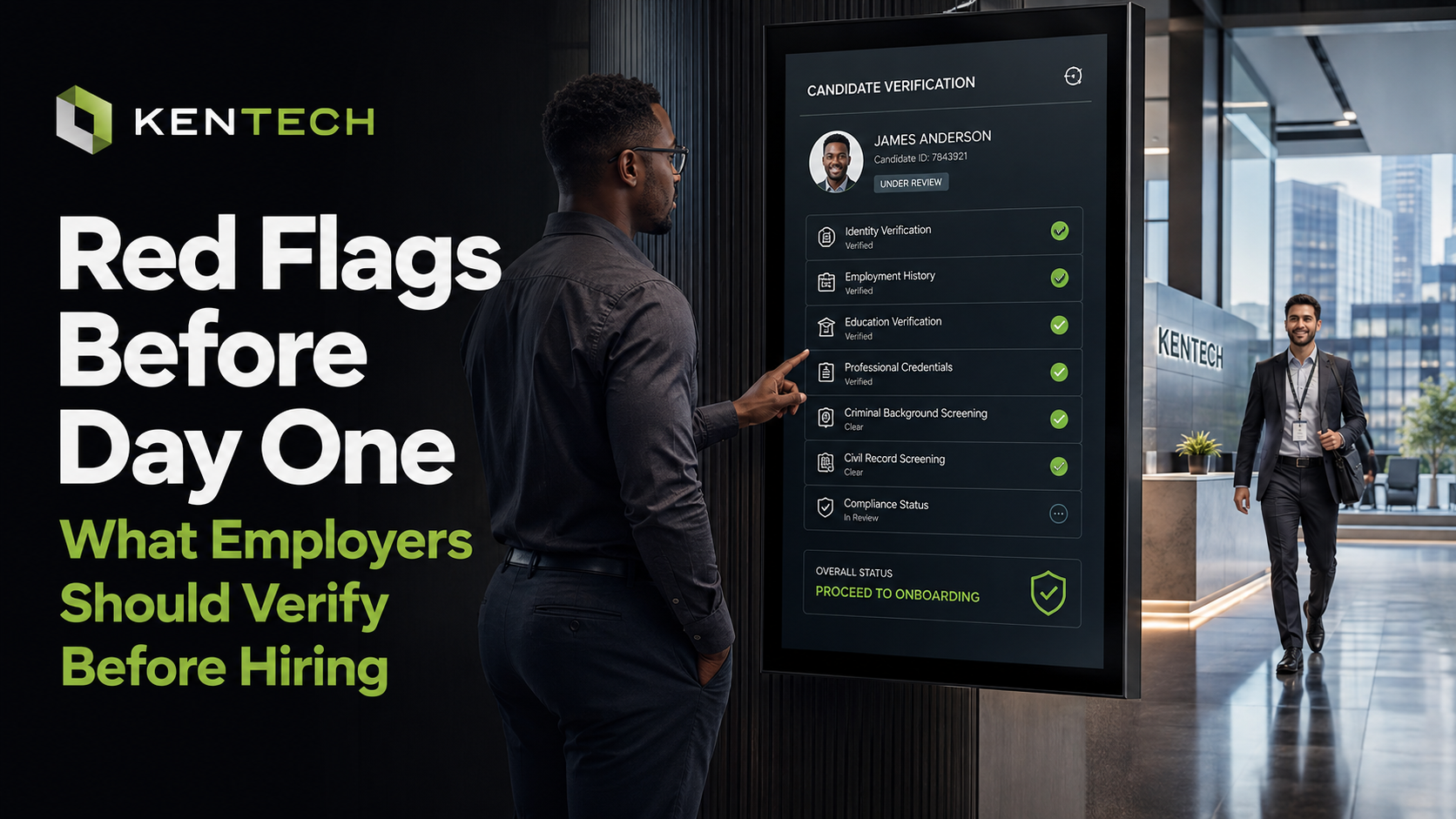
Hiring a new employee involves more than choosing the strongest resume.
Before someone receives access to company systems, represents the organization to customers, operates company vehicles, handles sensitive information, or takes responsibility for critical operations, employers may need to verify important details about their background.
A well-designed pre-employment background screening process can help identify inconsistencies before they become costly problems.
The goal isn't to assume every discrepancy represents intentional deception. Instead, verification gives employers an opportunity to identify information that deserves additional review before moving forward.
1. Identity Information
Identity verification should be one of the first steps in a screening process.
Employers need to know that the person being screened is the same individual who submitted the application.
Accurate identity information can also help ensure that subsequent background searches are associated with the correct person.
This is especially important as employers increasingly recruit candidates through online applications and remote hiring processes.
2. Employment History
A candidate's employment history can provide important insight into their experience.
Employers may want to verify previous employers, positions, dates of employment, or other relevant information.
Potential discrepancies can include significant differences between the information provided by the candidate and information that can be verified.
Again, a discrepancy isn't automatically a red flag.
There may be legitimate explanations. However, it can indicate that the employer should take a closer look before finalizing the hiring decision.
3. Education and Degrees
Educational qualifications are often an important part of a candidate's professional profile.
Employers may want to verify degrees, institutions, dates, fields of study, or other educational information relevant to the position.
For specialized roles, confirming educational credentials can be particularly important.
A candidate's degree or educational background may influence whether they meet the organization's stated requirements for a position.
4. Professional Credentials
Degrees aren't the only qualifications employers may need to verify.
Professional licenses, certifications, registrations, and other credentials may be critical for certain roles.
An employer should know whether a required credential exists and, where relevant, whether it remains valid.
Credential verification can help organizations avoid relying on outdated or inaccurate qualification information.
5. Criminal Background Information
For positions where criminal background screening is appropriate and legally permissible, employers may conduct relevant record searches.
The key is to use the information responsibly.
A criminal record does not automatically mean someone is unsuitable for employment. Employers should consider applicable laws, the nature of the position, the relevance of the information, and other required factors.
The purpose of screening is to provide information for a lawful and consistent decision-making process.
6. Civil Records
Civil records can provide another layer of information depending on the role and the employer's screening strategy.
Not every position requires civil record screening. However, certain employers may find relevant civil information useful when conducting a broader risk assessment.
The important principle is relevance.
Screening should focus on information that has a legitimate connection to the responsibilities and requirements of the position.
7. Driving History
For employees who drive as part of their job, a motor vehicle record check can be particularly important.
An employee may operate company vehicles, transport customers, visit client locations, or spend significant time on the road.
Driving history can help employers assess whether a candidate's driving record meets the organization's established requirements.
8. Credit Information for Appropriate Roles
For certain sensitive positions, employers may consider credit screening where legally permitted and relevant.
This can be particularly applicable to positions involving financial responsibilities, access to company funds, or other sensitive financial duties.
Credit information should never be treated as a universal measure of someone's character or suitability.
Instead, where applicable, it should be one component of a carefully designed screening process.
Red Flags Should Trigger Review—not Automatic Assumptions
One of the most important principles of background screening is understanding the difference between verification and judgment.
A discrepancy should not automatically become a hiring rejection.
An employment date may be slightly different because the candidate rounded the dates on their resume.
A credential may appear under a different name.
A record may belong to someone with similar identifying information.
The appropriate response is to investigate and clarify relevant information through a consistent process.
Consistency Is Critical
Employers should establish screening standards before beginning the hiring process.
For example, organizations may define which positions require employment verification, credential verification, criminal screening, credit screening, drug screening, or motor vehicle record checks.
Applying established standards consistently can help create a more structured hiring process.
It also helps prevent employers from changing screening requirements based on individual candidates.
A Strong Screening Process Starts Before Day One
The period between accepting an application and starting employment is an important opportunity for verification.
By the time a new employee arrives for their first day, the organization should have completed the appropriate screening steps required for the role.
A comprehensive approach may include:
Identity verification
Employment verification
Education verification
Credential verification
Criminal background screening
Civil record screening
Credit screening
Drug screening
Motor vehicle record checks
Not every employee needs every check.
The right combination depends on the position, business requirements, applicable laws, and legitimate risk considerations.
Turning Red Flags Into Better Information
Hiring decisions are easier to make when employers have reliable information.
Background screening doesn't eliminate uncertainty, but it can reduce the amount of unknown information surrounding a candidate.
Instead of relying entirely on a resume or interview, employers can build a more complete picture through appropriate verification.
That can help organizations identify inconsistencies earlier, improve hiring confidence, and establish a more structured process before an employee reaches day one.