
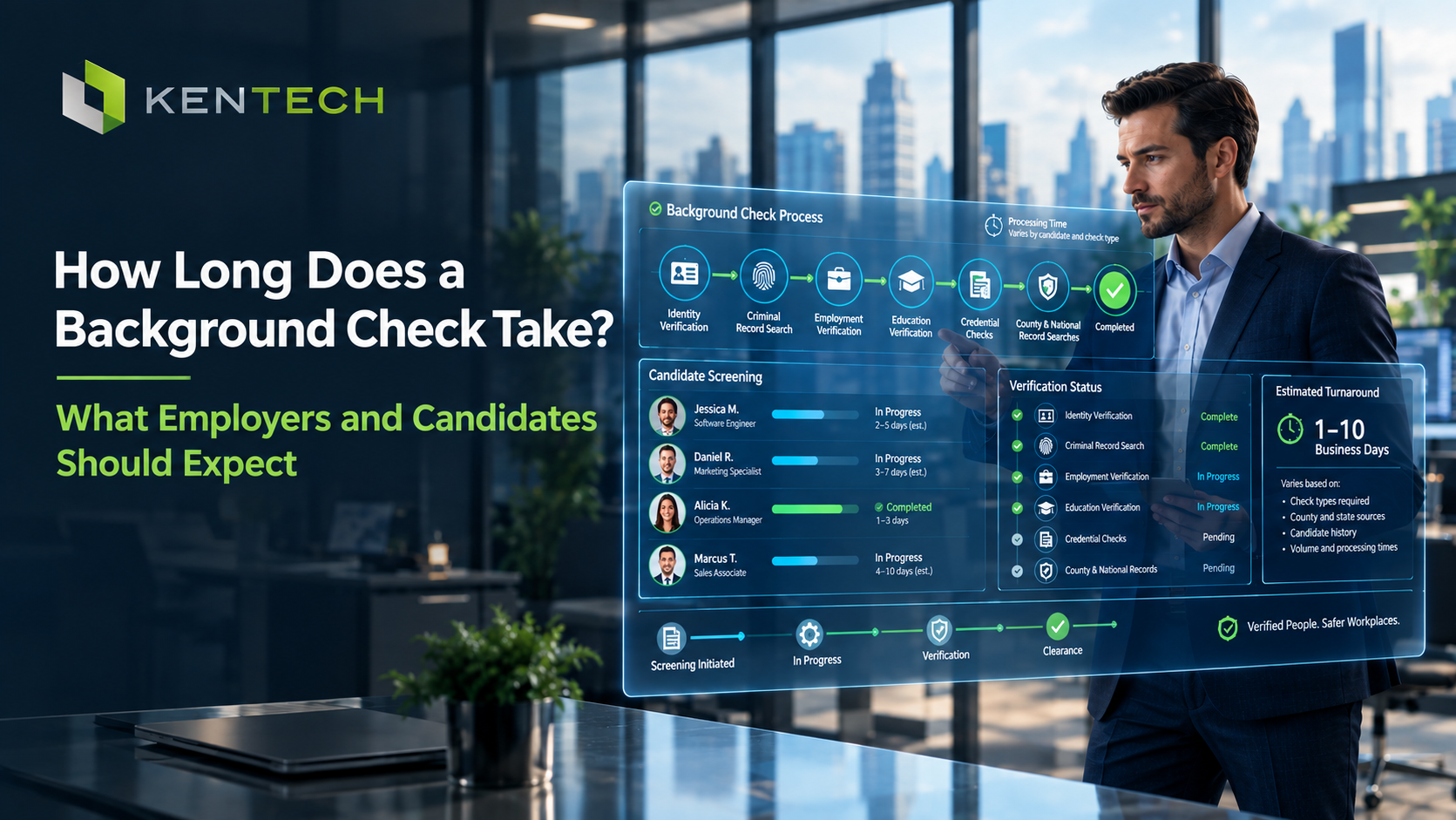
Every day a finalist waits on a background check is a day a competing employer can win them away. Yet the question "how long does a background check take?" rarely gets a straight answer. The honest one is that it depends on what you're checking, where the records live, and how clean the information going in is.
Here is a practical look at realistic timelines, the real reasons checks stall, and what you can do to keep hiring on schedule without cutting a single corner.
The Short Answer: One to Five Business Days for Most Checks
For a typical pre-employment background check, plan on roughly one to five business days. Some components return within hours. Others take longer because a person, a courthouse, or a foreign agency has to respond. A background check is only as fast as its slowest search, so a package with six components finishes when the last one does.
Typical Turnaround by Check Type
Timelines vary by jurisdiction and provider, so treat these ranges as planning guides rather than guarantees.
SSN trace and identity verification: Minutes to 1 day. Name mismatches can slow it down.
National criminal database search: Same day to 1 day. Common names may need manual review.
County and state criminal records: 1–3 business days. Courts that require manual retrieval add time.
Federal criminal and civil records: 1–3 business days. Searching multiple districts takes longer.
Employment verification: 2–5 business days. Slow HR departments and closed employers cause delays.
Education verification: 1–5 business days. Registrar backlogs and closed schools can stall it.
Professional license verification: 1–3 business days. Licensing board response times vary.
International searches: 1–4+ weeks. Foreign agencies, language barriers, and privacy laws all play a role.
Drug screening: 1–3 days after collection. The collection site visit, lab work, and review all count.
To put that in context, a standard domestic package might look like this: the identity trace and national database search return on day one, county criminal searches land by day two or three, and employment verification finishes around day three to five. In that scenario, the employment verification, not the criminal search, sets your finish line.
What Actually Happens Behind the Scenes
It helps to know why a "simple" check isn't instant. First, the provider verifies the candidate's identity and builds a search plan from their name and address history, because criminal records are filed by jurisdiction, not by person. Then each search is dispatched: some to databases, some to courthouses, some to people. Finally, a reviewer confirms that every record belongs to your candidate before anything is reported. Each of those steps protects accuracy, and each one is a place where missing information can cost you a day.
Why Background Checks Get Delayed
Most delays are avoidable. These are the usual culprits:
Incomplete candidate information. A skipped former address or a maiden name left off the form sends researchers down the wrong path or back to you with questions.
Unfinished consent. Nothing starts until the candidate signs the disclosure and authorization. Often the longest delay is an email nobody opened.
Records that aren't online. Many county courts still require a clerk or court researcher to pull files by hand.
Unresponsive sources. Former employers and schools can take days to answer verification requests.
Common names. A possible match needs a human to confirm identity before it is reported. That protects accuracy, but it adds time.
International history. Records abroad move on foreign timelines under different privacy rules.
Holidays and backlogs. Courts close, and high-volume hiring seasons stack the queue.
How Employers Can Speed Things Up
Start at the contingent offer. Trigger the check the moment the candidate accepts, not after a week of internal approvals.
Collect complete information once. A candidate self-registration portal lets applicants enter their own details securely, which cuts the back-and-forth that eats days.
Integrate with your ATS or HR platform. Re-keying data slows orders and introduces typos. Integration removes both.
Right-size the package. Ordering international, credit, and civil searches for every role adds time and cost. Match the screening to the position and to what the law allows.
Set expectations early. Tell candidates what is coming, who it is from, and roughly how long it takes. Silence is what makes candidates nervous, and nervous candidates take other offers.
How Candidates Can Help
Use your full legal name and list any other names you have used.
Provide every address for the past seven years.
Complete the consent form right away, and check your spam folder.
Give former employers and schools a quick heads-up that a verification request is coming.
Reply promptly if the screening company asks a follow-up question.
Speed Should Never Cost You Accuracy
The fastest report is not the best one if it misattributes a record or skips a required step. Rushed screening is how employers end up with incomplete searches, wrong-person matches, and compliance gaps, such as a missing standalone disclosure or a skipped pre-adverse action notice. A slightly slower, correct report protects your candidate and your company. The goal is fast and right.
This is also why "instant" background check promises deserve skepticism. Databases are fast, but on their own they are incomplete, and the records that matter most often sit in courthouses. A provider that pairs database speed with real record verification will serve you better than one that only sells speed.
How KENTECH Keeps Turnaround Tight
KENTECH is a licensed private detective agency, and its approach is built around HIGH TECH HIGH TOUCH™: technology handles the volume while trained investigators handle the exceptions. That is why the company reports average turnaround of 48 hours or less, backed by access to more than 500 million records.
In practice, that means:
Candidate self-registration to capture complete, accurate information the first time.
ATS and HR integrations so orders flow without manual re-entry.
Investigators on hits, so common-name matches and complex records are resolved by people, not left to sit in a queue.
Modular screening across KENTECH's .IQ services, so you order what the role requires and nothing that slows it down.
The Bottom Line
A background check usually takes one to five business days, but most of what stretches that timeline is within your control: complete information, prompt consent, the right package, and a screening partner that treats speed and accuracy as equals.