
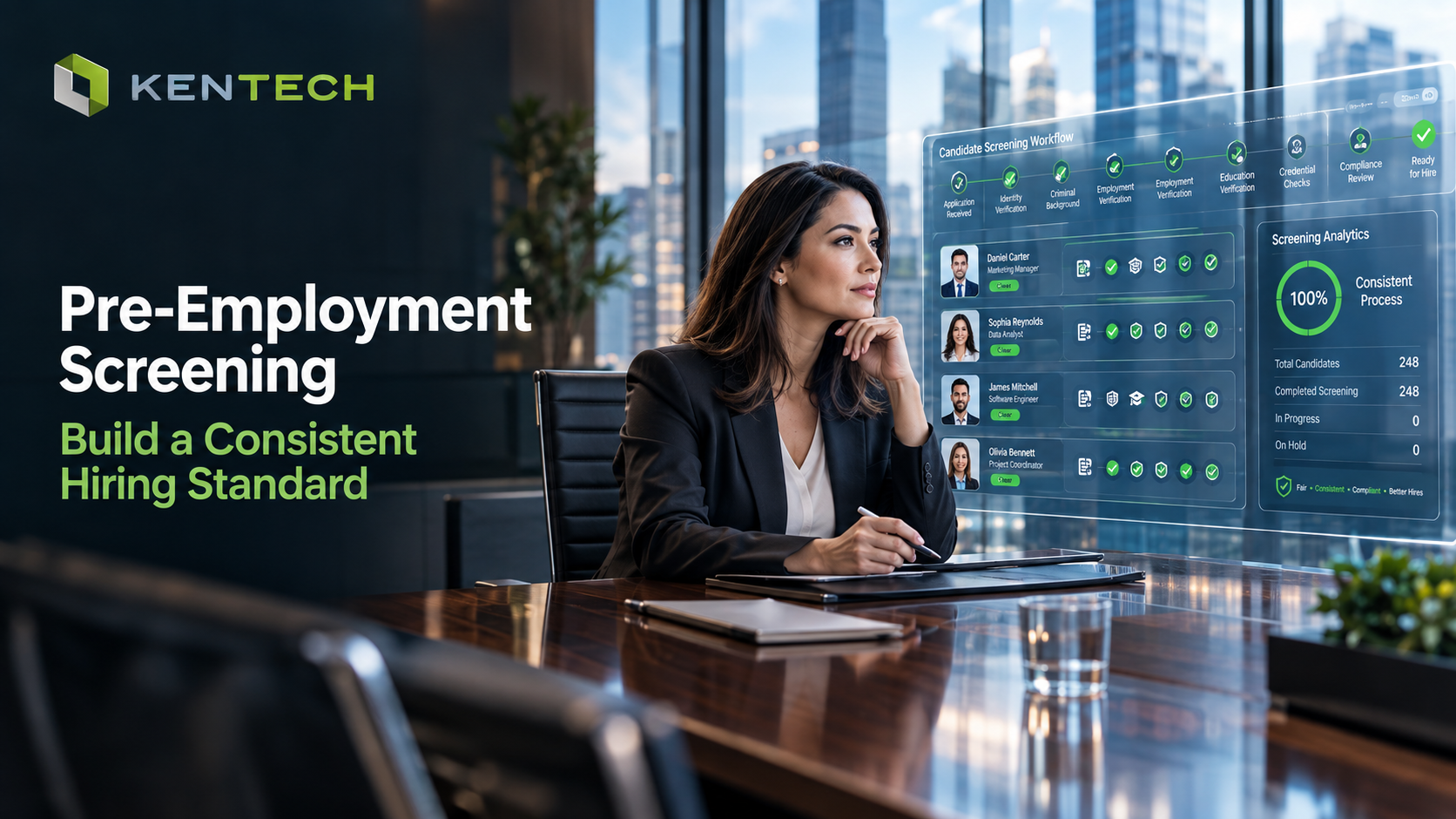
Hiring standards can become difficult to manage as an organization grows.
A small company may have a handful of employees and a simple recruitment process. A growing organization may hire across multiple departments, locations, and job categories.
As hiring volume increases, organizations can face an important question:
Are candidates being screened consistently?
A structured pre-employment screening program can help organizations create a more reliable hiring process while allowing screening requirements to vary according to the responsibilities of each position.
Why Consistency Matters
Without defined screening standards, hiring decisions can become inconsistent.
One hiring manager may request employment verification.
Another may only conduct a criminal background check.
A third may request credential verification because they consider the position more sensitive.
This can create unnecessary variation.
A consistent screening framework helps organizations determine which checks are appropriate for specific categories of positions.
Screening Should Be Based on the Job
The best screening strategy isn't necessarily the one that uses every available background check.
Instead, employers should consider what information is relevant to the position.
A delivery driver has different responsibilities from an accountant.
An accountant may handle financial information.
A technology employee may have access to sensitive systems.
A manager may supervise employees and interact with customers.
Different responsibilities can justify different screening requirements.
Create Role-Based Screening Packages
Organizations can simplify the process by developing screening packages for different job categories.
For example:
Standard Office Position
Identity verification + employment verification + appropriate background screening.
Financially Sensitive Position
Identity verification + employment verification + credential verification + appropriate credit screening.
Driving Position
Identity verification + employment verification + motor vehicle record check + other relevant screening.
Technology Position
Identity verification + employment verification + education and credential verification + relevant background screening.
The exact checks should be determined by the organization's requirements and applicable laws.
Standardization Doesn't Mean Every Candidate Gets Every Check
Consistency doesn't necessarily mean treating every position identically.
Instead, it means establishing predictable standards.
If two employees are applying for the same type of position, they should generally be evaluated using the same established screening criteria.
At the same time, a different position may appropriately require a different screening package.
This role-based approach can provide both consistency and flexibility.
Document the Screening Process
A structured screening program should be documented.
Employers should understand:
Which checks apply to each position
When screening takes place
Who reviews results
How discrepancies are handled
How candidate information is protected
Which compliance requirements apply
Clear procedures can help HR teams and hiring managers follow the same process.
Technology Can Simplify Screening
Managing multiple background checks manually can become complicated.
Modern screening platforms can help organizations coordinate different verification services and monitor screening progress.
This can reduce administrative work while giving HR teams better visibility into where each candidate is in the process.
Technology can be especially useful for organizations hiring frequently or across multiple departments.
Screening Should Be Part of the Hiring Workflow
Background screening shouldn't feel like an unrelated task performed at the end of recruitment.
It can be integrated into the broader candidate journey.
Application.
Interview.
Conditional hiring stage.
Authorization.
Screening.
Review.
Final approval.
Onboarding.
Creating a defined workflow can help reduce delays and ensure important verification steps aren't forgotten.
Consistency Can Improve the Candidate Experience
Candidates notice when hiring processes are disorganized.
Repeated requests for information, unclear communication, or long screening delays can create frustration.
A structured screening process can make the experience more predictable.
When candidates understand what information is required and why screening is part of the organization's standard hiring process, the process can feel more professional.
Compliance Should Remain a Priority
Background screening involves sensitive information and legal considerations.
Employers should ensure their screening programs comply with applicable federal, state, and local requirements.
Policies should also be reviewed regularly because laws and regulations can change.
Working with an experienced screening provider can help organizations manage the operational side of background checks while maintaining appropriate processes.
Measure the Screening Process
Organizations can improve their screening strategy by tracking performance.
Useful measurements may include:
Average screening turnaround time
Percentage of completed screenings
Frequency of discrepancies
Screening-related hiring delays
Candidate completion rates
Administrative workload
These metrics can help employers identify where their process could be improved.
Build a Screening Strategy That Scales
A screening process that works for 20 employees may not work as effectively when an organization reaches 200 or 2,000 employees.
Growth creates complexity.
A structured pre-employment screening program gives organizations a framework they can adapt as hiring needs change.
By creating role-based standards, integrating verification into the hiring workflow, using technology efficiently, and reviewing the process regularly, employers can create a stronger foundation for responsible hiring.
Smarter Screening Starts With Consistency
Hiring decisions will always involve judgment.
But the information supporting those decisions can be made more consistent.
A well-designed pre-employment screening program helps organizations verify relevant candidate information while aligning screening requirements with the responsibilities of each role.
The result is a hiring process that is more organized, more scalable, and better positioned to support confident employment decisions.
For growing organizations, consistent screening isn't just an HR process. It's part of building a stronger workforce.