
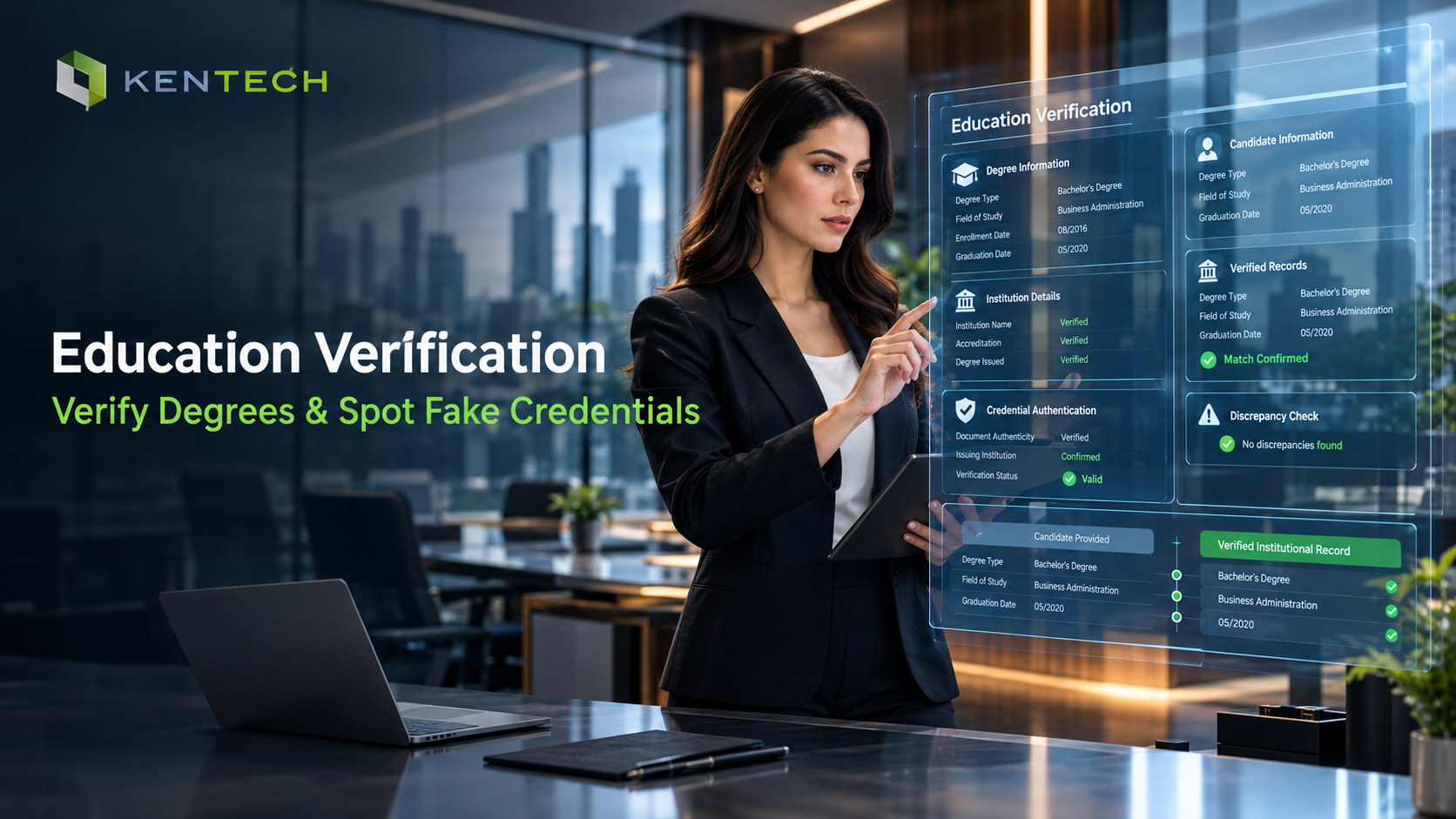
A degree on a resume is a claim, not a fact. Yet many hiring teams treat it as settled the moment it appears in the "Education" section, especially when the candidate interviews well and the reference calls are glowing.
That trust can be expensive. When a role legally or practically depends on a credential, such as a nurse, an engineer, an accountant, or a teacher, an unverified degree is a liability sitting quietly in your personnel file. This guide explains how education verification works, how to spot fake credentials, and how to build a repeatable process that protects your organization without slowing down your hiring.
What Is Education Verification?
Education verification is the process of confirming, directly with the source, that a candidate attended a school and earned the credential they claim. A thorough check confirms:
The institution: that it exists, is legitimate, and is properly accredited.
Attendance dates: that the timeline matches the rest of the candidate's history.
The credential: the degree, diploma, or certificate earned, and the major.
Completion status: whether the candidate actually graduated or simply attended.
Honors: any distinctions the candidate has listed.
It is different from asking for a transcript or a photocopy of a diploma. Documents can be altered or invented. A verification goes to the institution or a trusted data source, not to the candidate.
Why Fake and Inflated Credentials Slip Through
Credential fraud rarely looks dramatic. It usually takes one of a few quiet forms:
Diploma mills. Unaccredited operations that sell "degrees" for a fee, with little or no real coursework. Some have names deliberately close to respected universities.
Altered documents. A real transcript with a changed GPA, major, or graduation date.
Inflated claims. Listing a degree as completed when the candidate finished only part of the program.
Fabricated institutions. Schools that exist on a website and nowhere else.
Attendance without completion. "Studied at" phrasing that implies more than the record supports.
Red Flags to Watch For
No single signal proves fraud, but patterns are worth a second look:
Attendance dates that overlap with full-time employment in a different city or country.
A degree earned in an unusually short time.
A school name that is almost, but not quite, a well-known university.
No clear accreditation, or an accrediting body you cannot verify.
Missing graduation dates or vague wording such as "coursework toward."
Reluctance to sign the authorization needed to verify education.
How to Verify a Degree Step by Step
Identify what actually matters. Confirm which credentials the role requires or which ones the candidate is relying on for pay or level. Verify those first.
Get written authorization. Registrars often require the candidate's signed consent. Collect it as part of your standard background check authorization.
Verify directly with the institution or a trusted source. Go to the registrar, an official digital verification system, or a reputable clearinghouse rather than relying on candidate-provided documents.
Check accreditation. Confirm that the school is accredited by a recognized accrediting body, not one that exists only to lend legitimacy to a diploma mill.
Compare to the rest of the record. Match dates and locations against employment history and identity information.
Document everything. Keep the result, the date, and the source in the candidate's file.
The Extra Challenge of International Credentials
Most employers verify domestic degrees and quietly skip anyone who studied abroad. That is a gap, especially for organizations that hire globally or recruit internationally trained professionals.
Foreign verification comes with added hurdles:
Different record systems. Some countries have central registries; others require contacting each school.
Language and naming differences. Names, transliterations, and degree titles do not always translate cleanly.
Equivalency questions. Employers often need to know how a foreign degree compares to a U.S. credential.
Privacy laws and response times. Both vary widely and can stretch the timeline.
This is where specialized evaluators and global coverage matter. If your provider only handles U.S. schools, your international hires are effectively unchecked.
Handle Discrepancies Fairly
A mismatch does not always mean dishonesty. Registrar errors happen. Candidates change names. Degrees are sometimes conferred months after the last class, and schools close or merge. Before you make a decision:
Give the candidate a chance to explain and provide supporting documents.
Re-check with the institution if the explanation is plausible.
Apply the same standard to every candidate for the same role, so your process is consistent and defensible.
Follow the required notice steps if the result may lead you to reject the candidate, since education verification results are part of the consumer report.
Which Roles Should You Verify?
The safest approach is to verify education whenever a degree is a stated requirement of the job. Healthcare, education, engineering, finance, and legal roles are obvious candidates, but the principle is broader. If the posting says a bachelor's degree is required, you should be able to prove that every hire actually holds one. Consistency matters as much as coverage. Verifying some candidates and not others invites both risk and questions.
How KENTECH's Degree.IQ Makes It Repeatable
Degree.IQ is KENTECH's education verification and credential intelligence service. It is built to turn a slow, manual chore into a dependable workflow:
Complete academic details. It verifies degrees, attendance dates, majors, honors, and completion status through direct institution access and trusted global evaluators.
Fraud detection. It looks for diploma mills, falsified credentials, altered documents, and mismatches between submitted materials and institution records.
Multiple verification methods. KENTECH uses direct outreach, digital verification systems, and document analysis to confirm credentials across domestic and international sources.
International coverage. Global evaluators support verification of degrees earned abroad.
Clear, structured reporting. Reports separate verified, unavailable, and unverified fields, so hiring teams can see exactly what was confirmed and what was not.
Real-time status updates. You can track progress instead of waiting in the dark.
Because Degree.IQ sits alongside KENTECH's other .IQ services, education verification can be ordered with criminal, employment, and identity checks in a single, integrated workflow. And because KENTECH is a licensed private detective agency, investigators can follow up when a record does not line up.
The Bottom Line
Education verification is one of the most straightforward ways to protect the quality and credibility of your workforce. It confirms that the people you hire have the qualifications they claim, closes an easy door for fraud, and gives you a documented, consistent process you can stand behind.