
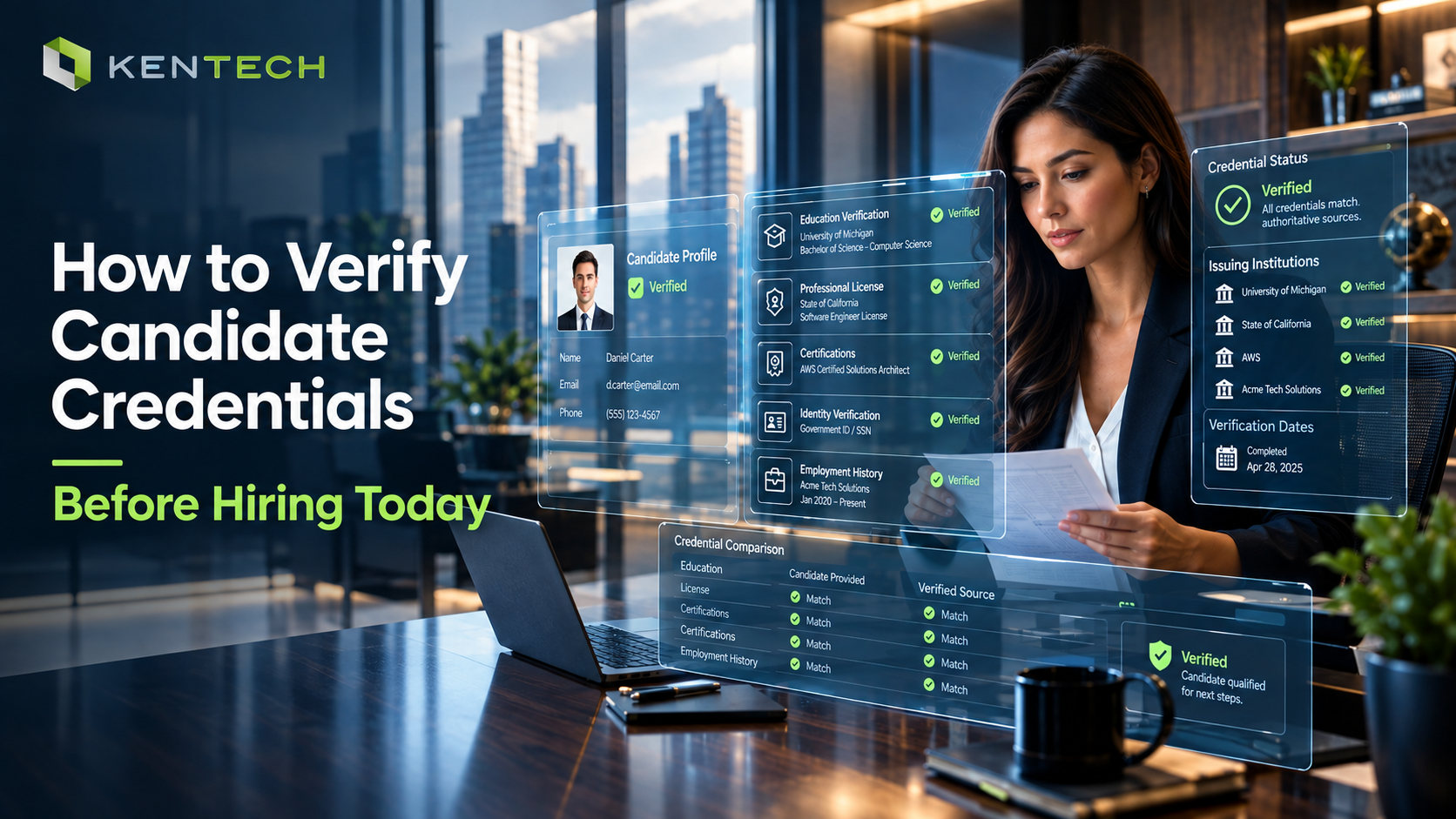
Hiring decisions often begin with a resume, application, or interview. But these materials only tell part of the candidate's story. Degrees, certifications, professional licenses, employment history, and other qualifications can have a significant impact on whether someone is actually prepared for a role.
That is why candidate credential verification has become an important part of a thorough pre-employment screening strategy.
Verifying credentials before hiring can help employers confirm that candidates possess the qualifications they claim while identifying discrepancies that may require additional review. A structured verification process can be especially valuable when hiring for positions involving regulated responsibilities, specialized skills, sensitive information, or significant organizational risk.
Why Candidate Credential Verification Matters
Candidates may provide information about their education, professional certifications, licenses, previous employment, and other qualifications during the hiring process.
Most applicants provide accurate information. However, resumes and applications can contain errors, outdated information, exaggerated claims, or inaccurate credentials.
Even a seemingly small discrepancy can matter.
For example, an employer may discover that:
A degree was earned from a different institution than originally stated.
A candidate attended a school but did not complete the claimed degree.
A professional license has expired.
Employment dates do not match the candidate's application.
A certification cannot be independently confirmed.
A job title or level of responsibility differs from what was reported.
Credential verification gives employers an opportunity to examine these details before a hiring decision is finalized.
What Should Employers Verify?
A comprehensive screening process can involve several types of verification depending on the position and the employer's requirements.
1. Education Verification
Education verification helps confirm information about a candidate's academic background.
Depending on the screening requirements, employers may verify details such as:
School or university attended
Degree earned
Field of study
Dates of attendance
Graduation date
Academic credentials
This can be particularly important for positions requiring specific degrees or educational qualifications.
For example, an employer hiring for a specialized professional role may need to confirm that an applicant actually possesses the educational background required for the position.
2. Professional License Verification
Certain positions require employees to hold valid professional licenses or credentials.
License verification can help employers determine whether a credential exists and whether the information is current.
Depending on the profession, employers may need to consider:
License status
License number
Issuing authority
Expiration date
Professional credential
Relevant restrictions or status information
For regulated positions, confirming licensing information before employment can be an important component of responsible hiring.
3. Employment Verification
A candidate's previous work experience can also be verified.
Employment verification may help confirm information such as:
Previous employer
Position held
Employment dates
Job title
Other permissible employment details
This can help employers determine whether a candidate's professional history aligns with the information presented during recruitment.
4. Identity Verification
Credential verification works best when the screening process is connected to reliable identity information.
Identity verification can help establish that the person being screened is the same individual associated with the records being reviewed.
This becomes particularly important when employers are evaluating multiple records across different sources.
Watch for More Than Obvious False Credentials
Credential verification is not simply about finding fraudulent degrees or completely fabricated employment histories.
Discrepancies can occur for many reasons.
A candidate may accidentally provide an incorrect graduation year. A company may have changed names. A professional credential may have been renewed under updated information. Employment dates may differ slightly between a resume and an employer's records.
The purpose of verification is therefore not automatically to assume that a discrepancy means misconduct.
Instead, verification provides information that employers can evaluate according to their hiring policies and applicable requirements.
That distinction is important.
A screening result should be considered within the appropriate context rather than treated as an automatic hiring decision.
Create a Consistent Verification Process
One of the most effective ways to improve credential screening is to establish a consistent process.
Employers should determine which credentials need to be verified for each position and apply their screening standards consistently.
A process might include:
Step 1: Identify position requirements
Determine which education, licenses, certifications, employment history, or other qualifications are necessary for the position.
Step 2: Collect candidate information
Obtain the information necessary to conduct authorized verification.
Step 3: Verify the information
Use appropriate sources and screening methods to confirm the candidate's reported credentials.
Step 4: Review discrepancies
If information does not match, determine whether additional clarification or investigation is appropriate.
Step 5: Document the process
Maintain appropriate records of the screening process and results.
Step 6: Apply hiring policies consistently
Use established criteria rather than making decisions based on inconsistent standards.
This type of structured process can help organizations make credential verification a repeatable part of hiring rather than an occasional response to a concern.
Why Verification Becomes More Important for Specialized Roles
Not every position requires the same level of screening.
A role involving access to sensitive financial information may require different checks than an entry-level administrative position. A position requiring a professional license may require verification that another role does not.
Organizations should therefore align screening requirements with the responsibilities and risks associated with each position.
Credential verification can be particularly relevant for roles involving:
Specialized technical expertise
Professional licensing
Financial responsibilities
Healthcare responsibilities
Education
Government functions
Access to sensitive information
Security-sensitive systems
Leadership responsibilities
The goal is not necessarily to conduct every possible screening check for every candidate. It is to build a screening process appropriate to the position.
Credential Verification Can Strengthen the Hiring Process
A resume is a candidate's representation of their qualifications. Verification provides another layer of information.
When employers combine credential verification with appropriate employment, identity, criminal, professional license, and other screening services, they can develop a more complete understanding of a candidate's background.
This can help organizations move beyond a resume-based hiring process toward a more structured screening strategy.
It can also help hiring teams identify questions earlier in the process, before onboarding is complete.
Partner With KENTECH for Candidate Screening
Effective candidate credential verification requires more than checking a box on a hiring checklist.
Employers need reliable processes for verifying information, identifying inconsistencies, and evaluating screening results in the context of their hiring requirements.
KENTECH provides background screening and verification solutions designed to help organizations make more informed workforce decisions.
From education and employment verification to professional credentials, identity checks, criminal records, and other screening services, KENTECH can help employers build a screening program that fits their organization's needs.
Before making your next hiring decision, verify the credentials behind the resume. Contact KENTECH to learn how a comprehensive candidate screening strategy can support your organization.