
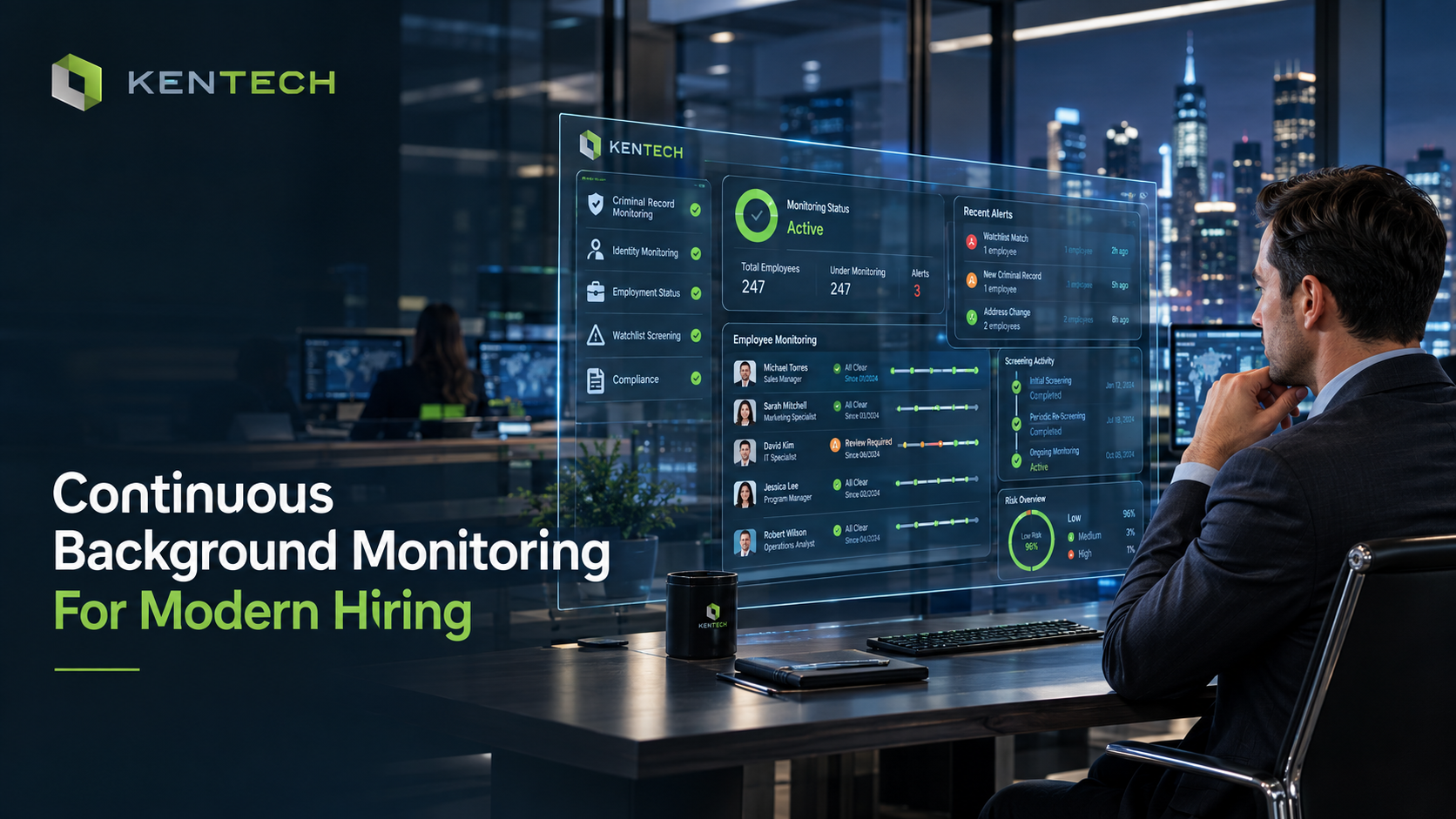
A pre-employment background check provides employers with important information before a candidate joins the organization. But what happens after the hiring decision?
Employees' circumstances can change over time. New records may become available, professional credentials may expire, and other developments can occur after an initial screening has been completed.
For organizations operating in industries where workforce risk is an ongoing concern, continuous background monitoring can provide an additional layer of visibility after the initial hiring process.
Rather than treating screening as a one-time event, continuous monitoring can become part of an organization's broader workforce risk management strategy.
Why One Background Check May Not Tell the Whole Story
Traditional pre-employment screening generally takes place at a specific point in time.
An employer conducts a background check, reviews the available results, makes a hiring decision, and moves forward with onboarding.
That process can be valuable. However, a background check reflects information available at the time it is performed.
An employee's record can change later.
For example, new information may become available after the initial screening. A professional license may change status. A new court record may appear. Other developments may affect information that was previously verified.
This does not mean that every employee requires constant monitoring.
Instead, organizations should consider whether ongoing screening is appropriate for specific roles, industries, and workforce risk requirements.
What Is Continuous Background Monitoring?
Continuous background monitoring is an approach that allows employers to receive ongoing notifications or screening updates related to specified records or information after an initial background check.
The exact services and monitoring capabilities can vary based on the screening program, jurisdiction, record type, and applicable requirements.
The concept is straightforward:
Instead of asking only, "What did the background check show when we hired this person?" employers can also consider whether relevant information changes over time.
This can be especially useful when employees remain in positions involving sensitive responsibilities for many years.
Which Employees May Require Ongoing Screening?
Continuous monitoring may be more relevant for certain positions than others.
Organizations may consider ongoing screening for employees who have access to:
Sensitive financial information
Confidential customer data
Healthcare information
Critical infrastructure
Security systems
Company technology
Privileged accounts
Valuable assets
Children or vulnerable populations
Regulated operations
The appropriate approach depends on the employer, industry, position, applicable laws, and internal policies.
A risk-based strategy can help organizations determine where ongoing monitoring provides meaningful value.
Continuous Monitoring Is Not the Same as Repeating a Background Check
It is important to distinguish continuous monitoring from simply ordering another background check every few years.
A periodic rescreening program involves conducting another screening at a defined interval.
Continuous monitoring, by contrast, is designed to provide ongoing visibility into specified information between traditional screening events.
Organizations may use one approach or a combination of approaches depending on their needs.
For example, an employer could conduct:
Pre-employment screening before hiring
Periodic rescreening for designated positions
Continuous monitoring for selected records
Credential or license verification when appropriate
Additional screening when an employee changes roles
The right structure depends on the organization's workforce and risk-management objectives.
Why Ongoing Screening Can Matter for Sensitive Positions
Consider an employee who has worked for an organization for five years.
At the time of hiring, the employee successfully completed the organization's background screening requirements.
Five years later, the original report still reflects what was known at the time of hiring.
That does not necessarily provide visibility into developments that occurred afterward.
For certain employers, that gap may be significant.
Ongoing screening can help organizations identify information that may warrant review while an employee remains in a sensitive role.
The purpose is not to automatically take action against an employee whenever new information appears.
Instead, the information can provide an opportunity for the appropriate internal team to review the circumstances according to established policies and applicable requirements.
Build Monitoring Into a Broader Screening Strategy
Continuous background monitoring works best when it is part of a comprehensive screening strategy rather than an isolated service.
Organizations can combine ongoing monitoring with other screening components such as:
Identity Verification
Confirming identity information helps organizations connect screening results to the appropriate individual.
Employment Verification
Verifying previous employment can help establish a candidate's professional history.
Education Verification
Education checks can confirm academic qualifications relevant to a position.
Criminal Background Screening
Criminal record searches can provide information relevant to an organization's established screening criteria.
Professional License Verification
For regulated positions, organizations may need to confirm that licenses and credentials remain valid.
Motor Vehicle Record Checks
For employees who drive as part of their job responsibilities, MVR screening may be an important component of workforce risk management.
Together, these services can provide a more comprehensive approach to employee screening.
Consistency and Compliance Matter
Employers should not implement monitoring simply because technology makes it possible.
A responsible monitoring program should be based on clearly defined policies and applicable requirements.
Organizations should consider:
Which positions are subject to monitoring
What information will be monitored
Why the monitoring is relevant
How employees will be informed
How results will be reviewed
Who is authorized to access results
How records will be handled
What procedures apply when potentially relevant information is identified
Screening policies should also be applied consistently and reviewed periodically.
Because employment screening requirements can vary by jurisdiction and circumstance, organizations should evaluate their programs carefully and obtain appropriate legal or compliance guidance when necessary.
Avoid Treating Every Alert as a Hiring or Employment Decision
A monitoring notification is information—not necessarily a final conclusion.
Records can contain errors, incomplete information, similar names, outdated information, or circumstances that require additional review.
Employers should therefore have a defined process for evaluating potential results.
That process can include verifying the information, assessing its relevance to the position, following applicable notification and dispute procedures, and allowing appropriate review before making an employment decision.
This helps prevent automated screening information from being treated as an immediate conclusion.
Continuous Screening Supports a More Dynamic Workforce Strategy
Today's workforce can change rapidly.
Employees move into new roles, take on additional responsibilities, gain access to new systems, and work with increasingly sensitive information.
A screening strategy created five years ago may not reflect the organization's current risk profile.
Continuous background monitoring gives employers another tool for keeping workforce screening aligned with changing circumstances.
It can be particularly useful when incorporated into a broader framework that includes pre-employment screening, ongoing compliance, credential verification, and role-based risk management.
Strengthen Your Workforce Screening Strategy With KENTECH
Background screening does not have to end when an employee receives an offer.
For organizations where ongoing workforce risk is important, continuous background monitoring can provide an additional layer of visibility after the initial hiring decision.
KENTECH offers background screening and workforce information solutions designed to help organizations build structured screening programs around their specific needs.
Whether your organization needs pre-employment screening, criminal searches, credential verification, employment verification, monitoring, or other screening services, KENTECH can help you develop a more comprehensive approach.
Want to strengthen your workforce screening strategy? Contact KENTECH today to explore continuous background monitoring and other screening solutions for your organization.