
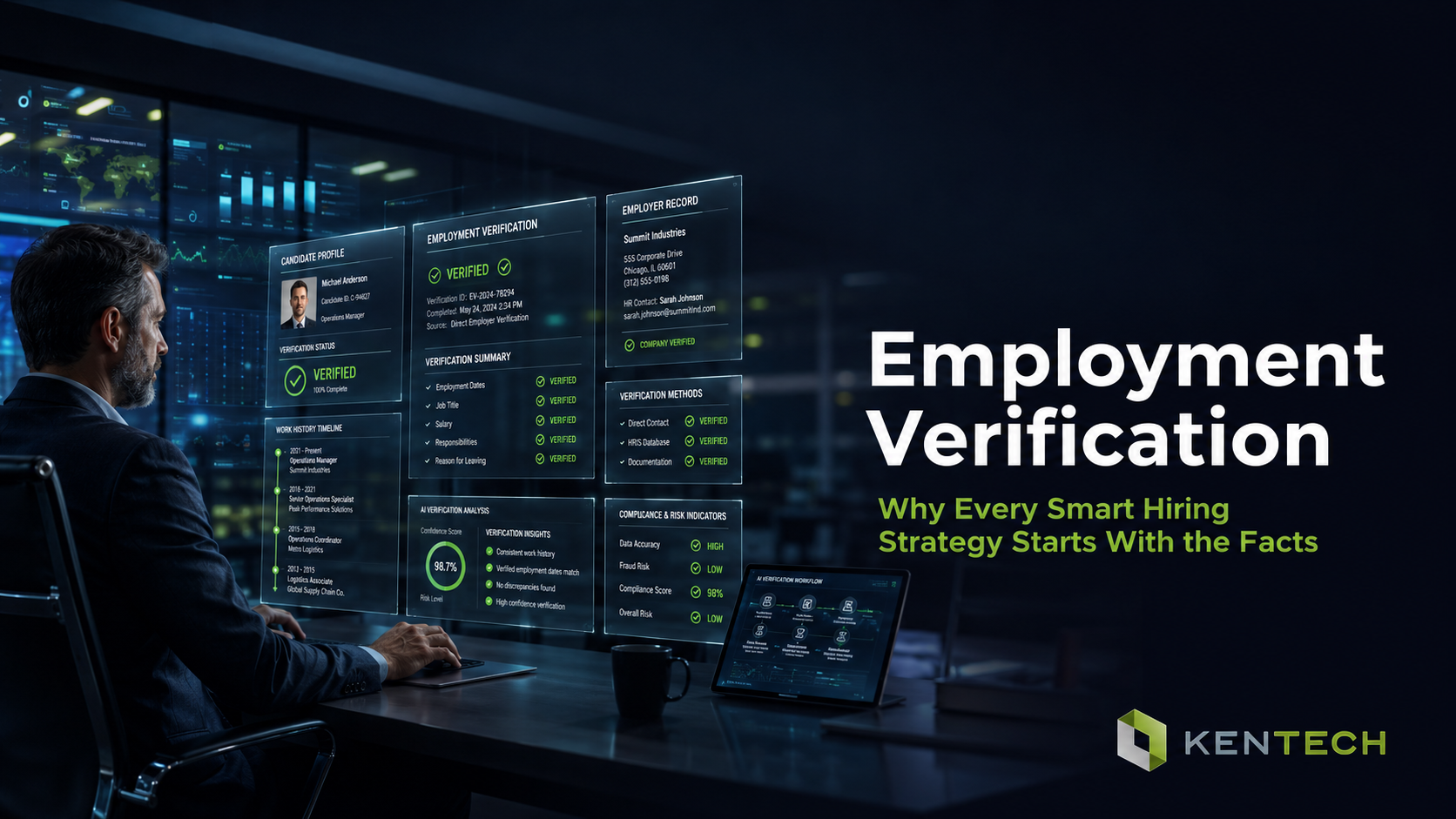
Every resume tells a story—but is it the whole story?
In today's competitive hiring market, employers receive hundreds of applications from candidates with impressive job titles, extensive experience, and seemingly perfect career paths. While many applicants present accurate information, hiring decisions based solely on resumes and interviews can expose organizations to unnecessary risks.
Employment verification has become one of the most valuable steps in the hiring process because it helps employers confirm whether a candidate's work history is accurate before extending an offer.
For HR professionals, recruiters, and hiring managers, verifying employment is more than checking dates of employment. It is about building confidence that the person joining your organization possesses the experience, integrity, and qualifications needed to succeed in the role.
What Is Employment Verification?
Employment verification is the process of confirming a candidate's previous work history with current or former employers. The goal is to verify that the information provided during the hiring process accurately reflects the applicant's employment record.
A thorough employment verification may include:
Employer name
Employment dates
Job title
Department
Employment status
Supervisor information (when available)
Reason for separation (where legally permissible)
Eligibility for rehire (when employers choose to disclose it)
Depending on company policy and local regulations, employers may provide different levels of information. Even limited verification, however, helps organizations validate important details before making hiring decisions.
Why Employment Verification Matters More Than Ever
Recruitment has become increasingly digital. Online applications, remote interviews, and virtual onboarding have made hiring faster and more convenient than ever before. However, this convenience also makes it easier for inaccurate or misleading information to go unnoticed.
Studies consistently show that resume inaccuracies remain common across industries. These discrepancies may range from minor date adjustments to exaggerated responsibilities or entirely fabricated employment history.
While not every inconsistency is intentional, even small inaccuracies can affect hiring decisions, especially for positions involving financial responsibility, leadership, healthcare, education, government contracts, or access to sensitive information.
Employment verification helps employers replace assumptions with verified information, allowing hiring decisions to be based on facts rather than claims.
The Risks of Skipping Employment Verification
Some organizations choose to move quickly through the hiring process to fill open positions. Although speed is important, overlooking employment verification can create long-term challenges that outweigh any short-term hiring gains.
Hiring an employee whose experience has not been properly verified may lead to:
Reduced productivity
Increased training costs
Poor job performance
Compliance concerns
Higher employee turnover
Damage to customer trust
Financial losses
Workplace safety risks
Replacing a poor hire is significantly more expensive than taking the time to verify employment before making an offer. Beyond recruitment expenses, organizations must also consider onboarding costs, lost productivity, and the impact on team morale.
Common Challenges HR Teams Face
While employment verification is essential, it is not always straightforward.
Many employers limit the information they disclose to protect employee privacy. Others may no longer have accessible employment records, particularly if a company has merged, relocated, or ceased operations.
International employment history can introduce additional complexities due to varying labor laws, recordkeeping practices, and language barriers.
HR professionals also face increasing pressure to complete hiring quickly while maintaining compliance and accuracy.
Balancing speed with due diligence requires efficient verification processes supported by reliable data sources and experienced professionals.
Best Practices for an Effective Employment Verification Process
Organizations looking to strengthen their hiring practices should establish consistent employment verification procedures for every candidate.
Rather than verifying only executive positions, applying standardized verification policies across similar job categories promotes fairness, reduces bias, and improves hiring consistency.
Employers should also obtain proper candidate authorization before conducting employment verification and ensure all screening activities comply with applicable employment laws.
Using a trusted screening partner can help simplify the verification process by accessing verified employment records, coordinating employer outreach, and documenting findings in a consistent, compliant manner.
Technology also plays an increasingly important role. Automated verification tools can streamline requests, organize documentation, and reduce administrative workloads, allowing HR teams to focus on evaluating candidates instead of chasing paperwork.
However, automation works best when combined with experienced professionals who can resolve discrepancies, interpret complex employment histories, and provide context when records are incomplete or inconsistent.
How Technology Is Transforming Employment Verification
The employment verification process has evolved significantly over the past decade. Traditional methods often relied on phone calls, emails, and manual record checks, which could take days—or even weeks—to complete. Today, advancements in technology have made verification faster, more efficient, and more reliable.
Artificial intelligence (AI), automation, and digital workforce intelligence solutions are helping HR teams streamline repetitive tasks while improving the accuracy of employment verification. Automated workflows can quickly identify inconsistencies in employment dates, flag missing information, and organize verification requests, reducing administrative burdens for recruiters.
However, technology alone should not replace human judgment.
Employment records are not always straightforward. Candidates may have worked under different company names due to mergers or acquisitions, held multiple positions within the same organization, or been employed internationally where recordkeeping practices differ. In these situations, experienced investigators and verification specialists play an essential role in interpreting findings and ensuring employers receive accurate, contextual information.
The most effective employment verification programs combine intelligent automation with human expertise. This hybrid approach enables organizations to move faster while maintaining the accuracy and fairness needed for responsible hiring decisions.
Building a Stronger Hiring Strategy
Employment verification should never be viewed as a standalone task. Instead, it should be integrated into a comprehensive employment screening strategy that helps organizations evaluate candidates from multiple perspectives.
A robust hiring process often includes:
Employment verification
Education verification
Professional license verification
Criminal background screening
Identity verification
Reference checks
Drug testing, when applicable
Compliance and regulatory screening
When these components work together, employers gain a clearer understanding of a candidate's qualifications and suitability for the role. This comprehensive approach reduces uncertainty, supports better hiring decisions, and helps organizations create a more reliable workforce.
It is equally important to establish consistent verification standards across departments. Applying the same verification procedures to candidates applying for similar positions promotes fairness, improves compliance, and reduces the potential for inconsistent hiring practices.
Looking Ahead: Employment Verification in the Future
As remote work, hybrid teams, and global hiring continue to expand, employment verification will become even more critical. Organizations are increasingly recruiting talent across state and international borders, making it more challenging to confirm work history through traditional methods alone.
Future verification processes will likely rely on more advanced digital technologies, including AI-powered analytics, secure data sharing, and integrated workforce intelligence platforms. These innovations will help employers verify information more quickly while maintaining compliance with evolving privacy regulations.
Despite these technological advancements, trust will remain at the center of every hiring decision. Employers will continue to need reliable information, experienced professionals, and transparent verification practices to confidently evaluate candidates.
Organizations that invest in modern employment verification processes today will be better prepared to navigate tomorrow's workforce challenges.
Conclusion
An impressive resume may open the door, but verified information builds confidence in every hiring decision.
Employment verification helps organizations confirm work history, reduce hiring risks, strengthen compliance, and create a more trustworthy workforce. In an increasingly competitive hiring landscape, taking the time to verify employment history is not simply a best practice—it is a strategic investment in long-term organizational success.
By combining efficient technology with experienced verification professionals, employers can streamline hiring while maintaining the accuracy, fairness, and compliance necessary to make informed decisions. As workforce expectations continue to evolve, organizations that prioritize thorough employment verification will be better positioned to hire qualified talent, protect their reputation, and build stronger teams for the future.