
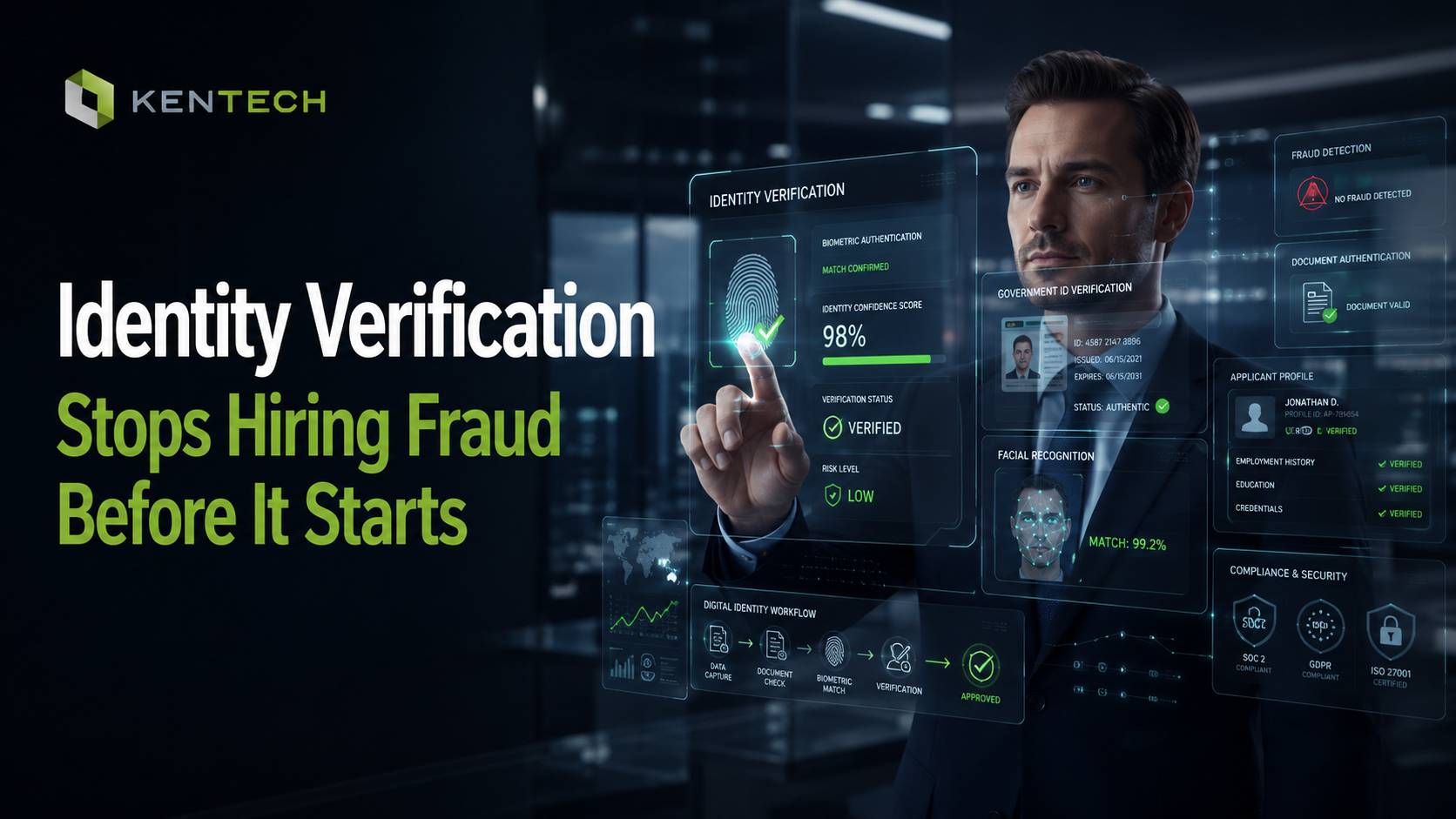
Every hiring decision begins with one essential question: Is the person applying truly who they claim to be?
In today's digital hiring environment, organizations are recruiting candidates faster than ever. Remote interviews, virtual onboarding, and online applications have expanded access to talent across cities, states, and even countries. While these advancements have created exciting opportunities, they have also introduced new risks that many employers cannot afford to ignore.
Identity fraud is no longer limited to financial crimes. It has become a growing concern in recruitment, where stolen identities, synthetic identities, falsified documents, and impersonation schemes can undermine hiring decisions before a new employee even starts their first day.
As businesses continue embracing remote and hybrid work, verifying a candidate's identity has become just as important as verifying their experience, education, or professional qualifications.
What Is Identity Verification for Employment?
Identity verification for employment is the process of confirming that a job applicant is genuinely the individual they claim to be. It helps employers establish confidence that the personal information submitted during the hiring process matches authentic records and belongs to the applicant.
Depending on the role and industry, identity verification may involve reviewing government-issued identification, validating Social Security information where legally appropriate, confirming addresses, comparing personal records, or using secure digital verification technologies to authenticate identity documents.
Identity verification is often one of the earliest steps in the employment screening process because it creates a reliable foundation for every subsequent verification. Once an employer has confidence in a candidate's identity, it becomes easier to accurately verify employment history, educational credentials, professional licenses, and other background information.
Why Identity Verification Matters More Than Ever
The hiring landscape has changed dramatically over the last decade.
Organizations increasingly rely on digital recruitment platforms, virtual interviews, and remote onboarding processes that reduce face-to-face interaction. While these practices improve efficiency, they also create opportunities for identity-related fraud that may be difficult to detect without proper verification procedures.
Some common hiring risks include:
Applicants using stolen identities
Fraudulent identification documents
Synthetic identities created from real and fabricated information
Individuals applying under another person's credentials
Candidates concealing previous employment or criminal history by using false personal information
Even when these situations are uncommon, the consequences can be significant. Hiring someone whose identity has not been properly verified can expose organizations to financial loss, compliance issues, operational disruption, and reputational damage.
For organizations in healthcare, financial services, education, government, transportation, and other regulated industries, identity verification is an essential safeguard rather than an optional step.
The Business Impact of Strong Identity Verification
Identity verification does more than reduce fraud—it strengthens the entire hiring process.
Improves Hiring Confidence
Recruiters and hiring managers make important decisions based on the information candidates provide. Confirming an applicant's identity helps ensure that subsequent background screening activities are connected to the correct individual, reducing the likelihood of inaccurate or incomplete results.
When organizations start with verified identity information, they gain greater confidence in every stage of the hiring process.
Reduces Hiring Fraud
Fraudulent applicants often rely on inconsistencies that can go unnoticed when organizations move quickly through recruitment.
Identity verification helps detect potential issues before employment begins, giving employers an opportunity to investigate discrepancies and make informed hiring decisions based on verified information rather than assumptions.
Preventing fraud at the beginning of the hiring process is far less costly than addressing its consequences after an employee has been onboarded.
Strengthens Regulatory Compliance
Many industries require employers to verify employee identities as part of broader compliance obligations.
Identity verification supports compliance by helping organizations maintain accurate employment records, verify work authorization where required, and establish consistent hiring practices that align with applicable regulations.
Working with experienced screening professionals also helps employers implement identity verification procedures that respect privacy requirements and legal standards.
Protects Organizational Reputation
Trust is one of the most valuable assets any organization can build.
Customers, business partners, investors, and employees all expect organizations to exercise reasonable diligence when hiring individuals who may have access to sensitive information, financial resources, or vulnerable populations.
By incorporating identity verification into the hiring process, businesses demonstrate a commitment to responsible hiring, workplace security, and long-term risk management.
Identity Verification Is More Than Checking an ID
One of the most common misconceptions is that identity verification simply involves reviewing a driver's license or passport.
While government-issued identification remains an important part of the process, modern employment identity verification goes much further.
Organizations increasingly rely on advanced technologies that analyze identity documents for authenticity, compare applicant information across trusted data sources, identify inconsistencies, and support secure digital verification during remote hiring.
When these technologies are paired with experienced investigators and compliance professionals, employers receive a more complete and reliable picture of candidate identity than traditional document reviews alone.
This combination of intelligent technology and human expertise helps organizations make hiring decisions with greater confidence while reducing the likelihood of identity-related fraud.
How AI Is Transforming Identity Verification
Artificial intelligence is reshaping the way organizations verify candidate identities. Traditional verification methods often depended on manual document reviews and phone calls, which could be time-consuming and prone to human error. Today, AI-powered solutions enable employers to validate identity information more efficiently while improving consistency and accuracy.
Modern identity verification platforms can quickly detect irregularities in government-issued identification, compare applicant information against trusted data sources, and identify potential inconsistencies that warrant further review. Machine learning algorithms can recognize patterns that may indicate document tampering, duplicate identities, or suspicious application activity.
Despite these advancements, technology should not replace professional judgment. AI is most effective when it assists experienced investigators rather than making employment decisions on its own. Human specialists provide context, review complex cases, and ensure that verification results are interpreted fairly and responsibly.
This combination of intelligent automation and human expertise allows organizations to move through the hiring process more efficiently without sacrificing quality or compliance.
Best Practices for Employment Identity Verification
A successful identity verification program begins with clear policies and consistent procedures. Every organization should establish standards that define when identity verification will be performed, what information will be verified, and how verification results will be documented.
Applying the same verification process to candidates applying for similar positions promotes fairness and reduces the risk of inconsistent hiring practices.
Organizations should also ensure that candidates understand why identity verification is required. Transparency helps build trust and demonstrates that the organization values security, privacy, and responsible hiring.
Another important consideration is selecting a screening partner with expertise in both technology and compliance. A reliable provider should offer secure verification processes, maintain strong data protection practices, and stay informed about evolving employment regulations.
Finally, identity verification should be integrated into a broader employment screening strategy rather than treated as a separate task. Combining identity verification with employment verification, education verification, criminal background screening, and professional license verification provides employers with a more complete understanding of each candidate.
Common Mistakes Employers Should Avoid
Even organizations that recognize the importance of identity verification can encounter challenges if their processes are not well designed.
One common mistake is relying solely on visual inspection of identification documents. Fraudulent documents have become increasingly sophisticated, making manual reviews alone insufficient in many situations.
Another mistake is verifying identity only for certain positions. While executive and high-security roles often require extensive screening, identity verification provides value across a wide range of positions because every employee contributes to the organization's overall security and reputation.
Employers should also avoid rushing the verification process simply to fill open positions more quickly. Hiring speed is important, but overlooking critical verification steps may result in costly hiring mistakes that affect productivity, customer trust, and organizational performance.
Finally, organizations should regularly review and update their verification policies. As fraud techniques continue to evolve, hiring procedures must adapt to address emerging risks and changing compliance requirements.
The Future of Identity Verification in Hiring
The future of employment identity verification will be shaped by continued advances in digital technology and workforce intelligence.
As organizations increasingly hire remote employees and expand into global talent markets, secure digital identity verification will become an essential part of recruitment. Employers will continue adopting solutions that provide faster verification while maintaining strong privacy protections and regulatory compliance.
Artificial intelligence, biometric authentication, encrypted digital credentials, and secure identity ecosystems are expected to play larger roles in helping organizations confirm candidate identities with greater confidence.
At the same time, organizations must balance innovation with responsibility. The goal is not simply to adopt the newest technology but to create verification processes that are accurate, transparent, fair, and respectful of candidate privacy.
Businesses that invest in modern identity verification strategies today will be better prepared to navigate future workforce challenges while protecting their employees, customers, and organizational reputation.
Conclusion
Every successful hiring decision begins with trust, and trust begins with verifying identity.
As hiring becomes increasingly digital, organizations can no longer rely on resumes, interviews, or identification documents alone. Identity verification provides the confidence that employers need to confirm applicants are who they claim to be before moving forward with employment decisions.
When integrated into a comprehensive employment screening program, identity verification helps reduce hiring fraud, strengthen regulatory compliance, improve workplace security, and support more informed hiring decisions.
By combining advanced technology with experienced investigative professionals, organizations can create hiring processes that are both efficient and dependable. In an environment where workforce risks continue to evolve, identity verification is no longer simply an administrative step—it is a strategic investment in building a safer, more secure, and more trustworthy organization.