
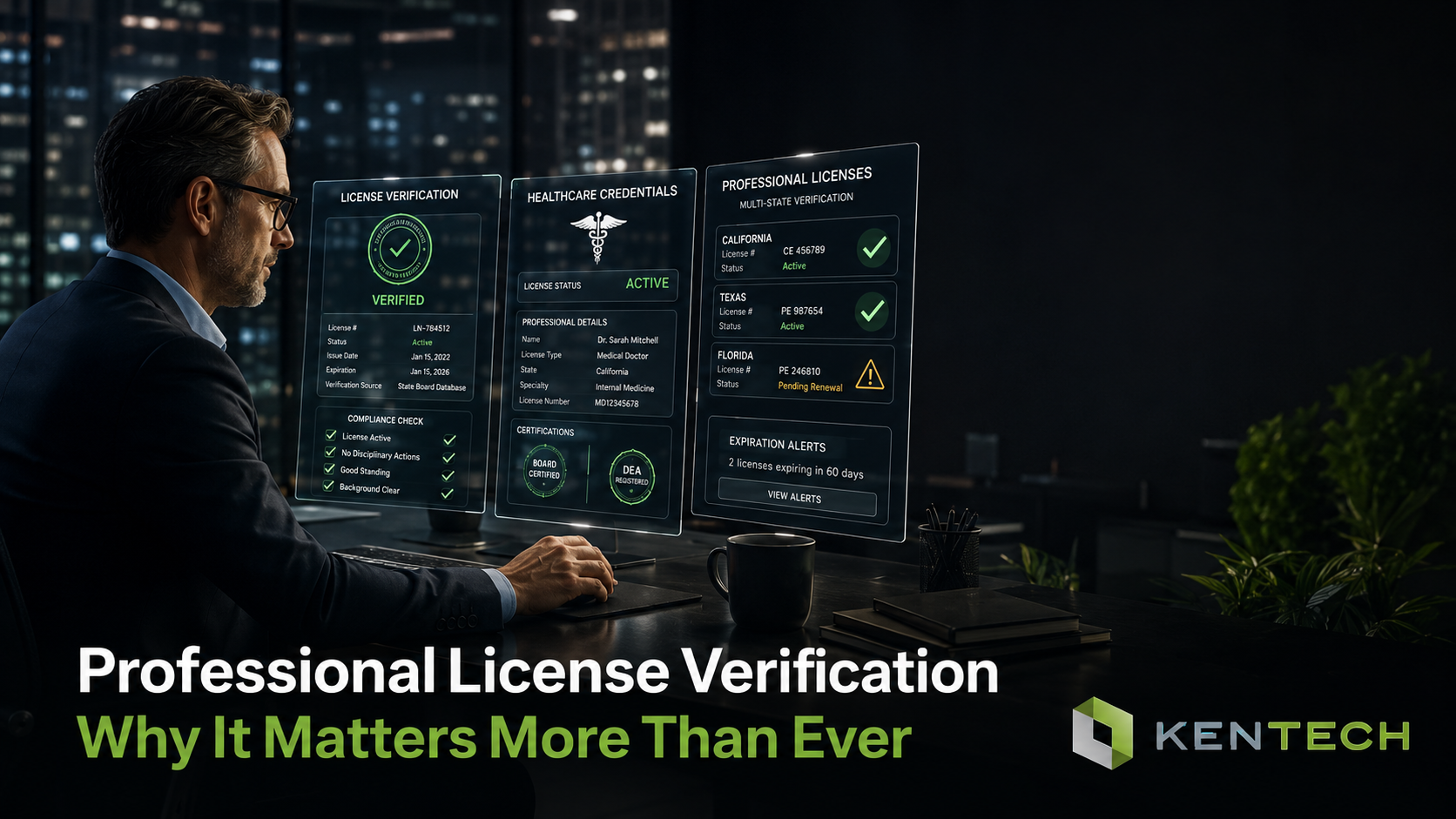
Hiring someone with the right experience is only part of making a successful hiring decision. In many professions, experience alone is not enough. Employees must also possess valid, active, and unrestricted professional licenses that legally authorize them to perform their work.
From healthcare providers and financial professionals to engineers, security personnel, educators, and commercial drivers, professional licensing serves as an important safeguard for public safety, regulatory compliance, and organizational accountability.
Yet many employers unintentionally assume that if a candidate lists a professional license on their resume, it must be valid.
That assumption can become an expensive mistake.
Professional license verification helps employers confirm that applicants possess the credentials required for their role before employment begins. More importantly, it helps organizations protect their customers, maintain regulatory compliance, and reduce the risks associated with hiring individuals whose licenses may be expired, suspended, revoked, or otherwise restricted.
As industries become more heavily regulated and workforce mobility continues to increase, professional license verification has become a critical component of responsible hiring and ongoing workforce management.
What Is Professional License Verification?
Professional license verification is the process of confirming that an applicant or employee holds a legitimate professional license issued by the appropriate licensing authority.
Verification typically confirms details such as:
License status
License number
Issue date
Expiration date
Active or inactive status
License restrictions
Disciplinary actions when publicly available
Licensing jurisdiction
Unlike simply reviewing a copy of a license certificate, professional verification confirms the information directly through authoritative sources whenever possible.
This additional step provides employers with greater confidence that the individual is legally qualified to perform duties requiring professional certification or licensure.
Why License Verification Is More Important Than Ever
The modern workforce is more mobile than ever before.
Professionals frequently relocate between states, change employers, obtain additional certifications, or expand into new specialties throughout their careers. At the same time, licensing boards regularly update records to reflect renewals, disciplinary actions, suspensions, and other changes.
A license that was valid several years ago may no longer meet current regulatory requirements.
Without verification, employers may unknowingly hire individuals whose credentials no longer satisfy legal or professional standards.
For regulated industries, the consequences extend far beyond hiring mistakes. Employing individuals without valid licenses may expose organizations to regulatory penalties, legal liability, financial losses, and reputational damage.
Professional license verification helps organizations identify potential issues before employment begins, reducing uncertainty while supporting informed hiring decisions.
Industries That Depend on Professional License Verification
Although many positions do not require occupational licensing, numerous industries depend on verified professional credentials to protect public safety and maintain compliance.
Healthcare
Healthcare organizations rely on physicians, nurses, pharmacists, therapists, technicians, and other licensed professionals to provide safe patient care.
Verifying professional licenses helps healthcare employers confirm that providers remain authorized to practice while identifying any disciplinary actions or restrictions that could affect patient safety.
Financial Services
Banks, investment firms, insurance providers, and financial advisory organizations often employ professionals whose licenses demonstrate compliance with industry regulations.
License verification helps financial institutions maintain regulatory standards while protecting clients and organizational integrity.
Engineering and Construction
Licensed engineers, architects, surveyors, and contractors perform work that directly impacts public safety and infrastructure.
Confirming professional credentials helps organizations ensure projects are completed by individuals who meet legal and professional standards.
Education
Teachers, administrators, counselors, and other education professionals frequently require state-issued licenses or certifications.
Schools and educational institutions rely on license verification to support student safety, regulatory compliance, and hiring quality.
Security and Public Safety
Private investigators, security officers, law enforcement personnel, and related professionals often require licenses or certifications depending on jurisdiction.
Verifying these credentials helps organizations maintain compliance while ensuring employees meet industry standards.
The Risks of Skipping License Verification
Some employers assume that reviewing a copy of a candidate's license is sufficient.
Unfortunately, printed credentials do not always reflect the most current licensing status.
Licenses can expire, be suspended, become subject to disciplinary action, or be revoked after the document was issued.
Failing to verify licenses directly with authoritative sources may expose organizations to significant risks, including:
Regulatory violations
Compliance penalties
Increased legal liability
Workplace safety concerns
Insurance complications
Financial losses
Damage to customer confidence
Reputational harm
For organizations operating in regulated industries, these risks can affect not only individual hiring decisions but also broader operational performance and long-term business success.
Professional license verification helps reduce these risks by ensuring hiring decisions are supported by current, accurate credential information rather than assumptions or outdated documentation.
Beyond Hiring: Why Ongoing License Monitoring Matters
Professional license verification should not end after a candidate accepts a job offer.
Many licenses require periodic renewal, continuing education, or compliance with professional standards throughout an individual's career. Changes to licensing status can occur months or even years after employment begins.
Organizations that rely solely on pre-employment verification may overlook important updates that affect an employee's eligibility to perform regulated work.
Implementing periodic license verification or ongoing credential monitoring helps employers remain informed about changes that could impact compliance, operational continuity, or workplace safety.
For organizations with large workforces, proactive monitoring provides greater visibility while reducing the administrative burden of manually tracking license renewals across multiple jurisdictions.
How Technology Is Transforming Professional License Verification
Verifying professional credentials once required significant manual effort. Human Resources teams often spent hours contacting licensing boards, reviewing public databases, and documenting results for each candidate. While this approach can still be effective, it becomes increasingly difficult as organizations grow, hire across multiple jurisdictions, or manage large numbers of licensed professionals.
Today, technology is making professional license verification faster, more efficient, and more reliable.
Modern verification platforms can access trusted licensing databases, automate verification requests, monitor renewal dates, and organize credential information in a centralized system. These tools help reduce administrative work while giving HR teams faster access to the information they need to make informed hiring decisions.
Automation also minimizes the risk of missed expiration dates or overlooked credential updates. Instead of relying on spreadsheets or manual reminders, employers can maintain a more structured process for tracking licenses across their workforce.
However, technology is only one part of an effective verification strategy.
Licensing requirements differ across states, professions, and regulatory agencies. Some occupations require multiple certifications, while others have unique renewal schedules or continuing education requirements. Human expertise remains essential for interpreting complex licensing records, reviewing discrepancies, and ensuring that verification results are evaluated accurately.
Organizations achieve the best results when technology supports experienced professionals rather than replacing them.
Common Challenges in Professional License Verification
While the verification process may appear straightforward, employers often encounter challenges that can delay hiring or create compliance concerns.
One of the most common issues is navigating the variety of licensing authorities. Different professions are regulated by different state or national boards, each maintaining its own verification procedures, databases, and reporting standards.
Another challenge is the growing mobility of today's workforce. Candidates frequently relocate between states, obtain additional certifications, or hold multiple active licenses in different jurisdictions. Verifying every credential accurately requires a structured process and access to reliable information.
Employers may also encounter applicants with expired licenses, pending renewals, disciplinary actions, or inactive credentials. Without proper verification, these issues may remain unnoticed until after employment begins.
International hiring introduces additional complexity, as licensing standards and verification processes vary significantly from one country to another. Organizations expanding globally must ensure they understand local regulatory requirements while maintaining consistent screening practices.
Best Practices for Employers
Professional license verification should be a standardized part of every hiring process for regulated positions. Establishing clear policies helps organizations improve consistency while reducing the risk of oversight.
One best practice is to verify credentials directly through official licensing authorities or trusted verification partners rather than relying solely on copies provided by candidates.
Employers should also document every verification, including the date it was completed, the source of the information, and the credential status at the time of review. Maintaining accurate records supports internal audits and demonstrates due diligence if questions arise later.
Another important practice is implementing ongoing license monitoring for current employees. Many organizations verify credentials during hiring but fail to monitor renewals throughout employment. Regular monitoring helps identify expired licenses, suspended credentials, or disciplinary actions before they affect business operations.
Finally, organizations should train HR teams and hiring managers to understand which positions require professional licenses and what verification standards apply to each role. A consistent approach helps reduce hiring delays while strengthening workforce compliance.
Professional License Verification as Part of a Comprehensive Screening Strategy
Credential verification is most effective when it is integrated into a broader employment screening program.
Rather than evaluating a candidate based on a single credential, employers gain a more complete understanding by combining multiple verification services.
A comprehensive screening program may include:
Employment verification
Criminal background screening
Identity verification
Education verification
Professional license verification
Reference checks
Compliance screening
Drug testing, when applicable
Together, these services provide a clearer picture of each candidate's qualifications while supporting informed hiring decisions and reducing organizational risk.
This holistic approach also promotes fairness by applying consistent screening standards across similar roles and ensuring that hiring decisions are based on verified information rather than assumptions.
The Future of Credential Verification
Professional licensing will continue to play an essential role in workforce compliance as industries evolve and regulatory expectations increase.
Digital transformation is already changing how credentials are issued, stored, and verified. Licensing authorities are adopting secure online databases, electronic records, and digital credentialing systems that improve accessibility while reducing administrative delays.
Artificial intelligence and workforce intelligence platforms are also helping organizations identify potential credential issues more efficiently by organizing data, monitoring renewal schedules, and supporting ongoing compliance efforts.
Despite these advancements, trust remains at the heart of credential verification. Employers need accurate information, transparent verification processes, and experienced professionals who can interpret results responsibly.
Organizations that invest in modern verification practices today will be better positioned to navigate changing regulations, maintain compliance, and build stronger, more qualified workforces in the years ahead.
Conclusion
Professional license verification is far more than an administrative task—it is a critical safeguard that protects organizations, employees, customers, and the communities they serve.
In regulated industries, verifying credentials helps ensure that professionals are legally authorized to perform their responsibilities while reducing the risks associated with expired, suspended, or invalid licenses. It also strengthens compliance, improves hiring confidence, and supports better long-term workforce management.
As organizations continue to expand across regions and industries, credential verification will become even more important. Employers who establish consistent verification policies, leverage modern technology, and integrate license verification into a comprehensive employment screening strategy will be better equipped to make informed hiring decisions.
Ultimately, professional license verification is an investment in workforce quality, operational integrity, and organizational trust. By confirming that every licensed professional meets the standards required for their role, businesses create a stronger foundation for sustainable growth, regulatory compliance, and long-term success.