
Every major business decision carries a level of uncertainty.
Whether your organization is acquiring another company, hiring a senior executive, selecting a strategic vendor, investing in a new partnership, or expanding into a new market, the information you have before making that decision directly influences the outcome.
Unfortunately, appearances can be deceiving.
A polished proposal, impressive financial presentation, or well-established reputation does not always tell the complete story. Hidden liabilities, unresolved legal issues, compliance concerns, financial instability, or reputational risks may remain undiscovered until after contracts have been signed or investments have been made.
This is why corporate due diligence has become an essential part of modern business strategy.
Rather than relying solely on publicly available information or internal assumptions, organizations are increasingly conducting professional due diligence investigations to verify facts, uncover hidden risks, and support informed decision-making.
For businesses operating in competitive and highly regulated industries, due diligence is no longer simply a precaution—it is a strategic investment in long-term success.
What Is Corporate Due Diligence?
Corporate due diligence is the process of investigating and verifying critical information before entering into significant business relationships or financial commitments.
The objective is to provide decision-makers with reliable information that helps them understand potential risks, validate claims, and identify issues that may affect future business performance.
Depending on the situation, a corporate due diligence investigation may include reviewing:
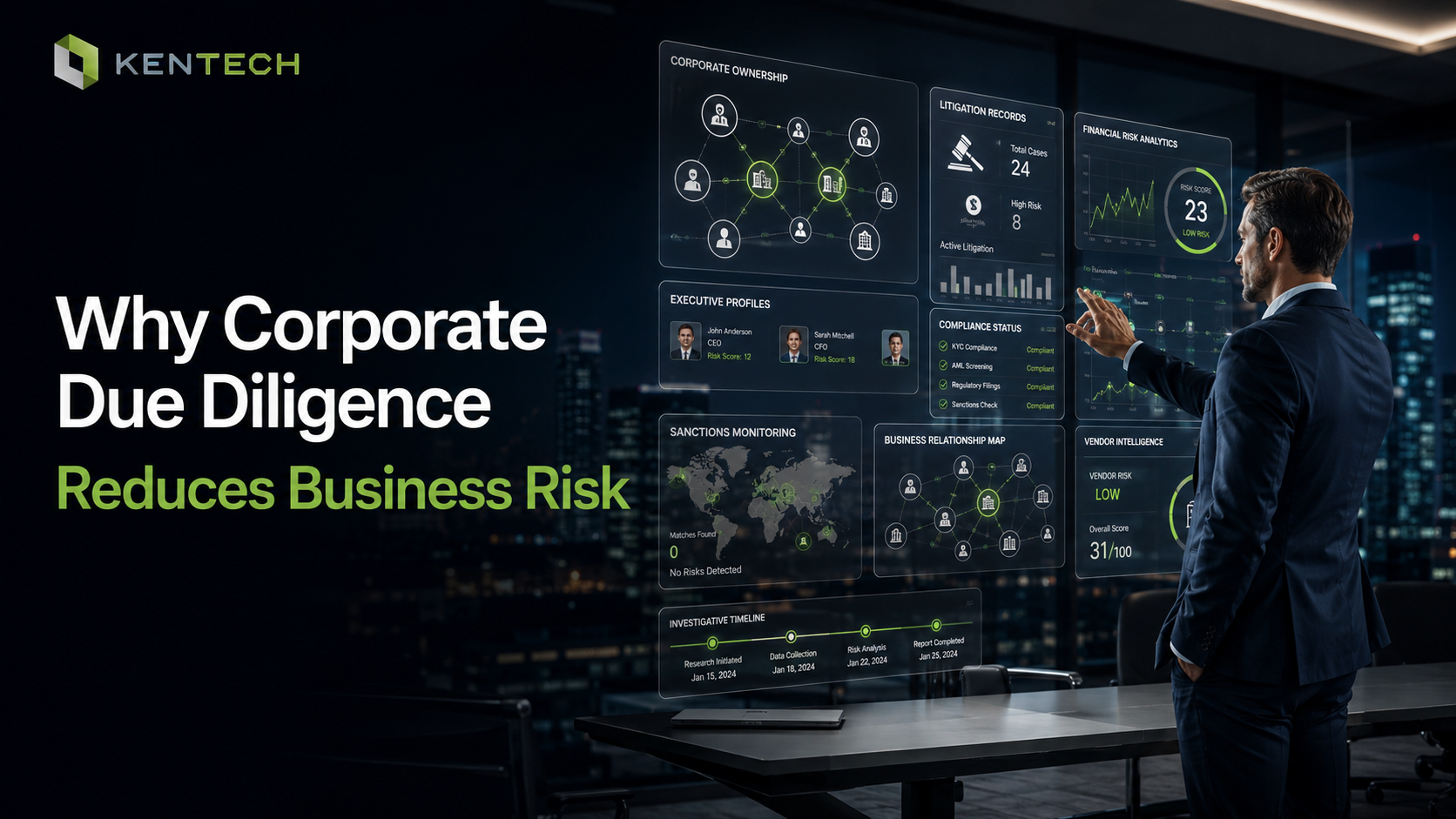
Corporate ownership structures
Business registration records
Litigation history
Regulatory compliance
Financial standing
Executive leadership backgrounds
Reputation and public records
Sanctions and watchlist information
Vendor history
Operational risks
Every investigation is tailored to the specific business objective, allowing organizations to gather meaningful intelligence before making high-value decisions.
Why Due Diligence Matters More Than Ever
Today's business environment is more interconnected than ever before.
Organizations frequently collaborate with external vendors, contractors, investors, technology providers, consultants, and strategic partners located across multiple regions and countries.
While these relationships create opportunities for growth and innovation, they also introduce new categories of risk.
A vendor experiencing financial instability may fail to deliver critical services. A merger candidate may have undisclosed legal disputes. A potential executive hire may present conflicts of interest that are not immediately visible. Even an investment opportunity that appears promising on paper may involve regulatory or operational concerns that deserve closer examination.
Without a structured due diligence process, organizations risk making decisions based on incomplete or inaccurate information.
Corporate due diligence helps reduce uncertainty by replacing assumptions with verified intelligence.
Business Decisions That Benefit from Due Diligence
Many business leaders associate due diligence only with mergers and acquisitions.
In reality, corporate investigations provide valuable insights across a wide range of business activities.
Mergers and Acquisitions
Before acquiring another company, organizations should understand the financial health, operational risks, legal obligations, and regulatory history of the business they plan to purchase.
Comprehensive due diligence helps identify potential liabilities before the transaction is finalized.
Vendor and Supplier Selection
Third-party vendors often gain access to sensitive systems, customer information, or critical business operations.
Vendor due diligence helps organizations evaluate financial stability, compliance history, litigation records, and reputational concerns before establishing long-term partnerships.
Executive Hiring
Senior executives influence company culture, financial performance, regulatory compliance, and strategic direction.
Executive due diligence provides additional insight into professional history, leadership experience, business affiliations, and potential conflicts of interest, helping boards and hiring committees make informed leadership decisions.
Investment Opportunities
Investors, private equity firms, and financial institutions frequently conduct due diligence before committing capital.
Verifying business information, leadership credibility, operational performance, and market risks helps investors make more confident investment decisions.
Business Partnerships
Strategic alliances can create tremendous opportunities for growth.
However, partnering with organizations that have unresolved compliance issues, financial instability, or reputational concerns may expose your business to unnecessary risk.
Due diligence investigations help organizations establish partnerships based on verified information rather than assumptions.
Common Risks Hidden Beneath the Surface
One of the greatest values of corporate due diligence is its ability to uncover issues that may not be immediately visible through standard research.
Some examples include:
Undisclosed litigation
Regulatory enforcement actions
Financial instability
Ownership disputes
Sanctioned individuals or organizations
Fraud indicators
Negative media trends
Reputation concerns
Compliance violations
Undisclosed business relationships
Individually, these issues may appear manageable.
Collectively, however, they can significantly influence the success of an acquisition, partnership, investment, or executive appointment.
Identifying these concerns before agreements are finalized allows organizations to negotiate more effectively, adjust risk strategies, or reconsider opportunities altogether.
Due Diligence Is More Than a Financial Review
Many organizations mistakenly view due diligence as simply reviewing financial statements.
While financial analysis remains important, modern due diligence extends far beyond accounting records.
Today's investigations examine operational performance, legal compliance, executive credibility, corporate governance, cybersecurity considerations, supply chain risks, public reputation, and regulatory history.
This broader perspective provides leadership teams with a more complete understanding of the organization they intend to work with.
The result is not simply more information—but better intelligence that supports smarter strategic decisions.
How Technology Is Transforming Corporate Due Diligence
The way organizations conduct due diligence has changed dramatically over the past decade. Traditionally, investigations relied heavily on manual research, paper records, interviews, and time-consuming document reviews. While these methods remain valuable, today's business environment demands faster access to reliable information without compromising accuracy.
Modern technology has made due diligence more efficient by helping organizations collect, organize, and analyze large volumes of information from multiple trusted sources.
Digital investigation platforms can streamline public records research, identify potential regulatory concerns, monitor sanctions lists, track corporate ownership structures, and flag inconsistencies that may require additional review. Artificial intelligence can also help detect patterns and relationships that might otherwise be overlooked during manual investigations.
These tools enable decision-makers to access critical information more quickly, allowing businesses to evaluate opportunities with greater confidence while reducing administrative workloads.
However, technology should never be viewed as a replacement for experienced investigators.
Business relationships are often complex. Corporate structures, executive histories, legal matters, and regulatory issues frequently require professional interpretation. Human investigators provide context, validate findings, and evaluate information that automated systems alone cannot fully assess.
The most effective due diligence programs combine advanced technology with investigative expertise, giving organizations both speed and accuracy throughout the decision-making process.
Building an Effective Corporate Due Diligence Process
Every organization has a different level of risk tolerance, but a structured due diligence process helps ensure important information is not overlooked.
The first step is defining the purpose of the investigation. The scope of due diligence should align with the business decision being considered. Acquiring a company requires different investigative priorities than evaluating a software vendor or appointing a new executive.
Once objectives are established, organizations should identify the areas requiring verification. Depending on the situation, this may include financial stability, legal matters, regulatory compliance, executive backgrounds, operational performance, cybersecurity practices, or reputational history.
Documentation is equally important. Every investigation should maintain clear records of information sources, verification methods, identified risks, and investigative findings. Well-documented due diligence supports stronger governance and provides valuable reference material for future business decisions.
Organizations should also recognize that due diligence is not a one-time event. Long-term partnerships, major suppliers, outsourced service providers, and strategic alliances should be reviewed periodically to ensure that new risks have not emerged after the initial agreement.
Common Due Diligence Mistakes Organizations Make
Even experienced businesses sometimes underestimate the importance of comprehensive investigations.
One common mistake is relying solely on information provided by the other party. Marketing materials, financial presentations, and self-reported documentation may present a positive picture but may not reveal legal disputes, compliance concerns, or operational weaknesses.
Another frequent oversight is focusing exclusively on financial performance. Although financial health is important, organizations should also evaluate governance practices, litigation history, regulatory standing, cybersecurity preparedness, leadership integrity, and public reputation.
Some businesses also postpone due diligence until negotiations are nearly complete. Discovering significant concerns late in the process can delay transactions, increase costs, or create unnecessary pressure to move forward despite unresolved risks.
Consistency is another challenge. Applying different investigative standards to different transactions may result in gaps that expose organizations to avoidable risk. Establishing standardized due diligence procedures helps create a more reliable decision-making framework.
Finally, businesses should avoid treating due diligence as a compliance requirement alone. Its greatest value lies in providing actionable intelligence that supports stronger strategic planning and long-term business success.
Corporate Due Diligence Across the Business Lifecycle
Although corporate due diligence is often associated with mergers and acquisitions, its value extends throughout the entire business lifecycle.
Organizations can use due diligence when evaluating new suppliers, selecting outsourcing partners, expanding into international markets, appointing board members, renewing major contracts, or assessing investment opportunities.
Regular due diligence also supports enterprise risk management by helping organizations identify emerging issues before they become operational challenges.
As businesses grow, their networks of vendors, partners, contractors, and service providers become increasingly complex. Ongoing due diligence enables leadership teams to maintain visibility across these relationships while supporting stronger governance and accountability.
By incorporating investigations into routine business processes, organizations move from reactive risk management to a proactive strategy focused on prevention and informed decision-making.
The Future of Corporate Due Diligence
As organizations continue operating in increasingly connected and data-driven environments, corporate due diligence will become even more sophisticated.
Artificial intelligence, predictive analytics, secure digital records, and advanced business intelligence platforms will improve the speed and depth of investigations, allowing organizations to identify risks more efficiently than ever before.
Continuous monitoring will also play a larger role in due diligence. Instead of conducting investigations only before major transactions, businesses are beginning to monitor critical vendors, strategic partners, and key executives throughout the relationship lifecycle. This proactive approach helps organizations respond more quickly to changing risk conditions.
At the same time, the role of experienced investigators will remain essential. Technology can process information rapidly, but evaluating credibility, understanding business context, and interpreting complex findings still require professional expertise.
Organizations that successfully combine intelligent technology with experienced investigative professionals will be better equipped to navigate uncertainty while making confident, evidence-based decisions.
Conclusion
Every important business decision involves a degree of risk, but uncertainty should never replace informed judgment.
Corporate due diligence provides organizations with the information needed to evaluate opportunities, verify critical facts, and identify potential risks before significant commitments are made. Whether assessing an acquisition, selecting a strategic vendor, hiring a senior executive, or entering a new partnership, thorough investigations help reduce uncertainty while supporting smarter business decisions.
Effective due diligence goes beyond financial analysis. It examines operational performance, legal history, regulatory compliance, executive backgrounds, reputational factors, and broader business intelligence to provide a more complete picture of the organizations and individuals involved.
As business relationships become more complex and interconnected, comprehensive due diligence will remain a vital component of responsible corporate governance. Organizations that invest in structured investigations, reliable intelligence, and consistent risk assessment practices will be better positioned to protect their assets, strengthen partnerships, and achieve sustainable long-term growth.