
Every business depends on trusted relationships.
Whether it's a technology provider managing sensitive systems, a logistics company handling customer deliveries, a cleaning contractor with after-hours building access, or a consulting firm supporting strategic initiatives, third-party vendors have become an essential part of modern business operations.
These partnerships help organizations improve efficiency, reduce costs, and access specialized expertise. However, they also introduce risks that many companies fail to evaluate thoroughly.
While employers often invest significant time and resources screening new employees, the same level of attention is not always given to vendors, suppliers, contractors, or outsourced service providers—even though these organizations may have access to confidential data, financial systems, intellectual property, or secure facilities.
As supply chains become increasingly connected and businesses rely more heavily on external partners, vendor background checks have become a critical component of effective third-party risk management.
A structured vendor screening process enables organizations to identify potential concerns before entering into business relationships, helping reduce operational, financial, legal, and reputational risks.
What Are Vendor Background Checks?
Vendor background checks are investigations conducted before establishing or renewing a business relationship with an outside company, supplier, contractor, consultant, or service provider.
Unlike employee background screening, which focuses on an individual's qualifications and history, vendor screening evaluates the organization itself and, when appropriate, the key individuals responsible for managing the business relationship.
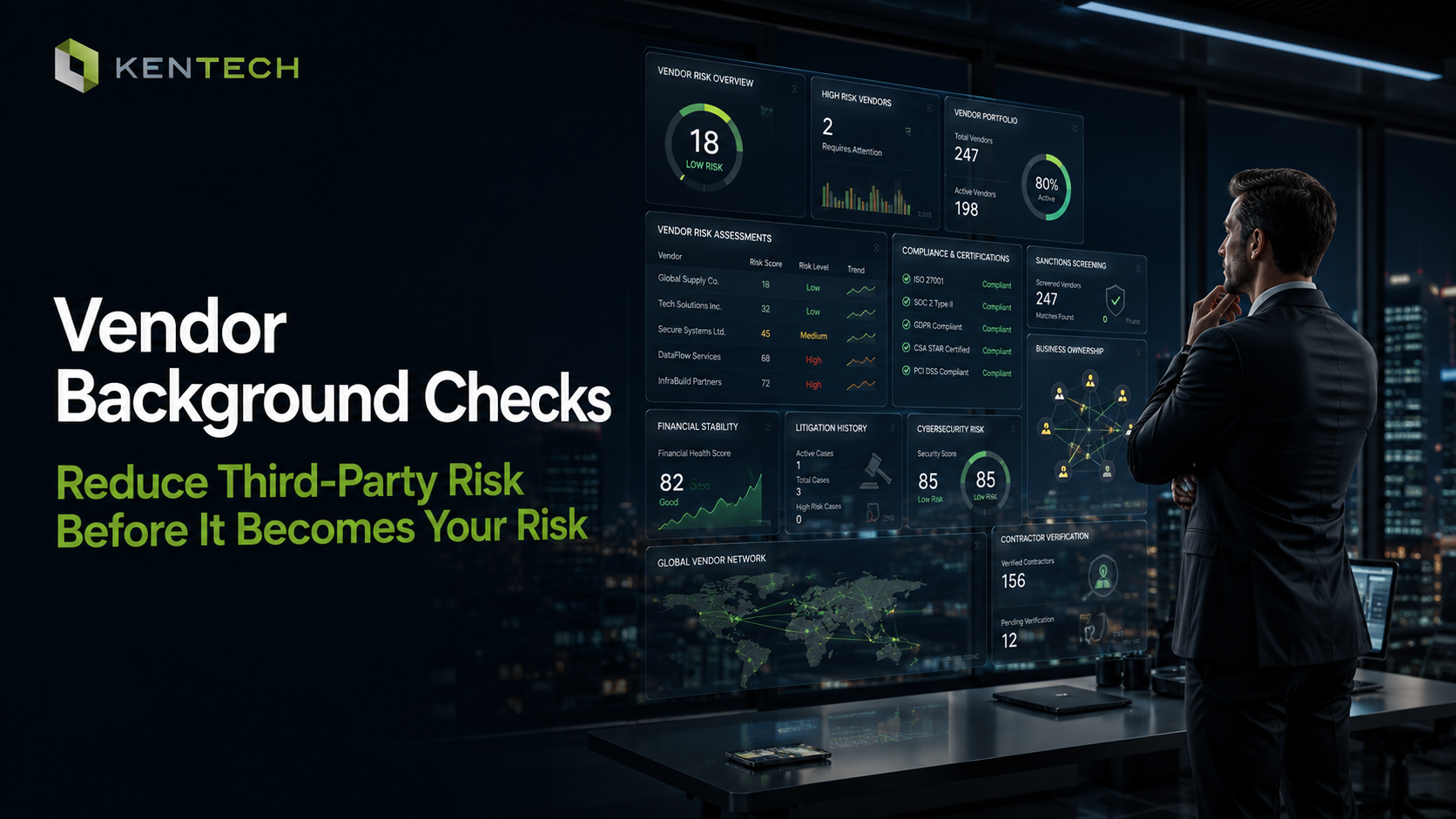
Depending on the nature of the engagement, vendor background checks may include:
Business registration verification
Corporate ownership research
Litigation history
Regulatory compliance reviews
Financial stability assessments
Sanctions and watchlist screening
Executive background investigations
Reputation analysis
Public records research
Industry certifications and licensing
The purpose is not simply to identify problems but to verify that the vendor meets your organization's standards for reliability, compliance, and operational integrity.
Why Third-Party Risk Is Growing
Today's organizations depend on a broad ecosystem of external partners.
Cloud software providers manage sensitive information. Payroll vendors process employee data. Marketing agencies access customer databases. Contractors enter secure facilities. Managed service providers oversee critical IT infrastructure.
Each of these relationships creates opportunities for growth—but also introduces new areas of exposure.
A security incident involving a vendor can disrupt business operations, compromise confidential information, damage customer trust, and create significant financial consequences.
In many cases, organizations remain responsible for the actions of third-party providers, particularly when vendors handle regulated information or perform services on the organization's behalf.
As cybersecurity threats, regulatory expectations, and supply chain complexity continue to evolve, businesses are placing greater emphasis on understanding who they are working with before signing contracts.
Vendor background checks provide the intelligence needed to make informed partnership decisions.
Common Risks Associated With Vendors
Not every vendor presents the same level of risk, but every third-party relationship should be evaluated according to its potential impact on the organization.
Some of the most common risks include:
Financial Instability
A vendor experiencing financial difficulties may struggle to fulfill contractual obligations, causing delays, service interruptions, or unexpected project failures.
Understanding a vendor's financial health helps organizations reduce operational disruptions and improve long-term planning.
Regulatory and Compliance Issues
Organizations operating in regulated industries must ensure that vendors comply with applicable laws, industry standards, and contractual requirements.
Working with vendors that have unresolved regulatory violations may expose businesses to compliance risks and reputational harm.
Data Security Concerns
Many vendors process or store confidential information on behalf of their clients.
Without proper due diligence, organizations may unknowingly partner with companies that lack strong cybersecurity practices or data protection controls.
Vendor screening helps identify potential concerns before sensitive information is shared.
Reputational Risk
Your organization's reputation is often influenced by the companies you choose to work with.
Negative publicity, unethical business practices, fraud allegations, or ongoing legal disputes involving a vendor can quickly affect customer confidence and stakeholder trust.
Evaluating public records, litigation history, and reputation indicators provides valuable insight into potential partnership risks.
Industries That Benefit Most From Vendor Background Checks
Although vendor screening is valuable across nearly every industry, some sectors face elevated levels of operational and regulatory risk.
Healthcare
Hospitals, healthcare systems, and medical providers regularly work with technology vendors, equipment suppliers, staffing agencies, and service providers that have access to sensitive patient information and regulated environments.
Vendor background checks support stronger compliance while helping protect patient privacy.
Financial Services
Banks, insurance companies, investment firms, and financial institutions frequently outsource specialized services ranging from technology support to payment processing.
Screening third-party providers helps reduce fraud risks, strengthen regulatory compliance, and protect confidential financial information.
Technology
Technology companies rely on software developers, cloud providers, cybersecurity consultants, and managed service organizations that often receive extensive access to proprietary systems and intellectual property.
Conducting thorough vendor due diligence supports stronger information security and operational resilience.
Government and Public Sector
Government agencies regularly engage contractors, consultants, and external suppliers to deliver essential services.
Vendor screening helps verify organizational integrity, regulatory compliance, and overall suitability before public resources are entrusted to third parties.
Best Practices for Building an Effective Vendor Screening Program
Conducting vendor background checks should not be treated as a one-time administrative task. Instead, organizations should establish a consistent screening framework that aligns with their overall risk management strategy.
The first step is to classify vendors based on the level of access they will have to your business. A company providing office supplies presents a very different level of risk than a cloud software provider with access to sensitive customer information or a contractor working inside secure facilities.
By categorizing vendors according to risk, organizations can apply screening requirements that are appropriate for each relationship.
It is also important to define standardized evaluation criteria before selecting a vendor. Reviewing every potential partner using the same process helps eliminate inconsistencies and demonstrates a commitment to fairness, governance, and compliance.
Vendor screening should also become part of the procurement process rather than an afterthought. Conducting due diligence before contracts are finalized allows organizations to identify concerns early, negotiate appropriate safeguards, or explore alternative providers if necessary.
Finally, businesses should document every stage of the review process. Maintaining records of verification results, risk assessments, and supporting documentation strengthens internal governance and provides valuable evidence during audits or regulatory reviews.
How Technology Is Improving Vendor Background Checks
The growing complexity of global supply chains has made manual vendor investigations increasingly difficult.
Organizations often manage hundreds—or even thousands—of vendors across multiple locations, making it challenging to evaluate every relationship using traditional research methods alone.
Modern technology helps streamline vendor background checks by collecting, organizing, and analyzing information from trusted data sources more efficiently.
Digital investigation platforms can assist organizations in monitoring business registrations, sanctions lists, litigation records, regulatory databases, and other publicly available information. Automated workflows also help procurement and compliance teams manage documentation, monitor screening progress, and maintain consistent evaluation standards.
Artificial intelligence further enhances the process by identifying patterns, highlighting potential anomalies, and connecting information from multiple sources that may warrant additional investigation.
However, technology should support—not replace—experienced investigators.
Complex corporate structures, legal matters, ownership relationships, and reputational concerns often require professional judgment. Human expertise provides context, validates findings, and helps organizations interpret information accurately before making important business decisions.
The combination of advanced technology and experienced investigative professionals provides a stronger foundation for effective vendor risk management.
Common Mistakes Organizations Make
Even organizations with established procurement processes sometimes overlook important aspects of vendor screening.
One common mistake is assuming that a well-known brand or long-established company automatically presents minimal risk. Every vendor relationship should be evaluated based on current information rather than reputation alone.
Another frequent oversight is conducting due diligence only during the initial onboarding process. Businesses change over time. Financial conditions, ownership structures, regulatory status, and legal matters can evolve long after a contract has been signed.
Organizations also make the mistake of focusing exclusively on price when selecting vendors. While cost remains an important consideration, choosing the lowest-priced provider without evaluating operational, compliance, or reputational risks may lead to far greater expenses in the future.
Inconsistent screening standards can also create unnecessary exposure. Applying different review processes across departments or business units increases the likelihood that critical information will be overlooked.
Developing a standardized vendor screening policy helps ensure every significant business relationship receives an appropriate level of evaluation.
Why Vendor Monitoring Should Continue After Onboarding
Vendor background checks should not end once a contract has been signed.
Long-term business relationships require ongoing oversight to identify changes that could affect organizational risk.
A vendor that met all compliance requirements at the beginning of a partnership may later experience financial difficulties, leadership changes, regulatory investigations, cybersecurity incidents, or legal disputes.
Periodic reviews and continuous monitoring allow organizations to identify these developments early and respond proactively before they affect operations.
For businesses operating in highly regulated industries, ongoing vendor oversight also supports compliance with evolving regulatory expectations related to third-party risk management.
By treating vendor screening as a continuous process rather than a one-time event, organizations strengthen resilience while reducing the likelihood of unexpected disruptions.
The Future of Third-Party Risk Management
As organizations continue expanding their networks of suppliers, technology providers, consultants, and outsourcing partners, vendor background checks will play an increasingly important role in enterprise risk management.
Artificial intelligence, predictive analytics, and business intelligence platforms are enabling organizations to evaluate third-party relationships more efficiently than ever before. These technologies help identify emerging risks, monitor changes in vendor profiles, and support faster decision-making without sacrificing accuracy.
At the same time, regulatory expectations surrounding third-party oversight continue to evolve. Organizations are expected to demonstrate greater visibility into the companies they work with, particularly when vendors handle sensitive information or provide critical business services.
Businesses that invest in structured vendor screening programs today will be better positioned to adapt to changing regulations, strengthen operational resilience, and build more secure supply chain partnerships.
Conclusion
Every vendor relationship represents both an opportunity and a potential source of risk.
Third-party providers often gain access to sensitive systems, confidential information, operational processes, and customer data, making vendor background checks an essential part of responsible business management.
A comprehensive vendor screening program helps organizations verify business credentials, assess financial and regulatory risks, evaluate reputational concerns, and make informed partnership decisions before contracts are finalized. When combined with ongoing monitoring and consistent evaluation standards, vendor background checks become a valuable component of enterprise risk management rather than simply a procurement requirement.
As businesses become increasingly interconnected, organizations that prioritize third-party due diligence will be better equipped to protect their operations, strengthen compliance, and build trusted partnerships that support sustainable long-term growth.