
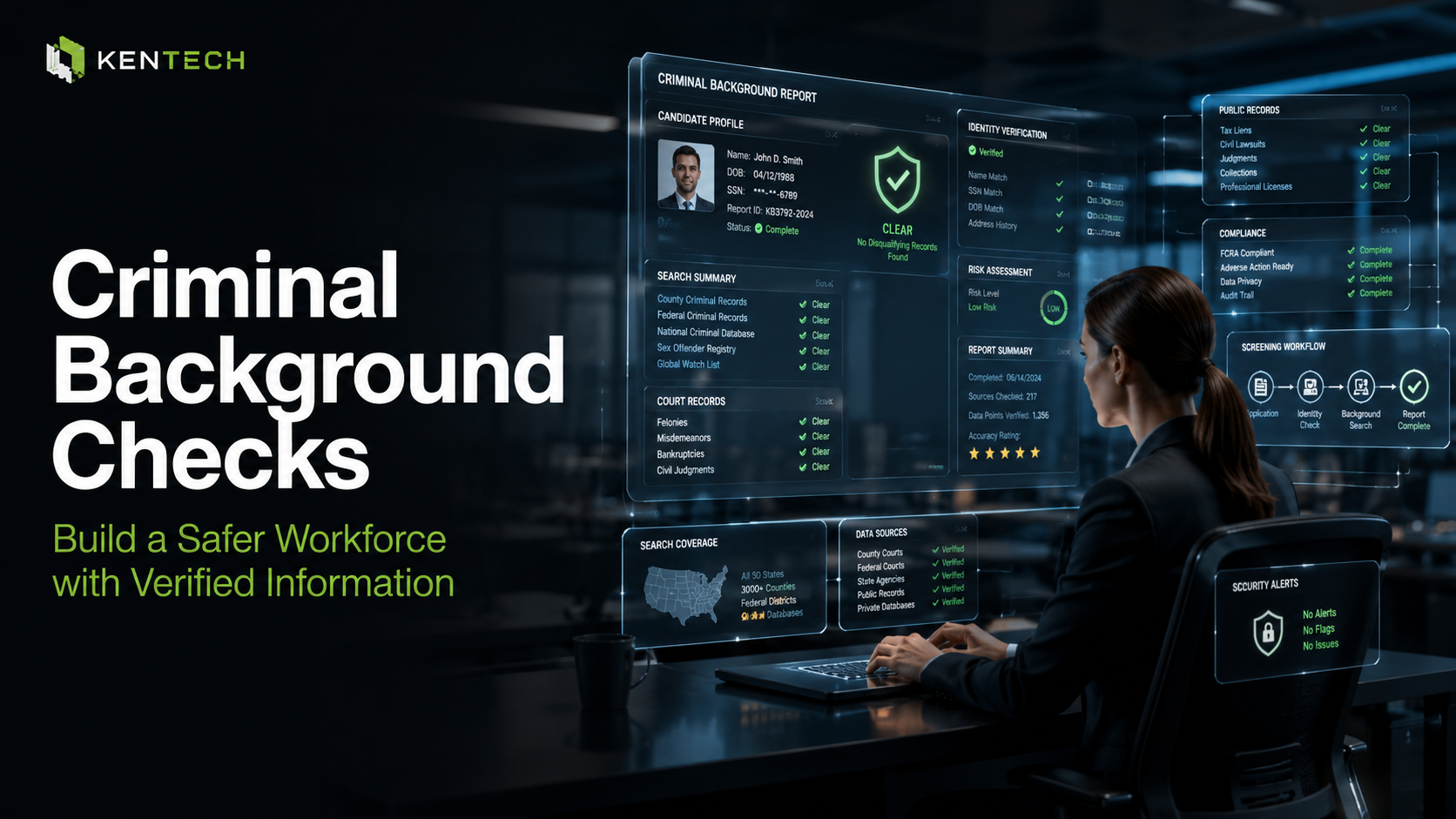
Hiring the right people is one of the most important decisions an organization can make. Every new employee contributes to workplace culture, operational success, customer relationships, and the overall reputation of the business.
While resumes, interviews, and professional references provide valuable insight into a candidate's qualifications, they represent only part of the hiring process. Employers also need reliable information that helps them evaluate potential risks while maintaining fair, compliant, and consistent hiring practices.
This is where criminal background checks play an essential role.
Rather than serving as a tool to automatically disqualify candidates, criminal background checks provide employers with verified information that supports informed employment decisions. When conducted responsibly and in compliance with applicable laws, they help organizations strengthen workplace safety, reduce organizational risk, and demonstrate due diligence throughout the hiring process.
As hiring becomes increasingly competitive and regulatory expectations continue to evolve, criminal background screening remains one of the most valuable components of a comprehensive employment screening program.
What Are Criminal Background Checks?
A criminal background check is a process used to determine whether an applicant has publicly reportable criminal history that may be relevant to the position being considered.
Depending on applicable laws, employer policies, and the nature of the role, criminal background checks may include searches of:
County court records
State criminal records
Federal court records
National criminal databases
Sex offender registries
Global watchlists and sanctions databases, when appropriate
Public records relevant to employment screening
The scope of a background check varies depending on the employer's industry, regulatory requirements, job responsibilities, and jurisdiction.
Employers should ensure that every screening program complies with applicable federal, state, and local regulations governing employment background checks.
Why Criminal Background Checks Matter
Organizations have a responsibility to provide a safe and secure environment for employees, customers, clients, and business partners.
While no screening process can predict future behavior, criminal background checks provide verified information that helps employers better understand potential risks before making hiring decisions.
For positions involving financial responsibilities, access to confidential information, vulnerable populations, secure facilities, or company assets, background screening can become an important component of organizational risk management.
Criminal background checks also support businesses by helping them:
Strengthen workplace safety
Protect customers and clients
Reduce organizational risk
Support regulatory compliance
Promote informed hiring decisions
Demonstrate due diligence
Maintain consistent hiring standards
When integrated into a broader employment screening strategy, criminal background checks help employers evaluate candidates using verified information rather than assumptions.
Criminal Background Checks Are About Context—Not Automatic Disqualification
One of the most common misconceptions surrounding criminal background checks is that any criminal record automatically prevents someone from being hired.
In reality, responsible employers evaluate information within the context of the position being filled and the legal requirements governing hiring decisions.
Factors that may be considered include:
The nature of the offense
The relevance of the offense to the job
The amount of time that has passed
Evidence of rehabilitation
Applicable employment laws
Organizational hiring policies
Many jurisdictions have implemented fair chance hiring initiatives that encourage employers to consider qualified applicants based on the complete picture rather than focusing solely on criminal history.
A well-designed screening program helps employers make individualized, legally compliant decisions that balance workplace safety with fair employment opportunities.
Industries That Commonly Require Criminal Background Checks
Although criminal background screening is valuable across many industries, some sectors have heightened responsibilities because of the nature of their work.
Healthcare
Hospitals, clinics, long-term care facilities, and healthcare providers often require criminal background checks to help protect patients and comply with industry regulations.
Financial Services
Banks, insurance companies, investment firms, and financial institutions frequently screen employees who manage sensitive financial information or customer assets.
Education
Schools, universities, childcare providers, and educational organizations commonly conduct background checks for positions involving direct interaction with children and young adults.
Government
Public agencies often require criminal background screening for employees, contractors, and consultants working with sensitive information or public resources.
Technology
Technology companies increasingly screen employees who have access to proprietary software, cybersecurity systems, customer databases, and confidential intellectual property.
Transportation and Logistics
Organizations responsible for transportation, shipping, warehousing, and supply chain operations often use criminal background checks as part of broader workforce risk management and security initiatives.
Criminal Background Checks as Part of a Comprehensive Screening Strategy
Although criminal history screening is valuable, it should never be the only source of information used during the hiring process.
Employers benefit most when criminal background checks are combined with other employment verification services that provide a more complete understanding of a candidate's qualifications.
A comprehensive employment screening program may include:
Identity verification
Employment verification
Education verification
Professional license verification
Reference checks
Criminal background checks
Drug testing, where appropriate
Compliance screening
Together, these services provide employers with a more balanced and informed approach to hiring while supporting consistency across the recruitment process.
Fair Hiring and Compliance Considerations
Criminal background checks are an important part of responsible hiring, but they must always be conducted fairly, consistently, and in accordance with applicable laws and regulations.
Employers should establish written screening policies that clearly define when criminal background checks are required, which positions require screening, and how results will be evaluated. Applying the same standards to similarly situated candidates helps promote consistency and reduce the risk of discriminatory hiring practices.
Organizations should also remember that a criminal background check is only one component of a candidate's overall profile. Hiring decisions should consider the individual's qualifications, work experience, skills, and the relevance of any criminal history to the responsibilities of the position.
Many jurisdictions have adopted "Fair Chance" or "Ban the Box" laws that regulate when employers may inquire about criminal history during the hiring process. Understanding and complying with these requirements is essential for reducing legal risk while maintaining fair employment practices.
By combining criminal background checks with thoughtful hiring policies, businesses can support workplace safety while respecting the rights of job applicants.
How Technology Is Improving Criminal Background Checks
Advances in technology have significantly improved the speed, efficiency, and accuracy of criminal background screening.
Modern employment screening platforms allow employers to securely collect candidate information, manage authorization forms, track screening progress, and receive verified results through centralized digital systems. These solutions reduce administrative workloads while helping HR teams make hiring decisions more efficiently.
Technology also improves consistency by standardizing workflows and reducing manual errors that can occur when information is gathered from multiple sources.
Artificial intelligence is further enhancing employment screening by helping identify inconsistencies, organize large volumes of public records, and streamline investigative workflows. However, AI should always support—not replace—professional judgment.
Experienced background screening professionals remain essential for interpreting search results, resolving record discrepancies, verifying identities, and ensuring that reports are accurate and legally compliant.
The combination of advanced technology and human expertise creates a more reliable screening process that supports both employers and job applicants.
Common Mistakes Employers Should Avoid
Even organizations with established hiring procedures can unintentionally weaken their background screening programs by overlooking important best practices.
One common mistake is applying the same criminal background check to every position regardless of job responsibilities. Different roles carry different levels of risk, and screening should reflect the nature of each position.
Another frequent error is relying solely on criminal history while overlooking other important verification services such as identity verification, employment verification, education verification, or professional license verification. A comprehensive employment screening program provides a more complete understanding of every candidate.
Some employers also fail to keep their screening policies updated as employment laws continue to evolve. Regularly reviewing hiring procedures helps organizations remain compliant with changing federal, state, and local regulations.
Finally, businesses should avoid making hiring decisions based solely on incomplete or unverified information. Every screening result should be reviewed carefully and, when appropriate, evaluated alongside other relevant factors to support fair and informed decision-making.
Criminal Background Checks Within a Broader Risk Management Strategy
Organizations that view criminal background checks as part of a larger workforce risk management strategy are better positioned to make consistent hiring decisions.
Background screening works most effectively when integrated with broader hiring and compliance practices, including workforce intelligence, identity verification, employment verification, and ongoing compliance monitoring.
Together, these services help organizations verify candidate information, strengthen workplace security, reduce fraud risks, and support regulatory compliance throughout the employment lifecycle.
As businesses continue expanding into remote work, hybrid environments, and global hiring, adopting a comprehensive approach to employment screening becomes increasingly important.
Rather than focusing on a single screening component, employers benefit from creating a structured program that provides reliable information while promoting fairness, transparency, and accountability.
The Future of Criminal Background Screening
Employment screening continues to evolve alongside changing technology, workforce expectations, and regulatory requirements.
Digital court records, secure identity verification, artificial intelligence, and workforce intelligence platforms are making criminal background checks more efficient while improving the accuracy of verification processes.
Continuous monitoring is also becoming more common in industries where ongoing compliance and workplace safety are critical. Instead of relying solely on pre-employment screening, some organizations are implementing ongoing risk monitoring programs that help identify reportable changes throughout the employment relationship, when legally appropriate.
At the same time, employers are placing greater emphasis on fair hiring practices. Modern background screening is increasingly focused on balancing workplace safety with equal employment opportunities, ensuring that hiring decisions are based on verified information, relevant job requirements, and consistent evaluation standards.
Organizations that embrace both innovation and responsible screening practices will be better equipped to build qualified, trustworthy, and resilient workforces.
Conclusion
Criminal background checks remain one of the most valuable tools available to employers seeking to build safer workplaces and make informed hiring decisions. When conducted responsibly, they provide verified information that supports workplace security, regulatory compliance, and organizational risk management without replacing thoughtful, individualized candidate evaluations.
An effective criminal background screening program goes beyond simply identifying criminal records. It becomes part of a broader employment screening strategy that includes identity verification, employment history verification, professional credential verification, and other services that help employers understand the complete picture of each candidate.
As hiring continues to evolve, organizations that invest in comprehensive, fair, and compliant background screening practices will be better positioned to reduce risk, strengthen trust, and support long-term business success. By combining modern technology with experienced investigative expertise, employers can make confident hiring decisions while fostering safe, productive, and inclusive workplaces.