
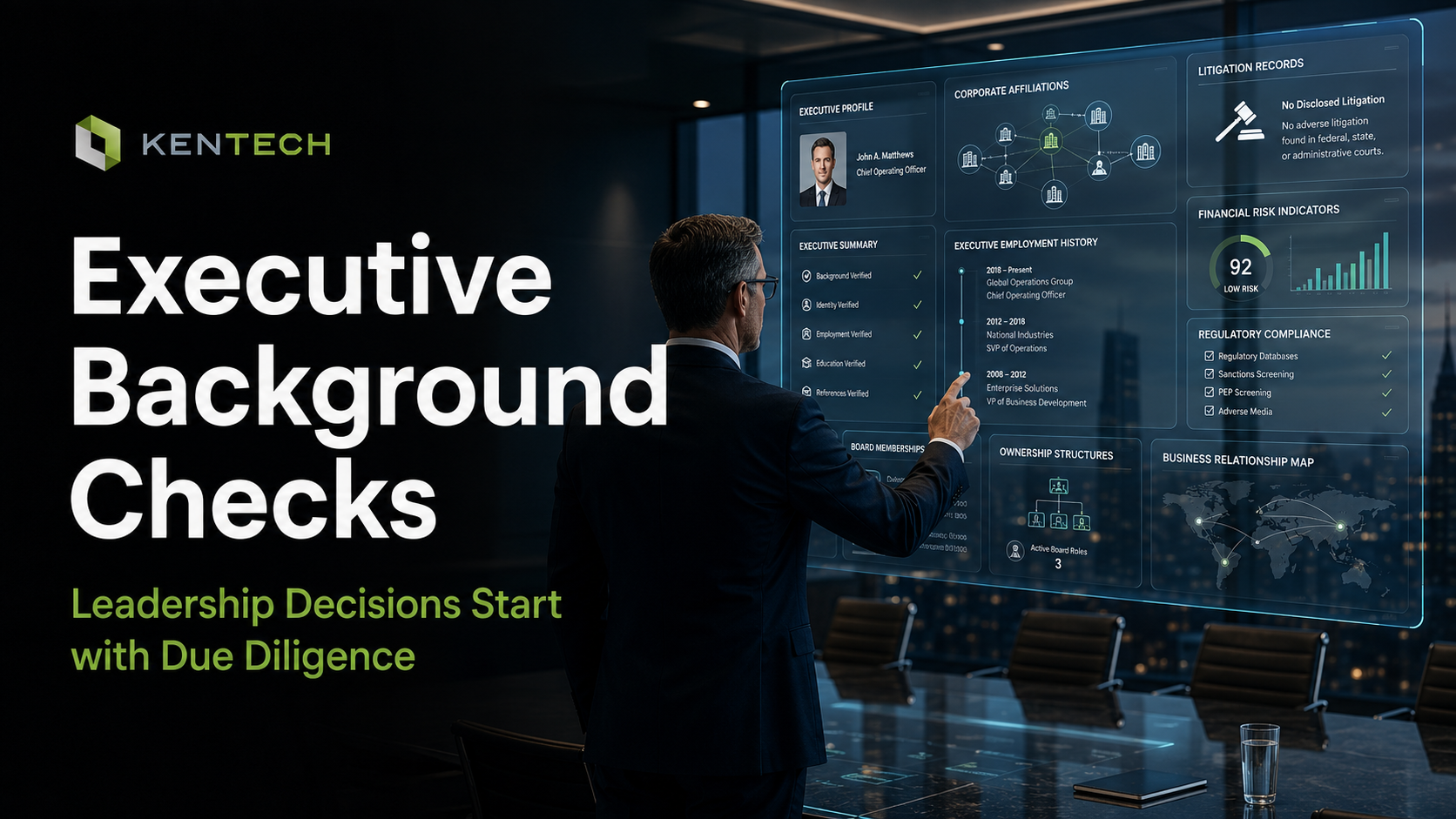
Hiring an executive is one of the most significant investments an organization can make.
Senior leaders shape company strategy, oversee financial performance, influence organizational culture, and represent the business to customers, investors, regulators, and the public. Their decisions affect every aspect of an organization—from daily operations to long-term growth.
Because executive hires carry such significant responsibility, traditional employment screening is often not enough.
A standard background check may verify identity, employment history, and criminal records, but executive-level positions require a much deeper understanding of a candidate's professional history, leadership experience, reputation, and potential business risks.
Executive background checks provide organizations with the comprehensive intelligence needed to make confident leadership decisions while protecting stakeholders, company assets, and corporate reputation.
As businesses operate in increasingly complex and highly regulated environments, executive due diligence has become an essential component of responsible corporate governance.
What Are Executive Background Checks?
Executive background checks are comprehensive investigations conducted on senior-level candidates before they are appointed to leadership positions.
Unlike traditional pre-employment screening, executive investigations examine both the professional qualifications and the broader business profile of an executive candidate.
Depending on the position and organizational requirements, executive background checks may include:
Identity verification
Employment verification
Education verification
Professional license verification
Criminal background checks
Civil litigation history
Bankruptcy records
Regulatory actions
Corporate affiliations
Executive reputation research
Media and public records reviews
Conflict-of-interest assessments
Business ownership investigations
Sanctions and watchlist screening
The objective is to provide organizations with a complete understanding of an executive candidate before making a critical hiring decision.
Why Executive Background Checks Matter
Executive leaders have access to confidential business information, financial assets, intellectual property, strategic planning, customer relationships, and organizational decision-making authority.
A poor leadership hire can create significant operational, financial, legal, and reputational consequences.
Executive background checks help organizations:
Verify executive credentials
Confirm leadership experience
Identify undisclosed business relationships
Detect potential conflicts of interest
Reduce hiring risks
Protect shareholders and stakeholders
Support corporate governance
Strengthen regulatory compliance
These investigations provide decision-makers with objective information that supports informed executive hiring rather than relying solely on resumes, interviews, or references.
Executive Screening Goes Beyond Traditional Background Checks
Many organizations assume that an executive candidate requires the same background screening process as any other employee.
In reality, executive investigations are significantly more comprehensive.
Senior executives often have decades of leadership experience, multiple corporate affiliations, board memberships, international business relationships, and extensive public visibility.
A thorough executive background check may examine:
Corporate Leadership History
Reviewing previous executive positions helps verify leadership experience while identifying organizational achievements and career progression.
Business Ownership Interests
Executives frequently maintain investments, ownership interests, or advisory roles in multiple organizations.
Understanding these relationships helps identify potential conflicts before employment begins.
Litigation History
Civil litigation involving executives may reveal disputes related to employment, business operations, contractual obligations, or corporate governance.
Reviewing publicly available legal records provides valuable context during the evaluation process.
Regulatory Compliance
Organizations operating in highly regulated industries often require executive candidates to meet specific compliance standards.
Executive investigations help identify regulatory actions, disciplinary findings, or compliance concerns that could affect leadership appointments.
Reputation Intelligence
An executive's reputation extends beyond internal business operations.
Media coverage, industry recognition, public speaking engagements, published articles, leadership awards, and publicly available information can provide valuable insight into professional credibility and influence.
Professional reputation research helps organizations better understand how executive candidates are viewed within their industries.
Industries That Benefit Most from Executive Background Checks
Although executive investigations are valuable across nearly every industry, they become especially important in organizations where leadership decisions directly influence regulatory compliance, financial performance, public trust, and shareholder value.
Financial Services
Banks, investment firms, insurance companies, and financial institutions rely heavily on executive integrity and regulatory compliance.
Executive background checks help organizations evaluate leadership candidates responsible for managing significant financial assets and regulatory obligations.
Healthcare
Healthcare executives oversee patient care operations, regulatory compliance, financial performance, and organizational governance.
Comprehensive executive investigations support informed hiring decisions while helping protect institutional reputation.
Technology
Technology companies depend on executives to manage innovation, cybersecurity, intellectual property, and strategic growth.
Executive screening helps organizations assess leadership experience while identifying potential business risks before appointments are finalized.
Government and Public Sector
Public agencies and government contractors often require enhanced due diligence for leadership positions responsible for public funds, critical infrastructure, and regulatory oversight.
Executive investigations help strengthen transparency and accountability.
Manufacturing and Global Enterprises
Large corporations with international operations often appoint executives responsible for global supply chains, mergers and acquisitions, regulatory compliance, and corporate governance.
Executive background checks provide valuable intelligence that supports long-term strategic decision-making.
Best Practices for Conducting Executive Background Checks
Executive hiring requires a structured and thorough due diligence process. Because senior leaders influence strategy, financial performance, regulatory compliance, and organizational culture, every stage of the investigation should be carefully planned and consistently executed.
Organizations should begin executive background checks as early as practical in the hiring process. Waiting until after salary negotiations or a verbal offer has been extended can create unnecessary delays and increase the risk of discovering critical information too late.
A comprehensive executive investigation should be tailored to the responsibilities of the position. While every executive screening should verify identity, employment history, education, and criminal records, organizations may also need to review litigation history, financial interests, board memberships, regulatory actions, media coverage, and business affiliations depending on the executive's role.
Maintaining consistency throughout the hiring process is equally important. Establishing standardized investigation procedures helps organizations evaluate leadership candidates fairly while supporting internal governance and regulatory compliance.
Finally, organizations should work with experienced investigative professionals who understand how to interpret complex findings, verify information through reliable sources, and provide objective intelligence that supports executive decision-making.
How Technology Is Transforming Executive Background Checks
Modern executive investigations have evolved far beyond traditional background screening.
Today's organizations have access to advanced investigative technologies that can organize large volumes of publicly available information, connect corporate relationships, and identify potential business risks more efficiently than ever before.
Artificial intelligence and workforce intelligence platforms assist investigators by analyzing executive career histories, corporate affiliations, litigation records, regulatory filings, sanctions databases, and public business records. These technologies help identify patterns and connections that may require further review.
Digital investigation tools also improve efficiency by consolidating information from multiple trusted sources into centralized reporting systems, allowing hiring teams to review findings more effectively.
However, technology alone cannot replace professional judgment.
Executive investigations often involve complex corporate structures, historical business relationships, legal matters, and reputational considerations that require careful analysis and context. Experienced investigators evaluate findings objectively, verify the accuracy of information, and distinguish meaningful risks from irrelevant or outdated information.
By combining advanced investigative technology with experienced professionals, organizations can conduct executive background checks with greater accuracy, efficiency, and confidence.
Common Mistakes Organizations Make When Hiring Executives
Even organizations with mature hiring processes sometimes underestimate the level of due diligence required for executive appointments.
One common mistake is relying exclusively on resumes and interviews. Executive candidates are typically accomplished professionals with impressive credentials, but resumes rarely provide a complete picture of leadership history, governance experience, or business relationships.
Another mistake is conducting the same background check used for entry-level employees. Executive positions carry significantly greater organizational responsibility and therefore require a broader investigative scope.
Some organizations also overlook corporate affiliations and outside business interests. Undisclosed ownership stakes, advisory roles, or board memberships may create conflicts of interest that affect executive decision-making after employment begins.
Failing to evaluate an executive's public reputation is another common oversight. Senior leaders often represent the organization publicly through media appearances, speaking engagements, industry events, and professional publications. Understanding how an executive is perceived within the industry can provide valuable insight into leadership credibility and reputational risk.
Lastly, organizations sometimes treat executive background checks as a one-time hiring requirement. Leadership risk continues to evolve throughout an executive's tenure, making ongoing monitoring an increasingly valuable component of corporate governance.
Why Ongoing Executive Monitoring Matters
Executive risk does not end after an employment contract is signed.
Senior leaders may assume additional board positions, become involved in new business ventures, face regulatory inquiries, or experience changes that affect their professional responsibilities over time.
Continuous executive monitoring helps organizations remain informed about significant developments that may influence corporate governance, compliance obligations, or organizational reputation.
Depending on the organization's industry and regulatory environment, ongoing monitoring may include updates related to:
Criminal records
Civil litigation
Regulatory actions
Professional licensing status
Corporate ownership changes
Sanctions and watchlists
Public media coverage
Executive business affiliations
By monitoring these developments responsibly and in accordance with applicable laws, organizations can respond proactively to emerging risks while strengthening governance and protecting stakeholder confidence.
The Future of Executive Background Screening
Executive due diligence continues to evolve as organizations face increasing regulatory expectations, global business expansion, and heightened scrutiny from investors, customers, and regulators.
Artificial intelligence, predictive analytics, and workforce intelligence platforms are making executive investigations more comprehensive by helping investigators analyze larger volumes of information with greater efficiency.
At the same time, organizations are placing greater emphasis on environmental, social, and governance (ESG) initiatives, ethical leadership, cybersecurity oversight, and corporate transparency. These priorities are expanding the scope of executive background checks beyond traditional employment verification.
Future executive investigations will increasingly combine advanced technology with experienced investigative professionals who can evaluate complex information, verify findings, and provide meaningful business intelligence that supports strategic hiring decisions.
Organizations that adopt a proactive approach to executive due diligence will be better positioned to identify leadership risks before they affect business performance, reputation, or stakeholder trust.
Conclusion
Executive hiring represents one of the most important decisions an organization can make. Senior leaders influence strategic direction, financial performance, regulatory compliance, organizational culture, and public reputation, making comprehensive due diligence essential before any appointment is finalized.
Executive background checks provide organizations with far more than basic employment verification. By evaluating leadership experience, corporate affiliations, litigation history, regulatory records, business relationships, and professional reputation, organizations gain the intelligence needed to make informed leadership decisions while reducing operational and reputational risk.
As businesses continue operating in an increasingly complex and highly regulated environment, executive investigations have become a critical component of effective corporate governance. Combining advanced investigative technology with experienced professionals allows organizations to strengthen hiring decisions, protect stakeholders, and build leadership teams capable of supporting long-term success.