
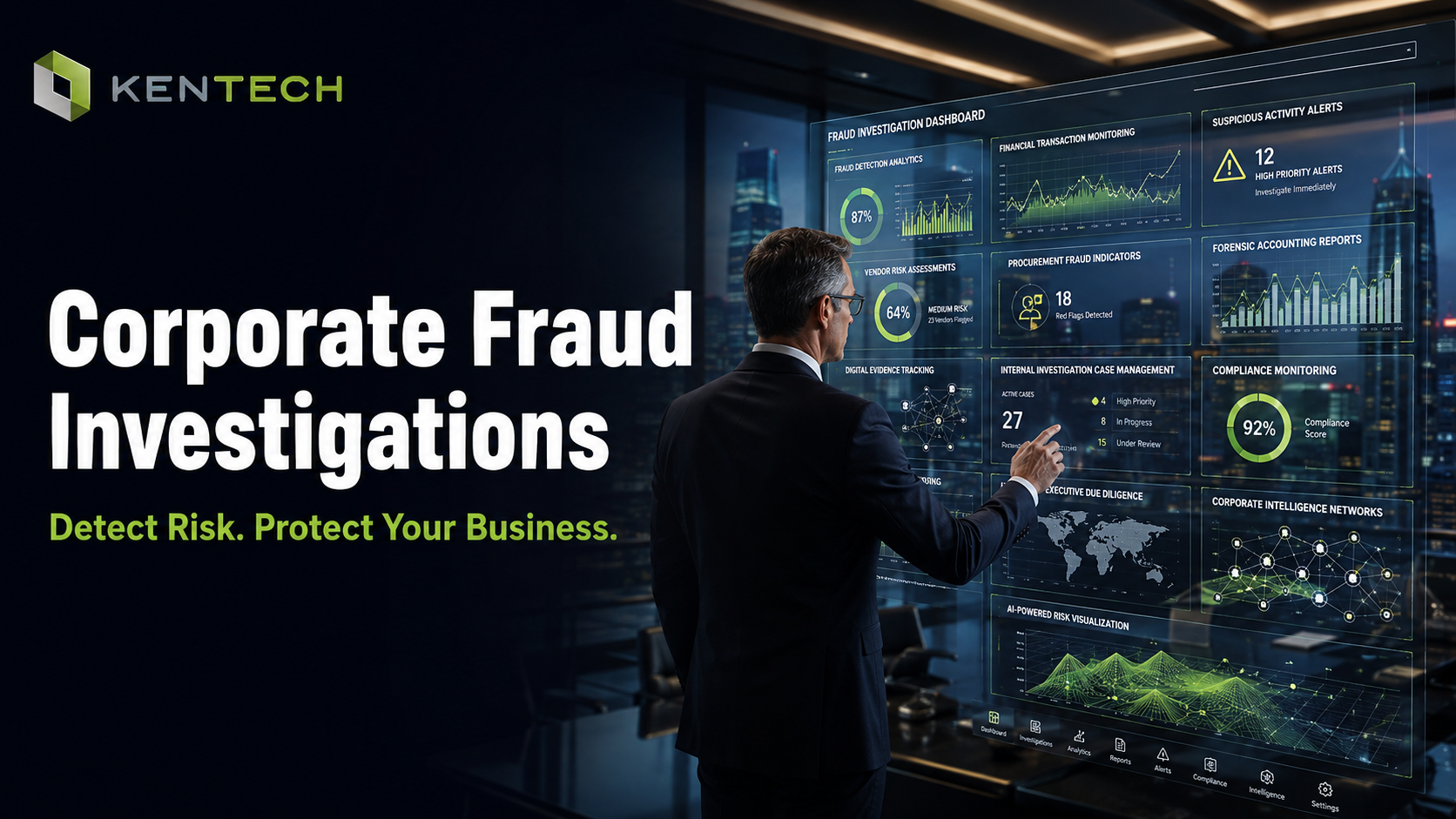
Fraud is one of the most significant risks facing organizations today.
Whether committed by employees, executives, vendors, contractors, or external actors, fraudulent activity can result in substantial financial losses, legal liabilities, operational disruption, and lasting reputational damage. As organizations become more digitally connected and business operations grow increasingly complex, identifying and responding to fraud has never been more important.
Unfortunately, fraudulent activity is not always immediately visible. Financial irregularities, procurement manipulation, conflicts of interest, payroll fraud, data theft, and other forms of misconduct often remain undetected for months—or even years—before significant damage becomes apparent.
Corporate fraud investigations help organizations identify these risks early by uncovering facts, verifying evidence, and providing the intelligence needed to support informed business decisions.
When conducted professionally and objectively, corporate investigations not only uncover misconduct but also strengthen governance, improve internal controls, and help organizations prevent similar incidents in the future.
What Are Corporate Fraud Investigations?
Corporate fraud investigations are structured investigative processes designed to identify, examine, and document suspected fraudulent activities affecting an organization.
Unlike routine audits or compliance reviews, fraud investigations focus on gathering factual evidence to determine whether misconduct has occurred and to understand its scope and impact.
Depending on the circumstances, corporate fraud investigations may include:
Financial record analysis
Employee misconduct investigations
Procurement fraud reviews
Vendor fraud investigations
Payroll fraud investigations
Expense reimbursement fraud
Asset misappropriation investigations
Conflict-of-interest investigations
Digital evidence analysis
Internal interviews
Corporate due diligence
Public records research
Every investigation is tailored to the organization's specific concerns while maintaining confidentiality, professionalism, and objectivity throughout the process.
Why Corporate Fraud Investigations Matter
Even a single fraud incident can create long-term consequences for an organization.
Beyond direct financial losses, fraud can damage customer confidence, disrupt operations, weaken employee morale, and expose businesses to regulatory penalties or civil litigation.
Corporate fraud investigations help organizations:
Identify fraudulent activity
Protect corporate assets
Reduce financial losses
Preserve critical evidence
Strengthen compliance
Support legal proceedings
Improve internal controls
Protect organizational reputation
By identifying issues early, organizations can respond quickly, minimize operational disruption, and implement corrective measures that reduce future risks.
Common Types of Corporate Fraud
Fraud can occur in nearly every department of an organization.
Understanding the most common forms of corporate fraud helps businesses recognize warning signs before significant losses occur.
Financial Fraud
Financial fraud involves the intentional manipulation of financial records, accounting practices, or reporting processes for personal or organizational gain.
Examples may include:
False financial statements
Revenue manipulation
Unauthorized transactions
Accounting irregularities
Misappropriation of funds
Corporate investigations help organizations analyze financial records, identify discrepancies, and document evidence that supports further action when necessary.
Procurement Fraud
Procurement fraud occurs during purchasing activities and supplier relationships.
Examples include:
Inflated invoices
Kickback schemes
Bid manipulation
Duplicate payments
Fictitious vendors
Unauthorized purchasing
Procurement fraud can significantly increase operating costs while exposing organizations to legal and compliance risks.
Investigative reviews help organizations identify irregular procurement patterns and strengthen vendor oversight.
Payroll Fraud
Payroll fraud involves the improper use of payroll systems for personal financial gain.
Common examples include:
Ghost employees
Falsified overtime
Unauthorized bonuses
Timekeeping manipulation
Payroll diversion
Corporate fraud investigations examine payroll records and supporting documentation to determine whether irregularities exist.
Expense Reimbursement Fraud
Expense fraud occurs when employees submit inaccurate or fabricated business expenses.
Examples include:
Duplicate reimbursements
Personal purchases submitted as business expenses
Inflated travel costs
Fabricated receipts
Although individual claims may appear minor, repeated expense fraud can result in significant financial losses over time.
Vendor Fraud
Organizations increasingly rely on third-party vendors, suppliers, and contractors.
Fraud involving external business partners may include:
Undisclosed conflicts of interest
Shell companies
Fictitious vendors
Billing fraud
Contract manipulation
Vendor investigations help organizations verify supplier legitimacy while reducing third-party risks.
Warning Signs That May Require a Corporate Investigation
Fraud is rarely discovered through a single event.
Instead, organizations often notice patterns of unusual activity that warrant further review.
Potential warning signs include:
Unexplained financial discrepancies
Missing documentation
Unusual purchasing behavior
Frequent policy exceptions
Anonymous whistleblower complaints
Sudden lifestyle changes inconsistent with known income
Unauthorized system access
Repeated accounting adjustments
Vendor payment irregularities
Conflicts of interest
While these indicators do not necessarily confirm fraud, they may justify a structured corporate investigation to determine whether additional action is required.
Corporate Fraud Investigations as Part of Enterprise Risk Management
Organizations that successfully manage fraud treat investigations as one component of a broader enterprise risk management strategy.
Fraud prevention begins long before misconduct occurs.
Effective organizations combine:
Corporate investigations
Vendor due diligence
Executive background checks
Employment background screening
Identity verification
Continuous monitoring
Compliance screening
Workforce intelligence
Together, these services help organizations proactively identify vulnerabilities while strengthening governance, operational resilience, and long-term business integrity.
Leveraging Technology in Corporate Fraud Investigations
Corporate fraud investigations have evolved significantly with advances in technology. Modern organizations generate enormous volumes of financial, operational, and digital data every day. Hidden within this information are patterns that can indicate fraudulent activity, making technology an essential tool for investigators.
Artificial intelligence (AI), data analytics, and workforce intelligence platforms enable investigators to analyze transactions, identify anomalies, and detect suspicious patterns that might otherwise go unnoticed.
For example, advanced investigative tools can:
Identify unusual financial transactions
Detect duplicate invoices or payments
Analyze vendor relationships
Monitor employee access logs
Review communication patterns
Identify conflicts of interest
Track digital activity across systems
Visualize connections between individuals, vendors, and organizations
These technologies significantly improve investigative efficiency by allowing professionals to focus on the most relevant information rather than manually reviewing thousands of records.
However, technology should support—not replace—experienced investigators. Human expertise remains essential for interpreting findings, evaluating context, conducting interviews, and ensuring conclusions are supported by verified evidence.
By combining intelligent technology with professional investigative services, organizations can strengthen fraud detection while improving the accuracy and reliability of investigations.
Best Practices for Conducting Corporate Fraud Investigations
An effective corporate fraud investigation requires careful planning, confidentiality, and objectivity.
Organizations should establish clear procedures for responding to fraud allegations before incidents occur. Having a structured investigation plan allows businesses to act quickly while protecting evidence and minimizing operational disruption.
Some best practices include:
Respond Promptly
Delays can result in lost evidence, continued financial losses, or additional misconduct.
Once credible concerns arise, organizations should begin documenting facts and preserving relevant records as soon as possible.
Maintain Confidentiality
Investigations should be conducted discreetly to protect the integrity of the process and the rights of everyone involved.
Limiting information to authorized personnel helps prevent rumors, protects evidence, and reduces unnecessary workplace disruption.
Preserve Digital and Physical Evidence
Financial documents, emails, contracts, access logs, surveillance records, and electronic files should be preserved immediately to maintain their integrity.
Proper evidence management supports internal decision-making and, where necessary, future legal proceedings.
Conduct Objective Interviews
Witnesses, employees, vendors, and other relevant individuals may provide important information during an investigation.
Interviews should be conducted professionally, consistently, and without assumptions regarding guilt or responsibility.
Document Every Step
Maintaining detailed records throughout the investigation provides transparency and supports organizational accountability.
Documentation should include investigative actions, evidence collected, interviews conducted, timelines, and findings.
Comprehensive documentation also assists legal counsel, regulatory agencies, and organizational leadership when evaluating next steps.
Legal and Compliance Considerations
Corporate fraud investigations should always be conducted in accordance with applicable employment laws, privacy regulations, and industry-specific compliance requirements.
Organizations must balance their responsibility to investigate misconduct with their obligation to protect employee rights and confidential information.
Investigators should ensure that evidence is obtained through lawful methods and that investigative activities comply with company policies and relevant regulations.
Businesses operating in regulated industries—including healthcare, financial services, government contracting, and critical infrastructure—may also have additional reporting obligations when fraud is identified.
Working with experienced investigative professionals helps organizations navigate these legal complexities while maintaining compliance and preserving the integrity of the investigation.
Common Mistakes Organizations Make
Even organizations with strong governance programs can make mistakes when responding to suspected fraud.
One common error is waiting too long to investigate. Small irregularities are sometimes dismissed as administrative mistakes, allowing fraudulent activity to continue undetected.
Another mistake is relying solely on internal reviews without independent investigative expertise. Internal teams may lack specialized investigative training or may face conflicts of interest when evaluating colleagues or leadership.
Organizations also sometimes focus only on financial losses while overlooking reputational damage, regulatory consequences, or weaknesses in internal controls.
Failing to strengthen policies after an investigation is another missed opportunity. Every investigation provides valuable insight that can improve fraud prevention strategies and reduce future risks.
Finally, businesses should avoid making assumptions before all relevant facts have been verified. Objective investigations protect both the organization and the individuals involved while supporting fair and defensible decision-making.
The Future of Corporate Fraud Investigations
Corporate fraud continues to evolve alongside advances in technology, digital payments, remote work, and global business operations.
As organizations become more interconnected, fraud schemes are becoming increasingly sophisticated, requiring equally advanced investigative capabilities.
Artificial intelligence, predictive analytics, machine learning, and workforce intelligence are transforming how organizations identify potential risks.
These technologies help investigators recognize behavioral patterns, detect anomalies in real time, and prioritize high-risk activities for further review.
Cloud-based investigative platforms also enable organizations to centralize case management, improve collaboration, and securely manage investigative records across multiple offices and jurisdictions.
Despite these technological advancements, professional judgment remains indispensable. Experienced investigators provide context, evaluate evidence objectively, and translate complex findings into practical recommendations that support business decisions.
Organizations that combine innovative technology with experienced investigative expertise will be better equipped to detect fraud early, strengthen governance, and protect long-term business value.
Conclusion
Corporate fraud investigations are an essential component of modern risk management. Whether addressing financial misconduct, procurement fraud, vendor irregularities, payroll manipulation, or conflicts of interest, professional investigations provide organizations with the factual intelligence needed to respond effectively and responsibly.
By combining structured investigative methodologies, advanced technology, and experienced professionals, businesses can uncover fraudulent activity, preserve critical evidence, and strengthen internal controls before small issues become major organizational risks.
Corporate investigations also play a vital role in improving compliance, protecting company assets, safeguarding reputation, and reinforcing stakeholder confidence. Rather than reacting to fraud after significant damage has occurred, organizations that invest in proactive investigative services are better positioned to identify vulnerabilities, mitigate risks, and support ethical business operations.
As fraud schemes continue to evolve, comprehensive corporate fraud investigations will remain an important part of enterprise risk management, helping organizations build resilient, transparent, and trustworthy businesses for the future.